| Piú votate - Mars Reconnaissance Orbiter (MRO) |

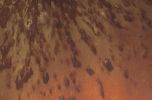
PSP_004313_1760_RED_abrowse-00.jpgWinslow Crater - context frame n. 1 (MULTISPECTRUM; credits: Lunexit)65 visiteIn this first HiRISE image of Winslow Crater (PSP_004313_1760), distinct dark rays surrounding the crater and are consistent with the THEMIS data’s suggestion of rockier materials. V-shaped patterns in the rays — referred to as a “herringbone” pattern — are identical to those around fresh Lunar Craters.
These form when materials are ejected from the crater at a very low angle, which form clusters of secondary craters that preferentially eject materials down-range in a V-shaped pattern. (It‘s the same pattern that you would get when shooting a water pistol nearly parallel to a sidewalk.)
Also noteworthy are the large meter-to-decimeter-sized boulders on the steep rim that have not been buried or physically weathered to smaller sizes in this windy region, indicating that they have not been exposed long.
This is also reminiscent of Meteor Crater and examples of fresh simple craters on the Moon.
The ring of rocky, cliff-forming materials in the inner wall of the Crater represents original bedrock that was uplifted and exposed by the impact. The characteristic morphology is called “spur and gully” consisting of both the protruding bedrock inter-fingered with debris shoots feeding fans of sandy materials that extend down to the crater floor.
Throughout this Region, the present-day surface consists of a mix of global dust and volcanic sands from the Syrtis Major complex that typically cover the local bedrock. Winslow Crater is an excellent example of how craters can provide a window into the subsurface by exposing the local bedrock within the ejecta and crater wall.MareKromium
(4 voti)
|
|
PSP_004313_1760_RED_abrowse-01.jpgWinslow Crater - extra-detail mgnf from frame n. 1: the "Herringbone Pattern" (MULTISPECTRUM; credits: Lunexit)60 visitenessun commentoMareKromium
(4 voti)
|
|

PSP_005381_0870_RED_abrowse.jpgSouth Polar Layered Deposits with Surface Modification (possible natural colors - elab. Lunexit)58 visiteThis image shows a scarp exposing the south polar layered deposits (SPLD). The polar layered deposits are thought to record recent climate variations on Mars, similar to ice ages on Earth.
Radar data indicate that the SPLD are ice-rich, with variations in dust contamination likely causing the layering visible here. HiRISE images of the SPLD will help to unravel Mars' climate history, but this image illustrates how this effort is complicated.
The development of surface features, by erosion, deposition, or modification of the surface, makes it difficult to determine the characteristics of the layers themselves. Some of the layers appear wavy, perhaps due to folding, flow, or uneven erosion since they were laid down. Short, branching, often radial channel systems are cut into the surface of the layers in places. These may be related to "spiders," thought to be formed as carbon dioxide gas flows along the surface when the seasonal polar cap sublimates in the spring. Pits and polygonal fractures are visible on the layers as well.
Apparently this exposure of SPLD is relatively old, as these features probably take many years to form. While these features are interesting in their own right, they disturb the SPLD outcrops and make it more difficult to measure the thickness of layers and compare them to other outcrops of SPLD.
MareKromium
(4 voti)
|
|

PSP_005346_1755_RED_abrowse-00.jpgLow-Order Inverted Streams near Juventae Chasma (context frame - elab. Lunexit)58 visiteThis image shows plains North-West of Juventae Chasma, one of the Martian canyons that are part of the equatorial Valles Marineris System. The two most noticeable features in this scene are craters on mesas (plateaux) and raised, winding ridges. The raised ridges are "Inverted Channels". It is likely that liquid water, either pure or salt water, flowed through these channels. The channels are raised because streams transport sediment as they flow, deposit the heavier sediment on the stream floor, and, eventually fill in once their water supply dwindles. Over time, wind erosion modifies a landscape, and this has played an important role on these plains. It eroded the land around the channels leaving the remnant channels exposed and standing high. The channels did not erode as much since they were more resistant, possibly because the deposited sediment had cemented together.
The craters on mesas are also evidence of active wind erosion: when craters form, they eject material out onto the surrounding landscape.
It appears that several of the craters’ ejecta visible here cemented, making the ejecta more resistant to erosion and leaving them standing high as craters on plateaux.MareKromium
(4 voti)
|
|
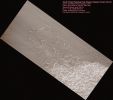
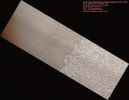
PSP_004765_0940_RED_browse.jpgSouth Pole Residual Cap - Swiss-Cheese Terrain Monitoring (Natural Colors; credits for the additional process. and color.: Dr Paolo C. Fienga - Lunexit Team)57 visiteLike Earth, Mars has concentrations of water ice at both Poles. Because Mars is so much colder however, CO2 ice is deposited at high latitudes in the Winter and is removed in the Spring, analogous to winter-time water ice/snow on Earth.
Around the South Pole there are areas of this CO2 ice that do not disappear every Spring, but rather survive Winter after Winter; this persistent CO2 ice is called the "South Pole Residual Cap". The retention of CO2 ice throughout the year by the Southern Polar Cap is one characteristic that distinguishes it significantly from Mars' North Polar Cap.
As can be seen in this HiRISE image of the South Pole Residual Cap, relatively high-standing smooth material is broken up by circular, oval, and blob-shaped depressions. This patterned terrain is called "Swiss Cheese" terrain.MareKromium
(4 voti)
|
|
PSP_004778_0945_RED_browse.jpgSouth Pole Residual Cap - Swiss-Cheese Terrain Monitoring (Natural Colors; credits for the additional process. and color.: Dr Paolo C. Fienga - Lunexit Team)59 visitenessun commentoMareKromium
(4 voti)
|
|
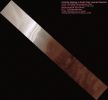
PSP_004917_1080_RED_browse-00.jpgComplex Geology in the South Polar Layered Deposits (context image)59 visiteThis section of the HiRISE image shows a scarp exposing the South Polar Layered Deposits, with illumination from the upper right (scarp slopes toward bottom). The Polar Layered Deposits probably contain a record of relatively recent climate changes on Mars, similar to ice ages on Earth.
The Deposits appear to be composed mostly of water ice, with variations in dust content controlling the erosion of the layers. This image shows that the history of the South Polar Layered Deposits has not been simple accumulation of horizontal layers.MareKromium
(4 voti)
|
|
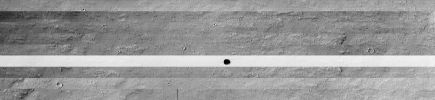
PSP_004847_1745-WFull.JPGThe "Martian Black Hole" (general context frame)61 visiteRingraziamo il Dr Gianluigi Barca per il lavoro svolto e per la pazienza avuta. Di che si tratta? Si tratta della ricostruzione, strip-by-strip, della Regione situata nei pressi del Grande Vulcano Arsia Mons laddove, come vedete bene, si trova il nostro "Martian Black Hole".
Come è facile notare, la striscia che comprende la voragine è stata processata (o ripresa?) in maniera tale da risultare, rispetto alle altre stripes che vanno a comporre l'interezza della Regione, completamente piallata e palesemente sovraesposta.
Il motivo (l'unico che ci viene in mente) potrebbe essere trovato nel tentativo di contrastare meglio quello che si vedeva "dentro" la voragine. Tuttavia, considerati i mezzi dei quali la NASA dispone, ci sentiamo pure di dire che quanto fatto NON è esattamente un "gran bel lavoro".
E allora?
E allora ribadiamo ed esplichiamo meglio quanto scritto in "Velvet Underground": o la NASA è in perfetta Buona Fede (però lavora - spesso - "in qualche modo"...), oppure la porzione di terreno che circonda la "voragine" è stata VOLUTAMENTE piallata, per motivi ignoti.
La Verità? Noi non la sappiamo, ma la nostra Coscienza e Professione ci spingono a proporre TUTTE le ipotesi che ci vengono in mente e che trovano una certa sostanza. Per il resto...dovete decidere Voi.MareKromium
(4 voti)
|
|
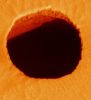
PSP_004847_1745_RED_browse-02.jpgThe "Martian Black Hole"...Again! (EDM - False Colors)146 visiteVi invitiamo a leggere l'ultimo articolo sull'argomento (pubblicato su TruePlanets) dal titolo "Velvet Underground".MareKromium
(4 voti)
|
|
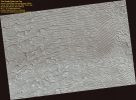
PSP_004820_0940_RED_browse.jpgFingerprint Terrain with Sawtooth Patterns in the South Polar Ice Cap (Natural Colors; credits for the additional process. and color.: Dr Paolo C. Fienga - Lunexit Team)58 visiteThis image shows a portion of the South Polar Ice Cap. The ice you see here is frozen CO2 rather than the frozen water you are used to here on Earth.
Even on Mars, where the temperatures are much lower than on Earth, CO2 ice is a volatile substance. As it is so unstable, large amounts can sublimate very quickly when heated. In this ice cap we can see icy features shrink in size by several meters per year as the ice that makes them up is removed by solar heating. Usually these icy features are almost circular as you get equal amounts of Sunlight from every direction when you are at the Pole.
However, in this location something strange has happened. Instead of the usual circular features we see features that are decidedly linear in shape. These sets of linear features have been dubbed "fingerprint terrain" by Planetary Scientists. They are seen in several locations in this ice cap and usually have a wavelength close to 90 mt (295 feet). It's hard to understand why linear features would form in this sort of environment by sublimation of ice alone.
It is possible that these features are formed instead by atmospheric processes. Either the features are sand dunes covered by a thin covering of frost or they might be made up of loose ice crystals that saltate like sand grains and have collected into ripples.
It would be a huge surprise to find sand dunes in this location, just as you wouldn't expect to see sand dunes on top of the Greenland ice sheet on Earth. To confirm that they are made of CO2 ice, HiRISE will image this location again at the end of the year and compare it to this image to look for changes.
Icy features should show large changes, but sand dunes move much more slowly. MareKromium
(4 voti)
|
|

PSP_003252_1425_RED_browse-02.jpgBright Gully Deposit in Terra Sirenum (the "gully" - close-up; false colors)59 visiteThe bright gully deposit has a very fluid-like appearance, and has not been covered by other gullies or debris flows, indicating a young age. The brightness is a mystery; it could be due to minerals formed from water or ice.
Alternatively, the flow that made the gully may have removed a thin coating of relatively darker dust and soil, revealing a brighter substrate.
In any case, this feature is probably indicative of recent flow of water or water-rich material on Mars.MareKromium
(4 voti)
|
|
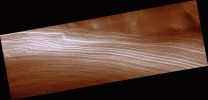
PSP_004708_1000_RED_browse-00.jpgFault in the South Polar Layered Deposits (CTX Frame - Extremely Enhanced Natural Colors; credits for the additional process. and color.: Dr Paolo C. Fienga - Lunexit Team)59 visiteThis image spans a section of the south polar layered deposits (SPLD). The SPLD are composed of layers of water ice mixed with impurities (mostly dust). The most similar terrestrial analog to the SPLD are ice sheets, like those covering most of Greenland and Antarctica.
Faults are created when rock (or, in this case, water ice) breaks due to some outside force and rocks (or ice) along either side of that break move in opposite directions. One of the most famous faults on Earth is the San Andreas Fault in California. There is a crack between the floor of the Pacific Ocean, plus a little bit of the California and Mexico coastline, and the rest of North America; the Pacific Ocean floor is moving northward along that crack, but North America is moving southward. Because the two sides are grinding against each other, they sometime stick together and then move again in jerky fashion, much like the way if you try to rub pieces of rough sand paper together. When movement along the fault occurs after a period of sticking together, this creates an earthquake.
For the case of this fault on Mars, it is unlikely that a "Marsquake" occurred when movement happened along this fault, because it is so small (over 1000 times shorter than the San Andreas Fault). This is interesting because faults are rare in the Martian polar layered deposits. The fault may have been created during widespread flow of the SPLD. Some of the stiffer ice could not flow and broke instead. Ice can only flow fast enough to create faults when it is relatively warm. Similarly, if you cool molasses enough, it becomes hard and doesn't flow. But the temperatures on Mars today are probably not warm enough to allow the creation of faults. This is why faults are so rare in the Martian ice. When were temperatures warm enough? This is still a mystery.
MareKromium
(4 voti)
|
|
| 2235 immagini su 187 pagina(e) |
 |
|
|
|
|
75 | |
|
|
|
|





