| Piú votate - Mars Reconnaissance Orbiter (MRO) |

PSP_007162_1915_RED_abrowse.jpgBright and Dark "Slope Streaks" in Arabia Terra (MULTISPECTRUM; credits: Lunexit)86 visiteThis observation is of region between large craters in Arabia Terra, which is a large swath of bright (high albedo) terrain in the Martian Cratered Uplands. At the center of this image is a channel with a sinuous, fluvial-like (such as "river-like") morphology, although it has long since been dry.
The floor of the channel is covered with an array of linear dunes, which are accumulations of windblown sediment.
Of special interest in this scene is a series of dark (low albedo) and brighter (higher albedo) discolorations along the channel walls, also known as slope streaks. Most slope streaks are initially dark, gradually brighten with time, and are thought to be due to dust avalanches that remove a thin layer of bright dust to reveal darker material. Here, many streaks appear brighter than the surrounding undisturbed slope surface, and the origin of these bright streaks is not entirely clear.MareKromium
(4 voti)
|
|
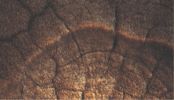
PSP_007173_2245_RED_abrowse-01.jpgScallops and Polygons in the Utopia Planitia Region (extra-detail mgnf - MULTISPECTRUM; credits: Lunexit)58 visiteSeveral cracks cut through the side of the scallops suggesting that they must be at least as deep as the scallops. The polygons may have been present previous to the erosion of the mantle.
The landforms we observe here most likely show that ice-rich permafrost is present or has been present geologically recently. At this latitude on Mars, the conditions of pressure and temperature allow water ice within the ground to sublime.
The disappearance of the ice component of the ground probably leads to the formation of the depressions, a process that may still be active today.MareKromium
(4 voti)
|
|

PSP_006991_1905.jpgSeeps (MULTISPECTRUM; credits: Lunexit)63 visitenessun commentoMareKromium
(4 voti)
|
|
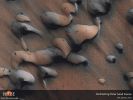
PSP_007043_2650-BLUE-MarsPolarDunes2_hirise_big-01.jpgSand Dunes Thawing on Mars (Natural Colors; credits: Lunexit)58 visitenessun commentoMareKromium
(4 voti)
|
|
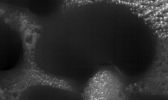
PSP_006952_1870_RED_abrowse-01.jpgDunefield in West Arabia Terra Unnamed Crater (extra-detail mgnf - RAW Frame; credits: NASA/JPL/Univ. of Arizona)59 visiteBarchan dunes are commonly found on Earth, and are generally crescent-shaped with a steep slip face bordered by horns oriented in the downwind direction (see here).
Barchan dunes form by unidirectional winds and are good indicators of the dominant wind direction. In this case, the strongest winds blew approximately North to South.
These dunes are most likely composed of basaltic sand that has collected on the bottom of the crater. Superimposed on their surface are smaller secondary dunes which are commonly seen on terrestrial dunes of this size.
Many smaller and brighter bed forms — most likely small dunes or granule ripples — also cover the substrate between the larger dark dunes.
The dark dunes overlie the small bright bed forms indicating that the darker dunes formed more recently.MareKromium
(4 voti)
|
|
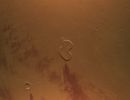
PSP-P14_006600_1881_XI_08N102W_071223sub_large.jpgUnusually-shaped Landform in Tharsis (MULTISPECTRUM; credits: Lunexit)79 visiteThis picture of a Landform (...) was acquired nearly two months ago by the CTX on 23 December 2007.
The Landform is about 1 Km (0,62 miles) across. The feature is located among lava flows South-East of the giant Tharsis volcano, Ascraeus Mons.
This picture is a sub-frame of CTX image P14_006600_1881_XI_08N102W_071223 and is located near 8,3° North Lat. and 101,9° West Long.MareKromium
(4 voti)
|
|
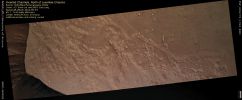
PSP_006770_1760_RED_abrowse-00.jpgInverted Channels, North of Juventae Chasma (context frame - MULTISPECTRUM; credits: Lunexit)59 visiteThis image shows raised ridges on a plain to the North of Juventae Chasma. Juventae Chasma, a canyon that is part of the Valles Marineris Canyon System, stretches for about 180 Km (approx. 110 miles) from East to West and about 250 Km (approx. 155 mi) from North to South.
Several examples of raised features have been identified on the plains near this canyon.
In this location, it is most likely that water - either pure or salt water - once flowed through these channels and deposited sediments that eventually filled the channels and became cemented by some chemical precipitating from the flowing water.
Over time, wind eroded the surrounding surface leaving the remnant channels exposed as raised ridges.MareKromium
(4 voti)
|
|
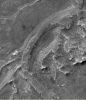
PSP_006770_1760_RED_abrowse-01.jpgInverted Channels, North of Juventae Chasma (extra-detail mgnf)59 visiteThe raised ridges in this image have been explained as former stream channels that are now preserved in inverted relief.
On Earth, inverted relief occurs when former depressions become elevated because materials that fill the depressions are more resistant to erosion than the surrounding terrain.
For example: a depression may become filled with lava that is more resistant to erosion than the surrounding surface; gravel or boulders transported in a high energy flow protect underlying material from erosion, or sediments deposited by a flowing stream become cemented.MareKromium
(4 voti)
|
|
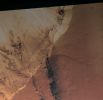
PSP_003545_2025_RED_abrowse-PCF-LXTT-01.jpgIntersection between Hyblaeus and Elysium Chasmata (EDM n.1 - Saturated Natural Colors; credits for the additional process. and color.: Dr Paolo C. Fienga - Lunexit Team)59 visiteA cross-section of Hyblaeus Chasma is visible in this first extra-detail mgnf).
The chasm seems to be filled with a resistant light-toned layer, about 200 mt thick (likely consisting of cemented windblown sand and dust) forming a mantling unit and overlying more resistant boulder-rich layers. The sand and dust was likely blown into Hyblaeus Chasma after it was formed by tectonic processes, possibly in combination with fluvial processes.
The chasmata were subsequently broadened by hillslope erosion: boulders are strewn along the top of this dusty mantling unit. Slumping, possibly caused by faulting, along the Southern Wall of Hyblaeus is visible at the intersection with Elysium Chasma.
This image also shows a number of dark streaks along the walls of Elysium Chasma, further to the south.MareKromium
(4 voti)
|
|
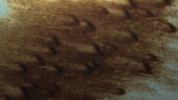
PSP_006538_1035_RED_abrowse-01.jpgSouthern Dunes and Spiders (extra-detail mgnf - MULTISPECTRUM; credits: Lunexit)57 visitenessun commentoMareKromium
(4 voti)
|
|
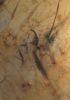
PSP_006477_1745_RED_abrowse-01.jpgDD Tracks in Southern Schiaparelli Basin (extra-detail mgnf - False Colors; credits: Lunexit)57 visiteThis observation shows a Region near the Martian Equator that is a perfect tablet for the scribblings of Dust-Devils. This Region is made up of dark bedrock that is thinly blanketed by bright dust.
Dark tracks form when Dust-Devils scour the surface, exposing the darker substrate. The tracks tend to cluster together, as Dust-Devils repeatedly form over terrain that has been previously scoured and is consequently darker and warmer than the surrounding surface.
Once lofted by a Dust-Devil, the fine dust can be transported great distances before it settles again onto the surface.MareKromium
(4 voti)
|
|
PSP_004313_1760_RED_abrowse-02.gifWinslow Crater's Changing (GIF-Movie; credits: NASA)72 visitenessun commentoMareKromium
(4 voti)
|
|
| 2235 immagini su 187 pagina(e) |
 |
|
|
|
|
74 | |
|
|
|
|





