| Piú votate - Mars Reconnaissance Orbiter (MRO) |
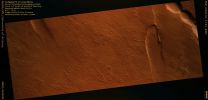
PSP_008130_1745_RED_abrowse-00.jpgSmall but deep Collapse Pit, North of Arsia Mons (context frame - MULTISPECTRUM; credits: Lunexit)74 visitenessun commentoMareKromium
(4 voti)
|
|

PSP_008199_1910_RED_abrowse.jpgFeatures of Cerberus Fossae (Enhanced Absolute Natural Colors; credits for the additional process. and color.: Dr Paolo C. Fienga - Lunexit Team) 57 visitenessun commentoMareKromium
(4 voti)
|
|
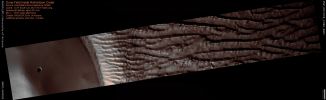
PSP_007078_1080_RED_abrowse.jpgThe Dunes of Richardson Crater (MULTISPECTRUM; credits: Lunexit)58 visitenessun commentoMareKromium
(4 voti)
|
|

PSP_005924_2210_RED_abrowse.jpgFeatures of Cydonia (MULTISPECTRUM; credits: Lunexit)58 visiteThe Cydonia Region on Mars is located in Arabia Terra at the boundary between the Northern Lowlands and Southern Highlands. This Region gained notoriety when Viking imaged a landform that looked like a face.
The “Face” has subsequently been imaged by many orbiters, including HiRISE ( PSP_003234_2210), showing that it is simply a rocky mound, and the face-like appearance was due to a trick of shadows. This observation was taken of a Region slightly to the South-West of that landform.
This Region is characterized by Knobs and Buttes. Knobs are rounded hills and Buttes are hills with steep vertical sides and a flat top. A butte is similar to a plateau, but smaller in scale. These are features that are resistant to erosion, and there are several ways that such features may become more resistant than the surrounding areas. They can be plutonic intrusions or volcanic rocks that are more resistant rock types than the surrounding sedimentary rock. Alternatively, these Regions may be resistant because they have been cemented by water carrying dissolved ions that precipitate as minerals binding the sediment together.
Either way, they provide important information about the geologic history of the Region.
Of note in this image is the interesting pitted and patterned ground. This pitting may have resulted from the sublimation of interstitial ice. Patterned ground is common throughout the Northern Mid-Latitude Plains.MareKromium
(4 voti)
|
|
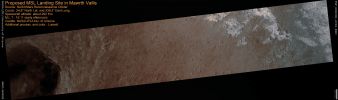
PSP_008390_2050_RED_abrowse.jpgProposed MSL Landing Site in Mawrth Vallis - ellipse 4 (MULTISPECTRUM; credits: Lunexit)60 visiteMawrth Vallis has a rich mineral diversity, including clay minerals that formed by the chemical alteration of rocks by water. The CRISM instrument detects a variety of clay minerals here, which could signify different processes of formation. The high resolution of the HiRISE camera helps us to see and trace out layers, polygonal fractures, and with CRISM, examine the distribution of various minerals across the surface.
This surface is scientifically compelling for the MSL Rover, although some of the terrain can be somewhat rough. Scientists use HiRISE images to find the safest possible Landing Site for the Rover.
MareKromium
(4 voti)
|
|
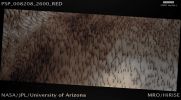
PSP_008208_2600_RED_abrowse-00.jpgAwakening Dunes... (MULTISPECTRUM; credits: Lunexit)58 visiteThis image captures unusual arrow-shaped sand dunes in the north polar Olympia Undae region that may have been formed by changing winds. The dark patches and streaks show sand that has begun escaping from a blanket of seasonal frost.
Many of the typical types of Martian dunes are similar to common dunes on Earth. Transverse dunes have gentle upwind slopes and steep lee sides that are perpendicular to the wind direction. Barchans are crescent-shaped dunes with a gentle upwind slope and steep lee with horns. Other common dunes on Earth and Mars are seif dunes that form sinuous parallel ridges with bi-directional winds forming the slip-faces.
The dune types in this image transition from transverse in the south through tight chains of barchans, to the strange, elongated dunes in the north. These elongated dunes appear to be modified barchans with two slip-faces and asymmetric horns. The drawn out limbs and remnant slip-faces were apparently produced by variations in the wind direction. The winds that created the transverse dunes blow from a single easterly direction, while the modified barchans are shaped by winds from an easterly-northeasterly direction. The elongated horns align parallel to northeasterly winds. These wind variations could be caused by local topography.
Two factors likely contribute to the unique morphology of these dunes. First, the southern horns defrost sooner than the northern horns because they receive sunlight more directly. This enables material to move more easily on their southern side. Second, the changing wind directions may be reorienting the dunes. One idea is that the barchans’ southern horns are being blown downwind into linear (seif-like) dunes, with sinuous crests and steep flanks. Another possible explanation is that they are drifts of sand (lee dunes) that form in the lee of an obstacle. The frozen barchans might act as obstacles to the wind, allowing loose sand to accumulate in their lee. In either case, the interaction between the sand, wind, and seasonal frost sculpts the dunes to their unusual, arrow-like appearance.
MareKromium
(4 voti)
|
|
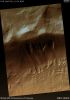
PSP_006760_1370_RED_abrowse.jpgGullies in Terra Sirenum (MULTISPECTRUM; credits: Lunexit)74 visiteThis image shows Pole-Facing Gullies in a Southern Hemisphere Crater. Gullies are young features that are widely thought to form from fluvial processes involving liquid water. These particular gullies have very fine channels, including some that intersect and overlap. This is evidence that multiple flow events occurred within the Gullies.
The wavy, arcuate ridges at the bottom of the slope may have formed by gravity moving ice-rich material off the crater wall.
The pitted texture of the crater floor suggests that volatiles (ices that easily turn into gas) escaped from the subsurface, causing the surrounding material to collapse and form small pits.
Coord.: 42,6° South Lat. and 214,8° East Long.
Spacecraft altitude: about 254 Km
M.L.T.: 14:38 (early afternoon)MareKromium
(4 voti)
|
|
PSP_008591_2485_cut_b.jpgPhoenix! (Natural Colors; credits: NASA/JPL/University of Arizona)56 visitenessun commentoMareKromium
(4 voti)
|
|

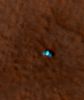
PSP_008591_2485_cut_a.jpgPhoenix Lander "Hardware" (Day-Time Frame)59 visiteCaption NASA:"MRO’s HiRISE camera acquired this image of the Phoenix Landing Site 22 hours after landing. The image shows three unusual features which were not present in a pre-landing HiRISE image.
We expect to find three main pieces of hardware: the parachute attached to the backshell, the heat shield, and the lander itself.
The Parachute (bottom) is easy to identify because it is especially bright, and this image also clearly shows the Back-Shell. We can even see the stripes on the Parachute.
The dark marking (middle right) appears most consistent with disturbance of the ground from impact and bouncing of the Heat-Shield, which fell from a height of about 13 kilometers.
The last object (top) is the Lander, and we can clearly see the solar arrays on each side. The solar arrays were relatively dark in the image acquired 11 hours after landing, but are brighter than the Mars surface in this daytime image acquired with the HiRISE blue-green filter.
There are dark halos around all three locations, perhaps due to disturbing a thin dust coating.
North is about 7°to the right of straight up in this image and illumination is from the lower left".MareKromium
(4 voti)
|
|
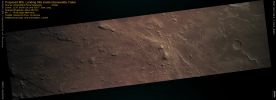
PSP_007481_1560_RED_abrowse.jpgProposed MSL Landing Site in Eberswalde Crater (MULTISPECTRUM; credits: Lunexit)59 visiteThis image covers a portion of Eberswalde Crater, which has an ancient deltaic depositional setting. Eberswalde is an approx. 65 Km diameter, closed basin crater. This image was targeted in the landing ellipse as a possible site for the 2009 Mars Science Laboratory Mission. The image shows resistant mounds and knobs as well as a scoured surface.
The CRISM instrument on board the Mars Reconnaissance Orbiter has detected Phyllosilicates (clays) in the bright layers in the crater. One of the ways clays form on Earth is when water erodes rock and makes fine particles which settle out of water; this often occurs in river deltas and lake beds.
The delta and meandering channels in Eberswalde Crater (to the West of the Landing Ellipse) and the detection of Phyllosilicates provides evidence for possible persistent aqueous activity on Mars.MareKromium
(4 voti)
|
|
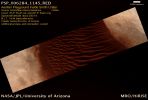
PSP_006284_1145_RED_abrowse-00.jpgLarge Dunefield inside Smith Crater (MULTISPECTRUM; credits: Lunexit)58 visiteThis image shows a Dark Dunefield in Smith Crater. The dark color of the dunes indicates that they are probably made of basaltic sand, a dark volcanic rock that is common on Mars. This is in contrast to dunes on Earth, which are dominated by quartz, a rare mineral on Mars.
The dunes here are “transverse dunes” that, based on analogy with similar features on Earth, form by winds that blow in a direction perpendicular to the crests. However, Secondary ripples on top of the dunes are oriented at right angles; that indicates a second wind regime that has redistributed the sand after the original dunes formed. The multiple orientations of the dunes may be partly caused by their location within the crater, whose own topography can act to redistribute regional wind patterns.
The dark streaks on the lighter terrain outside of the Dunefield are interpreted as DD tracks, where mini-tornadoes reveal darker ground beneath the bright dust of the surface.
Some long DD Tracks are visible in the southern part of the dune field and climb onto the troughs of the transverse dunes. There are also a few faded tracks at the northern part of the dune field.MareKromium
(4 voti)
|
|
PSP_006284_1145_RED_abrowse-03.jpgMedium-sized Boulders inside Smith Crater (MULTISPECTRUM; credits: Lunexit)64 visitenessun commentoMareKromium
(4 voti)
|
|
| 2235 immagini su 187 pagina(e) |
 |
|
|
|
|
73 | |
|
|
|
|





