| Piú votate - Mars Reconnaissance Orbiter (MRO) |
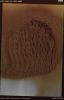
PSP_009233_2535_RED_abrowse-00.jpgEvolution of North Polar Dunes (ctx frame - natural colors; credits: Lunexit)74 visiteThis small unnamed crater is adjacent to the North Polar Erg and contains a fascinating Dunefield. Scientists are interested in the source of the dunes in the crater and the evolution of the Dunefield’s circular shape.
Wind transports material and shapes the dunes; the dominant wind comes from a Westerly-SouthWesterly direction and forms barchans (crescent-shaped) and barchanoid dunes. Secondary winds also play a role in shaping the dunes.
This can be seen in the Southern part of the Dunefield where the barchans transition into transverse dunes. On the northern edge of the dune field are opposite facing barchans formed by winds from the North-East.MareKromium
(4 voti)
|
|
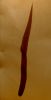
PSP_009192_1890_RED-01.jpgRelatively Recent Slope Streak started from a Dust Devil (edm - natural colors; credits: Lunexit)57 visitenessun commentoMareKromium
(4 voti)
|
|
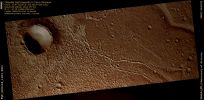
PSP_009318_1465_RED-00.jpgChloride Salt Deposits within a Channel in Terra Sirenum (ctx frame - natural colors; credits: Lunexit)79 visiteThis image shows a series of knobs, channels and inverted channels in the ancient Southern Highlands of Mars.
The inverted channels, which now appear as sinuous ridges, are filled with a fractured light-toned material that is also apparent in the knobs and nearby bedrock. Previous analyses of the infrared data from TES and THEMIS of similar materials in Terra Sirenum and elsewhere on Mars suggest that these light-toned materials are deposits of chloride salts such as Sodium Chloride (ordinary rock salt).
Salt deposits are key targets in the search for ancient life on Mars, because they represent places where bodies of liquid water may have ponded and evaporated.
The salt forms an ideal setting in which to preserve signs of biological activity. The clear association of the salt with the sinuous channels visible here suggests that the material was precipitated from brines that once flowed through these channels.
The fractured surface of the deposits is consistent with cracking by desiccation (rapid drying) of the thick salts as they were deposited.MareKromium
(4 voti)
|
|

PSP_009138_2025_RED-00.jpgMineralogical Diversity in Nili Fossae (ctx frame - natural colors; credits: Lunexit)56 visiteThere is evidence of phyllosilicate material (clays) throughout this Nili Fossae Region. The evidence comes from the OMEGA experiment on the European Space Agency’s Mars Express Spacecraft and CRISM on the Mars Reconnaissance Orbiter, Infrared Spectrometers that can identify minerals on the surface of Mars.
In the Nili Fossae Region, the spectrometers have found remarkable diversity in surface composition. Because of the evidence for clays and other interesting geology, Nili Fossae is also being considered as a Landing Site for the Mars Science Laboratory Rover.
HiRISE has targeted several places where OMEGA and CRISM show extreme diversity, with this being one example. In this specific area, low-calcium pyroxene (LCP) materials are adjacent to these clays.
The cracked terrain areas evident at the highest resolution - see the next edm frame - provide clues to the sequence of events which occurred in Nili Fossae.MareKromium
(4 voti)
|
|

PSP_009114_2645_RED.jpgEroding Dunes in Chasma Boreale (natural colors; credits: Lunexit)60 visiteSand moves along a planetary surface by a process scientists call “saltation”, whereby the individual grains are driven by the wind and bounce forward in short hops. In a process that is not yet completely understood, sheets of saltating sand grains organize themselves into sand dunes, visible in this image as the dark features.
Sand dunes move by having the wind push sand grains up and over the top of the dune where they then slide down to the base. The steep side of the dune that the sand grains slide down is called "slip-face" and it is the constant transport of sand from the downwind side of the dune to the "slip-face" that makes the dune move forward in this direction. HiRISE data allow us to see which side of these dunes has the steeper slope (such as the aforementioned "slip-face"), telling us what direction the dune — and strong near surface winds — are moving.
Yet something else is also happening to these particular dunes. Dark streaks lead away from the dunes toward the lower left of the image. These streaks are caused by sand grains being blown off the dunes and saltating away. This is not ordinarily a cause for concern because in a stable dune, individual grains are constantly added and removed; however, there does not appear to be any influx of sand upwind of these dunes, so they are probably being eroded.
It is also interesting that these streaks do not point in the same direction as the "slip-face". One possible scenario is that the dunes migrated Westward when sand supply was more plentiful. Today, the wind direction has shifted, blowing more toward the South-West, and the influx of new sand has ceased, such that in the future, the dunes will completely erode away. Repeated HiRISE observations will be able to look for changes in the shape and size of these dunes.MareKromium
(4 voti)
|
|

PSP_009162_1570.jpgFresh 5-Kilometer Diameter Rayed Crater (False Colors; credits: Dr M. Faccin)58 visiteThe crater featured in this scene formed on top of ejecta from a nearby rampart crater, located to the North.
The crater’s distinct rim indicates that it is relatively young. There is bright material on many of the crater walls that might be landslides of dust or another bright substance.
The mounds of material on the crater floor probably formed during late stages of crater’s own formation. The crater floor is speckled with even smaller craters.MareKromium
(4 voti)
|
|

PSP_008982_1965.jpgLayered Deposits in Arabia Terra Region (True Colors; credits: Dr M. Faccin & Lunexit)57 visiteThis image shows the floor of an Unnamed Impact Crater in Arabia Terra that has Layered Deposits. There are many craters in this Region where layering is observed.
These layers are often exposed along the sides of large isolated mounds, small knobs and mesas, and other positive relief features. In some cases, the layering is expressed as narrow sinuous ridge-like structures along crater floors.
The presence of Layered Deposits is of particular interest because these materials are not likely to be related to the impact event, but rather post-impact infill of the crater. Modification of the deposits has now revealed layers of material.
HiRISE and other instruments onboard the Mars Reconnaissance Orbiter may provide more clues to the origin of the these deposits.MareKromium
(4 voti)
|
|
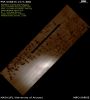
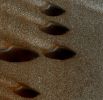
PSP_008839_2575_RED-00.jpgDunes and Polygons (ctx frame - natural colors; credits: Lunexit)82 visiteAt high Northern Latitudes, shallow troughs in the ice-rich ground form polygonal patterns. The polygons form over many years as the near-surface ice contracts and expands seasonally.
On top of this patterned ground in this image are dunes. Loose sand and dust are blown across the hard-cemented surface until collecting and forming a dune.
Streaks of dust are visible in the following edm-frame, coming from the horns of the dunes, while the higher portion of the dune blocks the dust from being blown across the surface.
Small ripples are also visible, and the small bright spots are the remnants of the seasonal Carbon Dioxide (CO2) Polar Cap that coats this area in the Winter.MareKromium
(4 voti)
|
|
PSP_008839_2575_RED-01.jpgDunes and Polygons (edm - natural colors; credits: Lunexit)57 visitenessun commentoMareKromium
(4 voti)
|
|
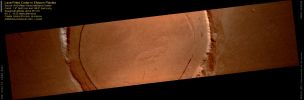
Psp_008753_1880_red.jpgLava-filled Crater in Elysium Planitia (natural colors; credits: Lunexit)59 visiteElysium Planitia is a part of the Martian Lowlands that has been repeatedly covered by vast floods of lava. This image shows an older Impact Crater that has been filled by one of the youngest of those lava floods.
Only sections of the circular rim of the Crater remain uncovered. The lava surface consists of ridged plates that have rafted apart with smoother lava filling between the plates. The ridges formed as the solidifying lava crust was crumpled by compression, and the gaps between the plates formed as the crust was pulled apart. Similar compression and extension of lava crust has been observed in the largest lava flows in Iceland.
The most puzzling aspect of this image is that the lava in the floor of the Crater appears to have sunk down compared to its surroundings. This happened after a thick crust had formed on the lava. The most likely explanation is that the last molten lava inside the flow drained away through a now buried gap in the crater rim.
A final point of interest are the small circular cones visible near the center of the Crater. These formed when ground water (or ice) was turned to steam by the heat of the lava flow. This steam exploded through the flow, producing the small cratered cones.MareKromium
(4 voti)
|
|
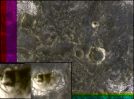
Mawrth_Vallis-The_Pyramid-HSol.jpgThe "Pseudo-Pyramid" of Mawrth Vallis (credits: Dr M. Faccin)97 visiteEd ecco qui, in versione a colori naturali ed extra-magnificata, la pseudo-piramide di Mawrth Vallis.
Opera della Natura? Opera "Artificiale"? Secondo noi, si tratta di un rilievo assolutamente particolare, questo è certo, e quindi da studiare. Ma il fatto di scendere ulteriormente in dettaglio e parlare di "artificialità", visti gli elementi (scarsissimi!) che abbiamo a disposizione, a nostro - onesto - parere, sembra eccessivo (e l'idea di restare colpiti anche noi dalla "Sindrome di' Hoagland", sinceramente, non ci riempie di gioia...).
Sempre complimenti al Dr Faccin per l'elaborazione ed all'ottimo Carlo Contu, per l'individuazione del rilievo.MareKromium
(4 voti)
|
|

PIA10145-CrypticTerrain~0.jpgCryptic Terrain (MULTISPECTRUM; credits: Lunexit)73 visiteThere is an enigmatic Region near the South Pole of Mars known as the "cryptic" terrain. It stays cold in the Spring, even as its albedo darkens and the Sun rises in the sky.
This Region is covered by a layer of translucent seasonal CO2 ice that warms and evaporates from below. As CO2 gas escapes from below the slab of seasonal ice it scours dust from the surface. The gas vents to the surface, where the dust is carried downwind by the prevailing wind.
The channels carved by the escaping gas are often radially organized and are known informally as "spiders". MareKromium
(4 voti)
|
|
| 2235 immagini su 187 pagina(e) |
 |
|
|
|
|
71 | |
|
|
|
|





