| Piú votate - Mars Reconnaissance Orbiter (MRO) |
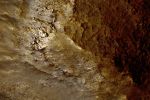
PSP_009708_2205_RED_abrowse-01.jpgHills in Acidalia Planitia (EDM - Enhanced Natural Colors; credits for the additional process. and color.: Dr Paolo C. Fienga - Lunexit Team)58 visiteThis edm frame (375x250 meters, or 410x273 yards) of the HiRISE depicts in detail the rocky layers existing in one of these hills.
CRISM, another of the instruments onboard Mars Reconnaissance Orbiter, has acquired data over this same region showing that the rocky outcrops contain clays. Clays of similar composition form in terrestrial environments favorable for life, where volcanic rocks are in close contact with water.MareKromium
(4 voti)
|
|
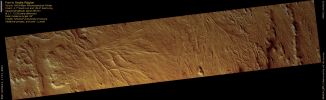
Psp_009623_1755_red.jpgFan in Aeolis Planum Region (natural colors; credits: Lunexit)58 visiteThis image shows a "Fan" of long raised ridges in the Aeolis Region of Mars.
These ridges are thought to be Inverted Stream Channels, where formerly low-lying streambeds have been hardened and then turned into ridges when the surrounding material was eroded.
This can occur if the stream deposited minerals, filling in pore spaces and hardening the streambed.
The assortment of ridges here is extremely complex, with strands cutting across each other. However, the actual stream system here could have been simpler, with ridges preserving different time periods in the history of the system. This possibility is supported by several sites where one ridge runs smoothly across another without disruption. One way for this to occur would be to have one streambed hardened and buried, with the stream subsequently changing course and cutting across its buried old route.
Although not all of the channels were active at once, this site clearly preserves a complex history, probably requiring thousands of years to foMareKromium
(4 voti)
|
|

Psp_009460_1745_red.jpgCeti Mensa (edm - natural colors; credits: Lunexit)58 visiteThis image gives us another clue to the formation of Ceti Mensa. Close-up examination shows fine banding in the layers of Ceti Mensa that is exposed by the ongoing erosion. The banding is produced by alternating bright and dark material. The thickness of the individual bands ranges from a few meters down to the resolution limit of the image, a few tens of centimeters. The bands are parallel, although they appear wavy on the irregular, eroded surface.
The banding visible in this image most closely resembles terrestrial lake deposits and similar rocks formed in aqueous, low energy depositional environments. Structures such as cross-bedding that are hallmarks of wind-deposited sediments are absent, as are cobbles and clasts that are typical of glacial sediments. If this interpretation is correct, the thickness of Ceti Mensa suggests formation in standing bodies of water that were several kilometers deep.MareKromium
(4 voti)
|
|

North_Polar_Features-Layers-MRO-PCF-LXTT.jpgNon-Conformities (Absolute Natural Colors; credits for the additional process. and color.: Dr Paolo C. Fienga - Lunexit Team)62 visiteCaption NASA:"How did these layers of red cliffs form on Mars? No one is sure. The Northern Ice Cap on Mars is nearly divided into two by a huge division named Chasma Boreale. No similar formation occurs on Earth. Pictured here, several dusty layers leading into this deep chasm are visible. Cliff faces, mostly facing left but still partly visible from above, appear dramatically reddish. The light areas are likely water ice. This image spans about 1 Km near the North of Mars, and the elevation drop from right to left is over one kilometer. One hypothesis relates the formation of Chasma Boreale to underlying volcanic activity".MareKromium
(4 voti)
|
|
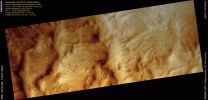
Psp_009548_1420_red.jpgEnigmatic Terrain in Hellas Planitia (Saturated Natural Colors; credits for the additional process. and color.: Dr Paolo C. Fienga - Lunexit Team)62 visiteHellas Planitia is the low-lying plain on the floor of the Hellas Basin, an ancient impact crater over 2000 Km wide. This Basin includes the lowest point on the surface of Mars.
A variety of unusual landforms occur on the floor of the basin due to the low elevation. One hypothesis is that Hellas may once have held lakes or seas, possibly with thick ice that might account for some of these features.
This image shows a small portion of Western Hellas, in a Region of "Enigmatic Ridges".
These ridges form an intricate pattern, enclosing kilometer-wide depressions. These strange features are still not well-understood; one possibility is that they formed in lake-bottom sediments when ice covering the lake touched bottom and shoved wet, loose material to the side.
This HiRISE image reveals that the ridges contain many boulders; sediments deposited on the bottom of a lake might be fine-grained, although they may have hardened to rock later. The image also shows lineations, probably outcropping layers, running between the large ridges.
Because the resolution of HiRISE images is sufficient to see details such as the abundance of boulders and the presence of thin sedimentary layers, images of this and other poorly-understood terrains will be important in interpreting the geological and climatological history of Mars.
This observation is part of a stereo pair along with PSP_007834_1420.MareKromium
(4 voti)
|
|
PSP_004000_0945_RED_browse~0.jpgThe "South Polar Residual Cap" (natural colors; credits: Lunexit)57 visite
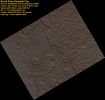
Like Earth, Mars has concentrations of water ice at both poles. Because Mars is so much colder, however, the seasonal ice that is deposited at high latitudes in the winter and is removed in the spring (generally analogous to winter time snow on Earth) is carbon dioxide ice. Around the south pole there are areas of this carbon dioxide ice that do not disappear every spring, but rather survive winter after winter&emdash;this persistent carbon dioxide ice is called the south pole residual cap.
Relatively high-standing smooth material is broken up by circular, oval, and blob-shaped depressions, forming a pattern called "swiss cheese" terrain. The high-standing areas are carbon dioxide ice with thicknesses probably of several meters. The depressions are thought to be caused by the removal of carbon dioxide ice by sublimation (the change of a material from solid directly to gas). By looking at different sized depressions in an image such as this, and by comparing images of the same place from year to year, the development of "swiss cheese" terrain can be observed.
The sublimation process may begin anywhere as a small depression. Once this small depression is formed, it expands laterally in all directions, creating the rounded depressions we see today. As most depressions seem to have a similar depth and have relatively flat bottoms, there is likely some layer below, possibly of water ice, that cannot be as easily removed by sublimation. Thus, while the south polar residual cap as a whole is present every year, there are certainly annual changes taking place within it.
Especially apparent and interesting in this image are the strips of material that parallel the edges of many depressions. Often there are two or more concentric strips that are smooth like the surrounding surface, but seem to be lower than the surrounding surface and in places appear to be tilted down towards the center of the depression. Inner strips are sometimes broken up into chunks. It may be that the uppermost smooth layer is a bit more resistant to sublimation than the material just below it&emdash;the quicker removal of the underlying material might cause the stronger upper layer to detach from the surrounding terrain and settle down towards the center of the depression.
Alternatively, these ringing strips may indicate that many layers are present within the carbon dioxide ice. Another interesting feature is the faint crisscrossing network of ridges on the upper smooth terrain. These may also be complexly involved in the sublimation and deposition of carbon dioxide ice.
With the high resolution capability of HiRISE, we intend to measure the amount of expansion of the depressions over one or more Mars years. Knowing the amount of carbon dioxide removed can give us an idea of the current atmospheric and climate conditions, and possibly how Mars climate may be changing.
MareKromium
(4 voti)
|
|
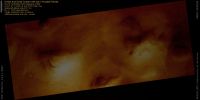
Psp_008210_2415_red~0.jpgKnobs and Small Craters with Ice in Northern Arcadia Planitia (natural colors; credits: Lunexit)70 visitenessun commentoMareKromium
(4 voti)
|
|
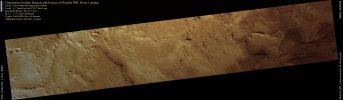
Psp_008706_1765_red.jpgCharacterize Surface Hazards and Science of Possible MSL Rover Landing Site - Equatorial Regions/Meridiani Planum (natural colors; credits: Lunexit)58 visitenessun commentoMareKromium
(4 voti)
|
|

PSP_008272_1560_RED.JPGCharacterize Surface Hazards and Science of MSL Rover Landing Site - Southern Lowlands/Margaritifer Terra (natural colors; credits: Lunexit)57 visitenessun commentoMareKromium
(4 voti)
|
|

Psp_008719_1815_red.jpgCharacterize Surface Hazards and Science of MSL Rover Landing Site - Equatorial Regions/Meridiani Planum (natural colors; credits: Lunexit)59 visitenessun commentoMareKromium
(4 voti)
|
|

PSP_008218_1815_red.jpgCharacterize Surface Hazards and Science of MSL Rover Landing Site - Equatorial Regions (Saturated Natural Colors; credits for the additional process. and color.: Dr Paolo C. Fienga - Lunexit Team) 79 visitenessun commentoMareKromium
(4 voti)
|
|
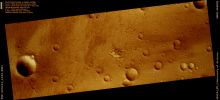
Psp_009319_1650_red.jpgDust Devil Tracks in Gusev Crater (Extremely Enhanced Natural Colors; credits for the additional process. and color.: Dr Paolo C. Fienga - Lunexit Team)63 visiteGusev Crater is decorated by tracks made by Dust Devils that have been observed by the Mars Exploration Rover Spirit, Mars Orbiter Camera (MOC), and HiRISE images.
Dust Devils are of interest because they may clean the Solar Panels that provide power to Spirit, and are partially responsible for dust transportation on the surface of Mars.
Dust Devils are actually giant convective vortices that form as a result of atmospheric vertical instability. Solar radiation warms the surface, forcing air to rise to an atmospheric convective boundary, where it then cools. The denser, cold air parcel descends and generates a circulation that creates a suction effect.
As the Dust Devil picks up material from the bright dust-mantled surface, it exposes the darker basaltic substrate. These scribble marks will follow the prevailing winds and tend to cluster together as the lower albedo surface heats up more quickly.
Scientists are trying to understand the relationship between Dust Devils and craters and other topographic features that generate multiple wind directions.MareKromium
(4 voti)
|
|
| 2235 immagini su 187 pagina(e) |
 |
|
|
|
|
70 | |
|
|
|
|





