| Piú votate - Mars Reconnaissance Orbiter (MRO) |

PSP_002290_1585andPSP_001868_1585-MemnoniaFossae-Channel-CollapseFeatures.jpgChannel and Graben in Memnonia Fossae (Hi-Def-3D - Extremely Enhanced Natural Colors; credits: Dr M. Faccin & Lunar Explorer Italia)54 visiteLatitude (centered): 21,5° South
Longitude (East): 211,2 °
Range to target site: 261,1 Km (approx. 163,2 miles)
Original image scale range: 26,1 cm/pixel (with 1 x 1 binning) so objects ~78 cm across are resolved
Map projected scale: 25 cm/pixel and North is up
Map projection: EQUIRECTANGULAR
M.L.T.: 15:37 (middle afternoon)
Emission angle: 9,3°
Phase angle: 70,6°
Solar Incidence Angle: 63°, with the Sun about 27 ° above the Local Horizon
Solar Longitude: 153,1° (Northern Summer)MareKromium
(7 voti)
|
|
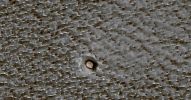
PSP_009942_2645_RED_abrowse-01.jpgSmall Crater on Planum Boreum (edm - natural colors; credits: Lunexit)66 visiteThis edm frame shows an example of a rare, small crater (approx. 115 meters, or 125 yards, in diameter). Scientists can count these shallow craters to attain an estimate of the age of the upper few meters of the Planum Boreum Surface.
The colors come from the presence of dust and of ice of differing grain sizes. The blueish ice has a larger grain size than the ice that has collected in the crater. The reddish material is dust. The smooth area stretching to the upper right, away from the crater may be due to winds being channeled around the crater or to fine-grained ice and frost blowing out of the crater.MareKromium
(7 voti)
|
|
PSP_009942_2645_RED_abrowse-00.jpgSmall Crater on Planum Boreum (ctx frame - natural colors; credits: Lunexit)77 visiteImpact craters on the surface of Planum Boreum, popularly known as the North Polar Cap, are rare. This dearth of craters has lead scientists to suggest that these deposits may be geologically young (a few million years old), not having had much time to accumulate impact craters throughout their lifetime.
It is also possible that impacts into ice do not retain their shape indefinitely, but instead that the ice relaxes (similar to glass in an old window), and the crater begins to disappear.MareKromium
(7 voti)
|
|

PSP_009696_2575_RED.JPGDunes and Translucent Ice-Spot in the Northern Plains (Saturated and Enhanced Natural Colors; credits for the additional process. and color.: Dr Paolo C. Fienga - Lunexit Team) 57 visiteThis Terrain is located near the North Pole. The bright patch of material is ice, which might have been deposited in the previous Winter.
After ice in the form of surface frost is deposited from the Atmosphere, it experiences changes throughout the Martian Year. Some of the ice has a polygonal texture which probably formed when temperature variations created stress and cracks in the ice.
The dark features scattered throughout the scene are Dunes. The streaks emanating from the Dunes trending in the South/West direction indicate the dominant direction of the wind in recent times.MareKromium
(7 voti)
|
|
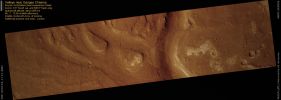
Psp_009578_1715_red.jpgValleys Near Ganges Chasma (natural colors; credits: Lunexit)56 visiteSeveral valleys as well as light-toned material are visible in this HiRISE image of a portion of Allegheny Vallis along the Plains West of Ganges Chasma.
The main valley, which starts in a pit called Ophir Cavus and extends for 155 Km into Ganges Chasma, is visible in the center of the image from left to right. Smaller and shallower valleys can be seen mostly to the north (Sx) of the image.
The observation that there are several valleys here suggests that water flowed for some extended period of time or multiple times in order to change direction and produce different valleys.
Light-toned material is visible on the upper surfaces of the plains but not inside the valleys, perhaps because smaller amounts of water could interact with the lava plains at these higher elevations, while in the valleys larger amounts of flowing water eroded and removed the plains unit. The light-toned nature on the upper surfaces could have resulted from chemical alteration of the lava plains or deposition of evaporites as the water disappeared and left behind minerals once carried in the water.MareKromium
(7 voti)
|
|
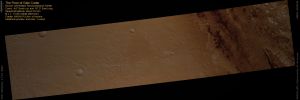
Psp_009650_1755_red.jpgCrater Floor and Central Mound in Gale Crater (natural colors; credits: Lunexit)56 visitenessun commentoMareKromium
(7 voti)
|
|
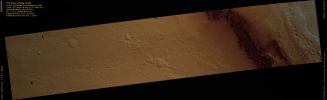
Psp_009505_1755_red.jpgThe Floor of Gale Crater (natural colors; credits: Lunexit)56 visitenessun commentoMareKromium
(7 voti)
|
|

Psp_009571_1755_red.jpgCrater Floor and Central Mound in Gale Crater (Natural Colors; credits for the additional process. and color.: Dr Paolo C. Fienga - Lunar Explorer Italia)56 visitenessun commentoMareKromium
(7 voti)
|
|

Psp_009474_1705_red.jpgWater Bearing Minerals in Noctis Labyrinthus (natural colors; credits: Lunexit)56 visiteNoctis Labyrinthus consists of a series of Pits on the western end of the large Valles Marineris Canyon System.
The HiRISE camera and the CRISM Spectrometer have revealed that the floors of some of these Pits exhibit layered rocks, or strata, that contain minerals with water. These Pits were formed several billion years ago, therefore the rocks and sediments on their floors record evidence of water during this period of Mars’ history.
The walls of the Pits are commonly covered with dust and other loose sediments that form dunes and dune-like forms, and in many cases the floors of the pits are also covered with these materials. This image shows an example of light-toned layers exposed beneath these sediments and dunes, and CRISM data show that these layers have hydrated minerals.
The dark-brown/orange tones in this natural color image correspond to areas with more Pyroxene, a mineral found in volcanic rocks and Martian Dust. Some Pits, such as this one, appear to have deposits associated with large landslides that are younger than the hydrated minerals and partially bury them.MareKromium
(7 voti)
|
|
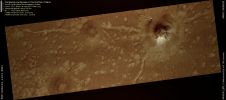
Psp_008216_2325_red.jpgPeriglacial Surface Features in the Northern Plains (natural colors; credits: Lunexit)56 visitenessun commentoMareKromium
(7 voti)
|
|
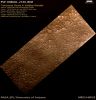
PSP_008681_2550_RED.jpgTransverse Dunes in Vastitas Borealis (natural colors; credits: Lunexit)56 visiteThe Vastitas Borealis Region, or Northern Lowlands, is a large area of low-lying surface that surrounds Mars’ North Pole.
On average, the Region is 4-5 Km lower in elevation than the mean radius of the Planet. How this basin formed is not known, although researchers have postulated that it could have been the result of a very large-scale impact sometime in Mars’ distant past. As of this writing, it is Summer in the Martian Northern Hemisphere, allowing the HiRISE camera to image this Region in full sunlight.
The sinuous landforms are dunes composed of sand that is made of basalt (a volcanic rock) or gypsum (a hydrous sulfate). There is a transition of modified barchanoid (crescent shaped dunes, generally wider than they are long) and transverse chains into star dunes; the winds change a lot in this area. The orientation of the barchanoid and transverse dunes indicate that the winds that formed them blow from the East (right side of image).
In some areas there are a few linear dunes. The light-toned, smaller bedforms are designated Transverse Aeolian Ridges (TARs).
MareKromium
(7 voti)
|
|
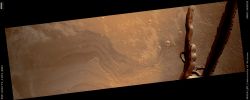
Psp_008779_1905_red.jpgThe Head of Athabasca Valles (natural colors; credits: Lunexit)54 visiteThis observation is located at the head of the Athabasca Valles Channel System, which lies just North of Mars’ Equator, in a low-elevation Region known as Elysium Planitia.
Athabasca Valles has an interesting geologic history. It was probably carved by one or more catastrophic floods of water, but more recently, a flood of lava coursed through the channel system. Both the water and the lava erupted from a few discrete points (or “vents”) along the Cerberus Fossae, a 1600-Km(1000-mile) long network of extensional (or “normal”) faults. The two prominent troughs that cut across the Southern end of this HiRISE image are part of the Cerberus Fossae. They are distinct fault segments that overlap at their tips, as one tapers in and the other pinches out.
They were not always as wide as they are today. Erosional processes have widened the troughs over time. Major eruptions occurred along both of the fault segments seen in this image, though they occurred to either side of the imaged area itself. Lava that erupted from the western vent covers the northern half of the image. The lava has raised, lobate margins and is slightly darker in tone than the older cratered plains it embays. The lava also has a banded appearance of subtly contrasting lighter and darker tones, that correspond to variations in surface roughness.
The bands are concentric to a vent located immediately west of the imaged area. Unfortunately, vents along the Cerberus Fossae are not well preserved.MareKromium
(7 voti)
|
|
| 2235 immagini su 187 pagina(e) |
 |
|
|
|
|
7 | |
|
|
|
|





