| Piú votate - Mars Reconnaissance Orbiter (MRO) |
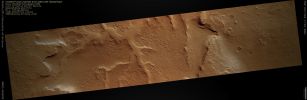
PSP_007394_1750_RED_abrowse~0.jpgInverted Fluvial Channels and Craters with Ejecta Rays (natural colors; credits: Lunexit)60 visiteThe lower part of this image shows well-defined overlapping channels, which have inverted topography (i.e.: they were once low spots that have been filled in with sediments and now eroded in a such a way that they appear as topographically high regions).
The channels have a winding and intersecting geometry indicating the shifting of the channels over time, a feature consistent with the flow of water in rivers. The channels have small craters that have excavated the channel materials and ejected them to form well-defined rays. There are dark slope streaks (toward the top of the image) showing transport of fine dust down the slope of an eroded bedrock terrain.MareKromium
(4 voti)
|
|
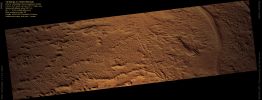
PSP_009966_1735_RED_abrowse-00.jpgInverted Channels and Yardangs in Aeolis Mensae (ctx frame - natural colors; credits: Lunexit)60 visiteThis image shows wind-eroded Layered Deposits in Aeolis Mensae. Aeolis Mensae is located close to the Volcanic Region of Elysium Planitia and near the boundary of the high-standing, heavily cratered Southern Hemisphere and the low, sparsely-cratered plains that cover most of the Northern Hemisphere of Mars.
MareKromium
(4 voti)
|
|

PSP_009966_1735_RED_abrowse-01.jpgInverted Channels and Yardangs in Aeolis Mensae (edm - natural colors; credits: Lunexit)63 visiteAeolis Mensae is well-known for its unusual features commonly related to wind activity on the Planet’s Surface. Near the bottom of the image (see the edm here) is a long, sinuous, flat-topped feature that has been exposed by wind erosion.
This sinuous ridge is one of several similar ridges in the region that are believed to be former stream channels now preserved in inverted relief.
On Earth, inverted relief occurs when formerly low-lying areas become elevated because the original depression is filled with materials, such as lava, that are more resistant to erosion than the surrounding terrain. In the case of stream channels, the streambed may contain larger rocks and/or sediments that have been cemented by chemicals precipitating from flowing water that remain, while adjacent fine material is blown away by the wind. In this location, it is most likely that water once flowed through this channel and deposited sediments that eventually filled the channel and became cemented.
Over time, wind eroded the surrounding surface leaving the remnant channel exposed as a raised flat-topped ridge.
On either side of the Inverted Channel and throughout the image are several linear, streamlined ridges oriented roughly South to North. These are Yardangs, such as streamlined remnants of material shaped by the action of sand-blown sediments that eroded away weaker material.
Landforms such as these are common in desert areas on Earth. The orientation of the Yardangs indicates the primary wind direction.MareKromium
(4 voti)
|
|
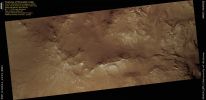
PSP_010012_2225_RED_abrowse-00.jpgDeep Rocks Unveiled at Bonestell Crater (ctx frame; natural colors; credits: Lunexit)59 visiteImpact craters are sometimes nicknamed “Mother Nature's drill holes” because, thanks to them, deep rock formations are exposed at the surface. Bonestell Crater is a good example.
This image depicts part of the floor of this relatively young impact crater located in the Northern Lowlands. The Northern Lowlands occupy most of the northern half of Mars. They are younger than the Southern Highlands, as shown by the lower number of impact craters, and well below the Planet’s Average Elevation. Their origin is still a mystery.
Bonestell is about 42 Km (approx. 26 miles) in diameter and about 1250 meters (4100 feet) deep. The rocky hills on the floor of this crater constitute its “Central Peak”.
Central peaks form due to elastic rebound of subsurface materials immediately after impact. The rocks in Bonestell's Central Peak may have been 4-to-8 Km below the surface before impact.MareKromium
(4 voti)
|
|
Psp_007242_2650_red.jpgChasma Boreale (natural colors; credits: Lunexit)59 visitenessun commentoMareKromium
(4 voti)
|
|

PSP_009488_1745_RED_abrowse-00.jpgMartian Caves (ctx frame - possible natural colors; credits: Lunexit)59 visitePit Craters exist in Volcanic Regions across Mars, and form when surface materials collapse into large underground cavities. Such pits are generally bowl-shaped, filled with sediment, and are relatively shallow when compared with their diameters.
Recently, a small number of anomalous Pit Craters were identified with strikingly different visible and thermal characteristics such as: sheer cliff walls; deep interiors that can extend out-of-sight beneath the surface and temperature fluctuations that behave unlike any known feature on Mars.MareKromium
(4 voti)
|
|

PSP_009488_1745_RED_abrowse-01.jpgMartian Caves (edm n. 1 - possible natural colors; credits: Lunexit)57 visiteThe pair of Pit Craters visible here are the smallest “anomalous” pits known to exist at this time. These have either vertical or sub-vertical interior walls (sub-vertical means that they are not visible from a nearly overhead viewing perspective), and each pit is deep enough that sunlight does not hit the floor when the Sun is at or near the Zenith.
Unfortunately, the only thermal-infrared camera currently orbiting Mars cannot resolve features this small, so the temperature characteristics of these pits must remain unknown for now, underscoring the need for a high-resolution thermal instrument on future missions.
Intriguingly, when pit craters on Earth have similar characteristics to the pair shown here, they often have cave entrances in their bases connecting to large underground networks. Current investigations are determining whether the anomalous Martian Pits may be shown to contain such entrances.MareKromium
(4 voti)
|
|

PSP_009488_1745_RED_abrowse-02.jpgMartian Caves (edm n. 2 - possible natural colors; credits: Lunexit)68 visiteThe ability to detect and explore Martian caves is of intense interest to many disciplines in Planetary Science. Caves, in fact, may expose entire sets of stratigraphic layers, providing windows into Mars’ Geologic and Atmospheric histories.
MareKromium
(4 voti)
|
|

PSP_009488_1745_RED_abrowse-03.jpgMartian Caves (edm n. 3 - possible natural colors; credits: Lunexit)58 visiteCave environments can also protect organic life from extremely harsh conditions on the Martian Surface, and may provide future human explorers with secure habitats. Accordingly, caves are considered among the most promising locations to find preserved evidence of past or present microbial life.
Furthermore, the challenges associated with Mars cave exploration may inspire a full range of new technologies, such as advanced robotics and target-specific landing capabilities.MareKromium
(4 voti)
|
|

PSP_009913_1910_RED_abrowse-00.jpgFissures in Cerberus Fossae (natural colors; credits: Lunexit)66 visiteThis image shows an example of “en echelon” fractures in the Cerberus Fossae Region.
These fractures formed tectonically, meaning by the movement of Mars’ crust.
En "echelon" means that the fractures are laterally displaced from each other in a way consistent with the lateral displacement of other fractures in the same area.MareKromium
(4 voti)
|
|
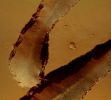
PSP_009913_1910_RED_abrowse-01.jpgFissures in Cerberus Fossae (Enhanced and Saturated Natural Colors; credits: Lunexit)64 visiteThe colors in this frame result from differences in composition of the materials and ALSO represent how the landscape would appear to the human eye. Note that one can make out boulders and small dunes at the bottom of these fractures and layering within the walls. Just visible at the top of the image is some well-preserved impact crater ejecta.
The image is 1,2 Km across.MareKromium
(4 voti)
|
|
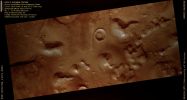
PSP_009708_2205_RED_abrowse-00.jpgHills in Acidalia Planitia (CTX Frame - Enhanced and Darkened Natural Colors; credits for the additional process. and color.: Dr Paolo C. Fienga - Lunexit Team)59 visiteThe hilly landscape visible in this observation may appear at first rather bleak, due to the pervasive soils of uniform brightness blanketing most of the area.
However, upon closer examination, the image reveals rocky outcrops at the top of some of the hills.
These rocks contain clues pointing to a watery past.MareKromium
(4 voti)
|
|
| 2235 immagini su 187 pagina(e) |
 |
|
|
|
|
69 | |
|
|
|
|





