| Piú votate - Mars Reconnaissance Orbiter (MRO) |

Psp_010141_1540_red.jpgPitted Plain, North of Hellas Region (possible True Colors; credits: Lunar Explorer Italia)81 visiteMars Local Time: 15:38 (middle afternoon)
Coord. (centered): 25,5° South Lat. and 55,6° East Long.
Spacecraft altitude: 258,8 Km (such as about 161,7 miles)
Original image scale range: 51,8 cm/pixel (with 1 x 1 binning) so objects ~1,55 mt across are resolved
Map projected scale: 50 cm/pixel
Map projection: EQUIRECTANGULAR
Emission Angle: 6,7°
Phase Angle: 74,2°
Solar Incidence Angle: 69° (meaning that the Sun is about 21° above the Local Horizon)
Solar Longitude: 132,0° (Northern Summer)
Credits: NASA/JPL/University of Arizona
Additional process. and coloring: Lunar Explorer ItaliaMareKromium
(4 voti)
|
|

Psp_010209_1855_red.jpgWhere the Waters flew... (possible True Colors; credits: Lunar Explorer Italia)79 visiteMars Local Time: 15:34 (middle afternoon)
Coord. (centered): 5,6° North Lat. and 355,5° East Long.
Spacecraft altitude: 274,8 Km (such as about 171,8 miles)
Original image scale range: 27,5 cm/pixel (with 1 x 1 binning) so objects ~55 cm across are resolved
Map projected scale: 25 cm/pixel
Map projection: EQUIRECTANGULAR
Emission Angle: 2,6°
Phase Angle: 56,1°
Solar Incidence Angle: 54° (meaning that the Sun is about 36° above the Local Horizon)
Solar Longitude: 134,5° (Northern Summer)
Credits: NASA/JPL/University of Arizona
Additional process. and coloring: Lunar Explorer ItaliaMareKromium
(4 voti)
|
|
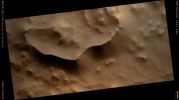
PSP_009356_1835_RED.jpgRidged Margin of Elevated Plateau North/West of Pavonis Mons (possible True Colors; credits: Lunar Explorer Italia)78 visiteSnaking across this observation is a ridged margin that appears as though it separates two parts of a canvas.
On closer examination (see the edm), it almost looks as though there is a relatively smooth landscape on the left, and pockmarked terrain on the right.
The ridge itself is revealed in incredible detail with what appear to be "gulley-esque" grooves running its length.
Pavonis Mons is part of what is called Tharsis Montes, being the middle of three volcanoes in this Region. The name "Pavonis Mons" itself is Latin for "Mount of the Peacock".
Mars Local Time: 15:25 (early afternoon)
Coord. (centered): 3,6° North Lat. and 243,8° East Long.
Spacecraft altitude: 265,3 Km (such as about 165,8 miles)
Original image scale range: 26,5 cm/pixel (with 1 x 1 binning) so objects ~80 cm across are resolved
Map projected scale: 25 cm/pixel
Map projection: EQUIRECTANGULAR
Emission Angle: 1,3°
Phase Angle: 54,5°
Solar Incidence Angle: 54° (meaning that the Sun is about 36° above the Local Horizon)
Solar Longitude: 103,5° (Northern Summer)
Credits: NASA/JPL/University of Arizona
Additional process. and coloring: Lunar Explorer ItaliaMareKromium
(4 voti)
|
|

Psp_009342_2650_red.jpgNorthern Dunes (possible True Colors; credits: Lunar Explorer Italia)58 visiteMars Local Time: 13:43 (early afternoon)
Coord. (centered): 84,9° North Lat. and 234,4° East Long.
Spacecraft altitude: 319,4 Km (such as about 199,6 miles)
Original image scale range: 32,0 cm/pixel (with 1 x 1 binning) so objects ~96 cm across are resolved
Map projected scale: 25 cm/pixel
Map projection: EQUIRECTANGULAR
Emission Angle: 6,5°
Phase Angle: 55,9°
Solar Incidence Angle: 61° (meaning that the Sun is about 29° above the Local Horizon)
Solar Longitude: 103,0° (Northern Summer)
Credits: NASA/JPL/University of Arizona
Additional process. and coloring: Lunar Explorer ItaliaMareKromium
(4 voti)
|
|
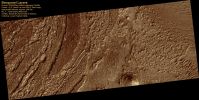
PSP_004078_2015_RED_browse-00.jpgLayered Deposits in Becquerel Crater (possible natural colors; credits: Lunar Explorer Italia)58 visiteImage PSP_004078_2015 shows light-toned layered deposits along the floor of Becquerel Crater, an impact crater in Arabia Terra. The deposits consist of stacked, repeating layers which consistently appear to be only a few meters thick.
The surface of the deposits also appears to be cracked into blocks a meter or so in length.
Layered deposits, such as these, form from sediments once deposited within the crater. Possible origins for the sediments include windblown debris, volcanic ash falling from the sky, or sediments that accumulated in a lake on the crater floor. The regular thickness of the layers suggests that they were most likely deposited in a water environment or by wind in a cyclic process.
Some of the layering has a dark appearance that produces an alternating bright-dark “zebra” banding. This may be the result of a thin surface layer of coarser and darker basalt sand collected on the more level surfaces, rather than indicating compositional differences in the eroded layered beds. Faults can also be seen displacing portions of the layered bed. An example of this can be seen just left of center in the bottom half of the subimage. The faulting indicates that the deposits have experienced disruption since their emplacement.
MareKromium
(4 voti)
|
|
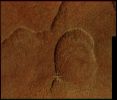
PSP_001331_2260andPSP_001872_2260-MidNorthernLatitudeScallopedTerrain.jpgScalloped Terrain (Hi-def-3D - possible True Colors; credits: Dr M. Faccin & Lunar Explorer Italia)81 visiteLatitude (centered): 45,6° North
Longitude (East): 93,7°
Range to target site: 298,4 Km (approx. 186,5 miles)
Original image scale range: 29,9 cm/pixel (with 1 x 1 binning) so objects ~90 cm across are resolved
Map projected scale: 25 cm/pixel and North is up
Map projection: EQUIRECTANGULAR
M.L.T.: 15:19 (early afternoon)
Emission angle: 0,4°
Phase angle: 49,4°
Solar Incidence Angle: 49°, with the Sun about 41 ° above the Local Horizon
Solar Longitude: 132,2° (Northern Summer)MareKromium
(4 voti)
|
|
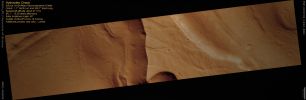
Psp_009709_1810_red.jpgA "segment" of Hydraotes Chaos (natural colors; credits: Lunexit)58 visiteHydraotes Chaos is an Equatorial Region of Chaotic Terrain located near some of the large outflow channels on Mars. Chaotic terrain near the Outflow Channels (ancient flood channels) is thought to form when ices beneath the surface rapidly become liquid or gaseous and escapes, and the remaining solid material collapses.
Chaotic terrain is called “chaotic” because it consists of a large jumble of randomly shaped Mesas (Hills) and Troughs. Many regions of Chaotic Terrain are located at the head (start) of the outflow channels, suggesting that the origins of the two classes of feature might be related to each other.
The Mesa located in the center of the image has elongated depressions that might be evidence of past fluvial activity.
Nota: questo dettaglio si riferisce ad una zona "famosa" per gli Eso-Archeologi...Quale?
Ma è la zona su cui dovrebbe sorgere la famosa "Città di Hydraotes Chaos", la Città del Bacino Alluvionale che è stata "vista" da illustri personaggi quali il Dr J. Skipper, il Dr R. Hoagland ed il nostrano Ing. E. Piccaluga.
Ora, avendo questa immagine davanti (che PARLA DA SOLA!), noi ci aspetteremmo due reazioni da questi personaggi:
1) se vogliono essere coerenti, allora devono dire che l'immagine è falsa o che è stata taroccata, per nascondere la "Città" oppure
2) se vogliono essere onesti devono cospargersi il capo di cenere, chiedere scusa alle migliaia di Appassionati presi per il fondo-schiena e quindi dedicarsi ad altra professione.
Purtroppo, però, costoro non faranno nulla di tutto ciò: costoro ignoreranno l'immagine e continueranno per la loro strada, fatta di bugie, traveggole e speculazioni pseudo-scientifiche a sfondo commerciale.MareKromium
(4 voti)
|
|
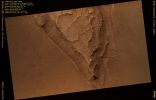
PSP_006005_2050_RED-00-PCF-LXTT.jpgStreamlined Island in Kasei Valles (Saturated Natural Colors; credits for the additional process. and color.: Dr Paolo C. Fienga - Lunexit Team)57 visiteIn this picture there is a Streamlined Island: one of many observed in the large outflow channels on Mars. This outflow channel is called Kasei Valles, and is one of the largest catastrophic outflow channels on Mars.
The Streamlined Island forms as water flows through the channel, but is blocked by some sort of obstacle, such as a crater or other topographic landform. In this HiRISE image, we only see the very tail end of the Streamlined Island, which is over 118 Km in length.
The platy surface within the channels has been attributed to either later lava or mud flows along the surface. The island itself is quite dusty and covered in small craters, so the island may be quite old. Along the edge of the island, however, you can see individual layers of rock.
These layers represent individual rock units that may be volcanic or sedimentary in origin.MareKromium
(4 voti)
|
|
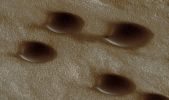
PSP_010169_2650_RED_abrowse-01.jpgDunes and other Surface Features in Chasma Boreale (edm n. 1 - possible True Colors; credits: Lunexit)58 visiteThe sand dunes visible here are Barchan Dunes.
Barchan Dunes are also commonly found on Earth, and are crescent-shaped with a steep slip face bordered by horns oriented in the downwind direction. Barchan Dunes form by uni-directional winds and thus are good indicators of the dominant wind direction.
In this case, the dunes indicate that the direction of the strongest winds are parallel to the chasma walls, roughly East to West. The dark material composing the dunes could be volcanic ash or is possibly dark sand eroding out of the polar layered materials.MareKromium
(4 voti)
|
|
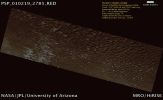
PSP_010219_2785_RED_abrowse-00.jpgDunes in Abalos Undae (ctx frame - possible True Colors; credits: Lunexit)58 visiteThe Abalos Undae Dunefield stretches westward, away from a portion (Abalos Colles) of the ice-rich North Polar Layered Deposits that is separated from the main Planum Boreum dome by two large chasms (---> abissi, crepacci).
These dunes are special because their sands may have been derived from erosion of the Rupes Tenuis unit (the lowest stratigraphic unit in Planum Boreum, beneath the icier layers) during formation of the chasms.
Some researchers have argued that these chasms were formed partially by melting of the polar ice.MareKromium
(4 voti)
|
|
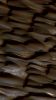
PSP_010219_2785_RED_abrowse-01.jpgDunes in Abalos Undae (edm - possible True Colors; credits: Lunexit)58 visiteThis enhanced-color close-up (1,2 Km across) shows an example of dunes in Abalos Undae.
The enhanced color data illuminate differences in composition: the dunes appear of a green/bluish color because of their basaltic composition, while the reddish-white areas are probably covered in dust and residual ice. Upon close inspection, tiny ripples and grooves are visible on the surface of the dunes (both ripples and grooves are formed by wind action, as are the dunes themselves).
It is possible that these dunes are no longer migrating (the process of dune formation forces dunes to move in the direction of the main winds) and that the tiny ripples are the only active parts of the dunes today.MareKromium
(4 voti)
|
|

PSP_006487_1580_RED.jpgCollapse Features in Tyrrhena Patera (natural colors; credits: Lunexit)58 visiteIn this image you can notice a set of craters around the rim of Tyrrhena Patera. Tyrrhena Patera is a volcano in the Southern Highlands with shallow slopes, and only 2 Km (about 1,2 miles) of vertical relief.
The craters are aligned and are known as Pit Crater Chains. These are common in Volcanic Regions on Mars.
They are not formed by a meteorite impact, but by collapse into some void space underground.
Because the Pit Crater Chains and Concentric Fractures are generally aligned, these are most likely due to extension in the Region, where parts of the Martian Crust pull apart during growth of the volcano or emplacement of dikes.
Another way pit crater chains can occur is when Lava Tubes partially collapse forming chains of holes along the roof of the Lava Tubes themselves.
A third possibility is that these may be associated with collapse of the underground magma chamber.MareKromium
(4 voti)
|
|
| 2235 immagini su 187 pagina(e) |
 |
|
|
|
|
68 | |
|
|
|
|





