| Piú votate - Mars Reconnaissance Orbiter (MRO) |

PSP_003249_1510_RED_browse_00~0.jpgLayered Deposits in Ritchey Crater (Enhanced Natural Colors; credits for the additional process. and color.: Dr Paolo C. Fienga - Lunexit Team)66 visiteThis HiRISE image shows eroding layered deposits in Ritchey Crater, a large impact crater in the Southern Highlands.
Three general units can be seen: a relatively dark upper layer, a light middle unit, and the floor material, which may be mostly obscured by dust.
The dark cap layer appears to be relatively hard and resistant, while the light material is weak.
Once the upper layer is removed, the light layer does not last long.
It is unclear how each of these layers formed.
Volcanic ash layers, lake or stream deposits, or sandstone deposited by dunes can all produce horizontal layers. Unraveling the origin would provide important clues to Mars' past.MareKromium
(4 voti)
|
|
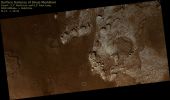
Psp_001440_1820_red~0.jpgFeatures of Sinus Meridiani (possible True Colors; credits: Lunar Explorer Italia)58 visitenessun commentoMareKromium
(4 voti)
|
|
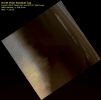
Psp_001470_2665_red~0.jpgNorth Polar Residual Cap (possible natural colors; credits: Lunar Explorer Italia)59 visitenessun commentoMareKromium
(4 voti)
|
|

Chasma_Boreale-Psp_001412_2650_red-00~0.jpgChasma Boreale: the Martian "Pentagon" and other unusual surface features (1)125 visiteUn modestissimo esempio (si fa per dire...) di Anomalìa di Superficie sul Pianeta Rosso: siamo nella Regione conosciuta come Chasma Boreale. Un frame bello, senza dubbio, ma privo di interesse.
Privo di interesse?!? Ne siamo/siete certi?!?
Ma no, certo che no! Basta un minimo di "occhio" e di attenzione, infatti, per scoprire alcuni rilievi che non hanno davvero nulla di usuale e che, quindi, sono interessanti per definizione.
Eccoli qui (dall'alto in basso):
1) un doppio cratere da doppio impatto (...sic...) - a forma di "8" - con/su "piedistallo";
2) un cratere a forma PENTAGONALE (quasi) REGOLARE e
3) un rilievo ad ANGOLO RETTO (che abbiamo definito "L-shaped") all'interno di un altro cratere.
Ora, a noi vanno bene gli Scrittori di Fantascienza (tipo Hoagland e Discepoli) i quali vedono manufatti ed artificialità ovunque, però ci sorprende che questi "Fenomeni" non riescano a vedere delle Anomalìe di simile portata! Insomma: costoro vedono le "pagliuzze", ma NON VEDONO LE TRAVI!!!
Certo, parlare di "piramidi" ed altre scemenze simili fa audience&business, siamo d'accordo. Ma allora - per favore - smettetela di dire che "cercate la Verità"!
La Verità è che di rilievi (a dir poco) anomali, su Marte (e non solo), ce ne sono migliaia e non si tratta, purtroppo per Voi, delle solite "facce" e delle immancabili "piramidi". Si tratta di rilievi i quali FANNO A PUGNI con la Geologia Convenzionale, le Meccaniche da impatto e tanti altri precetti della Scienza Consolidata. Quella Scienza che viene usata solo quando fa comodo e solo da coloro che possono disporre del supporto di mezzi di comunicazione di massa.
Volete parlare di Anomalìe Marziane? Guardate questo frame ed il successivo detail mgnf! Non c'è bisogno di Cydonia & dintorni (o delle pseudo-fotografie ESA) per porsi delle domande "intelligenti, affascinanti ed indiscrete"...MareKromium
(4 voti)
|
|

Coprates_Labes_Canyon-Tra_000849_1675_red~0.jpgCoprates Labes (possible True Colors; credits: Lunar Explorer Italia)109 visiteCoprates Labes is a Martian canyon, part of the huge Valles Marineris System. Valles Marineris most likely formed through tectonic processes, with extensional stresses leading to collapse of the terrain that now lies at the base of the canyons. Filling most of this image, we see a raised block on the canyon bottom, which is quite possibly a horst—a block bounded by faults that separate it from sunken blocks on each side. The raised block is heavily eroded, possibly by wind; this erosion has exposed its internal layering, especially at the Southeastern margin of the block.
Here we see asymmetric erosion features with shallow slopes trailing off to the North-West, suggesting that southeasterly winds dominate the flow through this Region. The arrangement of dunes and ripples in the lower right portion of the image confirms this prevailing wind direction.
Finally, dark-toned material appears to have flowed from North-East to South-West along the block, possibly moving in a very fluid debris flow. MareKromium
(4 voti)
|
|
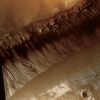
PSP_004071_1425_RED_browse-01.jpgMesas in Gorgonum Chaos (edm - possible True Colors; credits: Lunar Explorer Italia)58 visitePSP_004071_1425 shows mesas that are part of Gorgonum Chaos, a region of chaotic terrain, which is a jumble of mounds and mesas grouped together.
Chaotic terrain is most commonly found in Mars near the sources of the gigantic outflow channels. Gorgonum Chaos is one of the few exceptions.
Some of the troughs between the mesas appear to have V-shaped bottoms; there is no obvious flat floor in between. Others have dunes running down their centers probably indicating flat floors. It is possible that the mesas were once connected and that something caused fractures in the original mesa's surface that were then preferentially eroded.MareKromium
(4 voti)
|
|

PSP_003252_1425_RED_browse-00%7E0.jpgBright Gully Deposit in Terra Sirenum (ctx image - MULTISPECTRUM; credits: Lunar Explorer Italia)70 visiteThis HiRISE image shows a bright gully deposit and other gullies within a crater wall in Terra Sirenum (37,7° South Lat. and 229,0° East Long.).
Three images are available:
(context image - A): The full frame HiRISE image, with the crater at left center; the width of the image is 6 Km;
(close-up of the crater's rim - B): an enlargement showing the crater;
(close-up of the bright gully deposit - C).
Frames B and C have been stretched to enhance contrast. The red box in B shows the location of C. MareKromium
(4 voti)
|
|
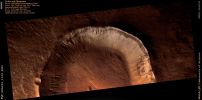
PSP_006261_1410_RED_abrowse.jpgGullies with Meanders (MULTISPECTRUM; credits: Lunexit)57 visiteThis observation features a relatively pristine crater in the Southern Mid-Latitudes. The crater still has a sharp rim on its South end, but it has experienced modification since forming.
The North half of the crater is populated by a large number of gullies that appear to emanate from resistant layers. The layers likely continue around the crater, but the gullies do not. Distinct layers are visible on the South wall of the crater.
It is unknown why gullies form on certain slopes and not others. Interestingly, the gullies themselves are not so pristine. They are covered by dunes and cut by polygonal fractures, indicating that they have been modified by aeolian and periglacial processes, respectively.
There are a large number of boulder tracks visible on the crater walls. Boulder tracks typically are approximately constant in width, and can often be seen at the track ends.
The crater floor has a texture indicative of sublimation processes.
If a soil is ice-rich under Martian conditions, the ice can sublimate causing the ground to collapse and “crinkle” where the ice used to be.
MareKromium
(4 voti)
|
|
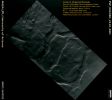
PSP_006980_2610_RED_abrowse.jpgSmooth Surface Features of Chasma Boreale (False Colors; credits: Lunexit)81 visitenessun commentoMareKromium
(4 voti)
|
|

PSP_010546_2615_RED_abrowse-01.jpgSand Slide (EDM - Absolute Natural Colors; credits for the additonal process. and color.: Dr Paolo C. Fienga - Lunar Explorer Italia)79 visiteSand Dunes are found in numerous Regions of Mars. These Dunes are in the North Polar Region: high latitude dunes are covered seasonally with Carbon Dioxide - CO2 - Frost (such as dry ice frost).
This edm shows a place where material has slipped from the crest of the dune and slid down to form a deposit at the bottom.
The material may have been loosened by the activity associated with sublimation (evaporation from a solid to a gas) of seasonal frost.
Coord. (centered): 81,6° North Lat. and 135,1° East Long.
Spacecraft altitude: 321,6 Km (such as about 201,0 miles)
Original image scale range: 64,3 cm/pixel (with 1 x 1 binning) so objects ~1,93 mt across are resolved
Map projected scale: 50 cm/pixel
Map projection: EQUIRECTANGULAR
Emission Angle: 6,2°
Phase Angle: 65,4°
Solar Incidence Angle: 71° (meaning that the Sun is about 19° above the Local Horizon)
Solar Longitude: 147,6° (Northern Summer)
Credits: NASA/JPL/University of Arizona
Additional process. and coloring: Lunar Explorer Italia MareKromium
(4 voti)
|
|
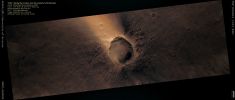
PSP_006841_1935_RED_abrowse~0.jpgJust like a "Butterfly": Dilly Crater... (MULTISPECTRUM; credits: Lunexit)57 visiteThis image covers the primary cavity of the distinctive rayed crater Dilly. Dilly is what is commonly referred to as a “butterfly” crater. This colloquial name refers to the asymmetry of the ejecta giving the appearance of “wings” around an elliptical cavity, and hence, the overall appearance of a butterfly. The “butterfly” appearance and elliptical cavity of Dilly (approx. 2 x 2,3 Km in diameter) are distinctive clues indicating that the crater formed from a low-angle impact (< 45°), likely from the South-West.
In addition to being a “butterfly” crater, Dilly is one of the smallest of the large rayed crater systems discovered in THEMIS nighttime infrared (temperature) images. Dilly, like its rayed counterparts such as Zunil, Gratteri, Tomini, Zumba, and the recently discovered unnamed crater seen in PSP_003611_1970, possesses distinctive rays (i.e.: spoke-like and far-traversing radial ejecta features) that are most readily viewed in THEMIS images. Crater rays are distinctive in the infrared because they are comprised of both dust and coarse, rocky materials, which are contrasted as cold (dark) and warm (bright) respectively. Because rays are ephemeral features, they are noted by scientists as a tell-tale sign of a fresh or well-preserved crater.
In the image, we can also observe that Dilly possesses a very distinctive light-toned South-West-trending streak that indicates modification by wind.
Light-toned dunes are also visible in the bottom of the crater.MareKromium
(4 voti)
|
|
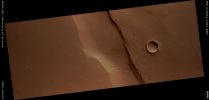
PSP_010054_1765_RED.jpgPlain North-West of Tithonium Chasma (possible True Colors; credits: Lunar Explorer Italia)60 visiteMars Local Time: 15:34 (middle afternoon)
Coord. (centered): 3,6° South Lat. and 268,4° East Long.
Spacecraft altitude: 260,2 Km (such as about 162,6 miles)
Original image scale range: 52,1 cm/pixel (with 1 x 1 binning) so objects ~1,56 mt across are resolved
Map projected scale: 50 cm/pixel
Map projection: EQUIRECTANGULAR
Emission Angle: 0,3°
Phase Angle: 57,8°
Solar Incidence Angle: 58° (meaning that the Sun is about 32° above the Local Horizon)
Solar Longitude: 128,7° (Northern Summer)
Credits: NASA/JPL/University of Arizona
Additional process. and coloring: Lunar Explorer ItaliaMareKromium
(4 voti)
|
|
| 2235 immagini su 187 pagina(e) |
 |
|
|
|
|
66 | |
|
|
|
|





