| Piú votate - Mars Reconnaissance Orbiter (MRO) |
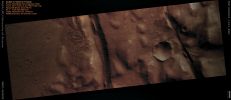
PSP_006695_1415_RED_abrowse~0.jpgGullies in Sirenum Fossae (MULTISPECTRUM; credits: Lunexit)58 visiteThis image shows parts of Sirenum Fossae that are southwest of Gorgonum Chaos. Some of the troughs (Fossae) have gullies on their walls. Gullies are incised slope features that are thought to have formed by liquid water flowing down the slopes.
It is unknown whether the water came from the subsurface or above the surface. The plains around the troughs have a number of mesas and hills that might have formed from erosion of a once-larger rock unit.
The left side of the image shows some dark linear features which MIGHT BE Dust Devil Tracks.MareKromium
(4 voti)
|
|
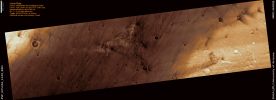
PSP_005456_1650_RED_abrowse-00~0.jpgHome Plate from Orbit (CTX Frame - Enhanced Natural Colors - elab. Lunexit)57 visitenessun commentoMareKromium
(4 voti)
|
|

PSP_005574_1720_RED_abrowse-00~0.jpgLayers and Slope-Streaks within Valleys along the Highland-Lowland Boundary (context frame - MULTISPECTRUM; credits: Lunexit)61 visiteThis image shows Slope Streaks and Layering on the walls of a valley along the border between the Martian Southern Highlands and Northern Lowlands (see the extra-detail mgnf. At the bottom of the valley and in the lower portion of the valley walls are many large dunes.
The Slope Streaks generally start at a point source and widen downslope as a single streak or branch into multiple streaks. Some of the Slope Streaks show evidence that downslope movement is being diverted around obstacles, such as large boulders. In particular, several of the Slope Streaks in this image appear to be diverting around individual dunes, with downslope movement occurring in the low troughs between the dunes. The darkest Slope Streaks are youngest and cross cut and lie on top of the older and lighter-toned Streaks.
The lighter-toned Streaks are believed to be dark streaks that are lightening with time as new dust is deposited on their surface.MareKromium
(4 voti)
|
|

PSP_005392_0995_RED_abrowse-00~0.jpgImpact Crater on the South Polar Layered Deposits (context frame; MULTISPECTRUM - credits: Lunexit)58 visiteThis image covers a portion of the ice-rich SPLD.
Layers in the Mars Polar Regions are of great interest because layers in ice on the Earth, as in the Antarctic and Greenland ice caps, are known to contain records of past atmospheric, environmental, and climate conditions. By studying Mars Polar Layers, we hope to be able to understand the past climate and history of water on the Red Planet.MareKromium
(4 voti)
|
|

PSP_005748_1075_RED_abrowse~0.jpgBuried Crater in the SPLD (natural colors; credits: Lunexit)59 visiteThis image of the SPLD shows some of the layers cut off against other layers below and right of center. Geologists call this an “angular unconformity” because the layers do not conform to each other across this boundary.
In this case, the angular unconformity was probably caused by erosion of the SPLD followed by deposition of new SPLD on top of the eroded surface, but faulting could also have caused the observed unconformity.
Near the unconformity is an impact crater, one of dozens found on the SPLD. The presence of these craters implies that the surface of the SPLD has been relatively stable (i.e., little erosion or deposition) in the past few million years.
This is in stark contrast to the NPLD, on which craters are very rare, implying very recent erosion/deposition.MareKromium
(4 voti)
|
|
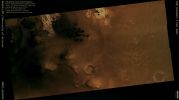
PSP_006820_1760_RED_abrowse~0.jpgPeri-Equatorial "Sand-Patches" on a Crater Floor (MULTISPECTRUM; credits: Lunexit)58 visiteThis image shows part of the floor of a large crater in Arabia Terra, near Mars’ Equator. A notable feature on this crater floor is a region of "Dark Patches" up to about 100 mt (330 feet) across. These Dark Patches sit in an area of connected small ridges and spurs and bury them, filling in the low areas and piling up. In several places light ridge crests protrude through the dark material.
The dark patches appear to be collections of wind-blown sand. Sand on Mars is often dark, likely because it is fragments of a volcanic rock called basalt. (Sand on Earth is most often light-toned quartz). Sand may tend to collect in patches that can ultimately evolve into large dunes if more sand gathers. The patches of sand here are not big enough to form such large structures, but small-scale regular texture due to blowing wind is visible on the surface.
The relatively dark tone which can be seen around the Sand Patches (compared with the surrounding material) is probably due to small amounts of additional sand. In some places this collects at the bottom of troughs.MareKromium
(4 voti)
|
|
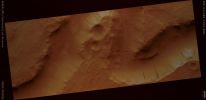
ESP_011289_1950_RED_abrowse.jpgMeander and Tributaries in Scamander Vallis (Enhanced Natural Colors; credits: Lunar Explorer Italia)61 visiteMars Local Time: 15:48 (middle afternoon)
Coord. (centered): 14,6° North Lat. and 29,1° East Long.
Spacecraft altitude: 278,2 Km (such as about 173,9 miles)
Original image scale range: 55,7 cm/pixel (with 1 x 1 binning) so objects ~1,67 mt across are resolved
Map projected scale: 50 cm/pixel
Map projection: EQUIRECTANGULAR
Emission Angle: 5,7°
Phase Angle: 52,4°
Solar Incidence Angle: 58° (meaning that the Sun is about 32° above the Local Horizon)
Solar Longitude: 178,5° (Northern Summer)
Credits: NASA/JPL/University of Arizona
Additional process. and coloring: Lunar Explorer ItaliaMareKromium
(4 voti)
|
|
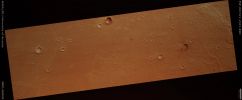
PSP_001521_2025_RED_abrowse-00.jpgThe Viking Lander 1 Landing Site - Thomas Mutch Memorial Station (ctx frame - Natural Colors; credits: Lunar Explorer Italia)58 visiteViking Lander 1 (VL1) touched down in Western Chryse Planitia on July 20, 1976.
The Lander, which has a diameter of about 3 meters, has been precisely located in the HiRISE orbital image, and likely locations have been found for the Heat-Shield, Backshell and Parachute attached to the Backshell.
The Lander location has been confirmed by overlaying the lander-derived topographic contours on the HiRISE image, which provides an excellent match. VL1 was one element of an ambitious mission to study Mars, with a 4-spacecraft flotilla consisting of 2 Orbiters and 2 Landers.MareKromium
(4 voti)
|
|

ESP_011292_1720_RED_abrowse.jpgLayering at Ganges Chasma (possible Natural Colors; credits: Lunar Explorer Italia)61 visiteMars Local Time: 15:42 (middle afternoon)
Coord. (centered): 8,1° South Lat. and 307,5° East Long.
Spacecraft altitude: 258,6 Km (such as about 161,6 miles)
Original image scale range: 28,7 cm/pixel (with 1 x 1 binning) so objects ~86 cm across are resolved
Map projected scale: 25 cm/pixel
Map projection: EQUIRECTANGULAR
Emission Angle: 25,4°
Phase Angle: 81,1°
Solar Incidence Angle: 56° (meaning that the Sun is about 34° above the Local Horizon)
Solar Longitude: 178,7° (Northern Autumn)
Credits: NASA/JPL/University of Arizona
Additional process. and coloring: Lunar Explorer ItaliaMareKromium
(4 voti)
|
|

Psp_010656_2170_red.jpgThe "Omega" Crater of Ismenius Lacus (possible True Colors; credits: Lunar Explorer Italia)62 visite
Per gli amanti dei Misteri Orbitali e delle possibili "Forme Assonanti" (con questa definizione si intendono tutti i rilievi superficiali situati su mondi extraterrestri i quali, in ragione della loro distanza dal punto di osservazione, o per motivi oggettivi - ex.: affinità morfologica -, o per entrambe le ragioni, richiamano alla mente dell'Osservatore dei rilievi superficiali artificiali che sono individuabili sulla Terra), ecco a Voi il (piccolo) "Cratere Omega".
Il nome del cratere (battezzato da noi e quindi, ufficialmente, ancora "Unnamed") lo abbiamo scelto in ragione della sua forma inequivocabile (che ricorda una "Omega", appunto), ma il mistero che lo caratterizza è dato da almeno due eccellenti motivi: 1) la sua forma (che è - quasi - perfettamente circolare e 2) la lacuna di rim sul suo versante Nord (Sx dell'Osservatore).
Una lacuna decisamente bizzarra non solo perchè i suoi margini sono smussati e regolari (vedere per credere!), ma anche perchè, se si fosse trattato - come è comunque probabile che sia - di un cedimento naturale, allora c'è davvero da chiedersi che fine avranno mai fatto i detriti derivati dal crollo...
Insomma: se si vuole, se c'è pazienza nella ricerca e nello studio, se si possiede un pizzico di immaginzione e, soprattutto, se e quando si OSSERVA BENE, di rilievi superifciali ambigui (come minimo) se ne possono trovare OVUNQUE!
Ed è quest'ultimo dato (la localizzazione: OVUNQUE) che ci spinge, talvolta, a ritenere che le storie sull'esistenza di una possibile - ma antichissima - Civiltà Marziana potrebbero possedere un minimo di sostanza (comunque ancora tutta da ricercare e dimostrare, DIMENTICANDO - se possibile - Cydonia Mensae).
MareKromium
(4 voti)
|
|
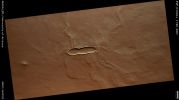
Psp_010661_1780_red.jpgShield Volcano with Leveed Channels in Noctis Fossae (possible Natural Colors; credits: Lunar Explorer Italia)59 visiteMars Local Time: 15:42 (middle afternoon)
Coord. (centered): 1,9° South Lat. and 256,3° East Long.
Spacecraft altitude: 258,3 Km (such as about 161,4 miles)
Original image scale range: 51,7 cm/pixel (with 1 x 1 binning) so objects ~1,55 mt across are resolved
Map projected scale: 50 cm/pixel
Map projection: EQUIRECTANGULAR
Emission Angle: 0,9°
Phase Angle: 56,2°
Solar Incidence Angle: 57° (meaning that the Sun is about 33° above the Local Horizon)
Solar Longitude: 152,2° (Northern Summer)
Credits: NASA/JPL/University of Arizona
Additional process. and coloring: Lunar Explorer ItaliaMareKromium
(4 voti)
|
|
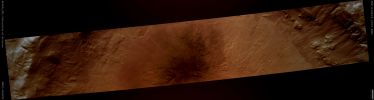
Psp_010679_2205_red.jpgEquator-Facing Slope with Gullies (Natural Colors; credits: Lunar Explorer Italia)58 visiteMars Local Time: 15:37 (middle afternoon)
Coord. (centered): 40,3° North Lat. and 120,2° East Long.
Spacecraft altitude: 304,2 Km (such as about 190,1 miles)
Original image scale range: 60,9 cm/pixel (with 1 x 1 binning) so objects ~1,83 mt across are resolved
Map projected scale: 50 cm/pixel
Map projection: EQUIRECTANGULAR
Emission Angle: 8,8°
Phase Angle: 47,2°
Solar Incidence Angle: 56° (meaning that the Sun is about 34° above the Local Horizon)
Solar Longitude: 152,9° (Northern Summer)
Credits: NASA/JPL/University of Arizona
Additional process. and coloring: Lunar Explorer ItaliaMareKromium
(4 voti)
|
|
| 2235 immagini su 187 pagina(e) |
 |
|
|
|
|
65 | |
|
|
|
|





