| Piú votate - Mars Reconnaissance Orbiter (MRO) |
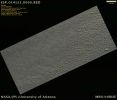
ESP_014123_0930_RED_abrowse.jpgDry Ice (Natural Colors; credits: Lunexit)61 visitenessun commentoMareKromium
(4 voti)
|
|
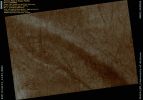
ESP_014272_1245_RED_abrowse.jpgEsker in Southern Argyre Planitia (Natural Colors; credits: Lunexit)63 visiteThough a variety of origins have been proposed, this sinuous, layered, boulder-filled deposit in the Southern Argyre Planitia is likely an "Esker".
"Eskers" form in wet-based glaciers, when water flows inside or below the glaciers and deposits sediment. After the ice melts, the sediment is left behind as a ridge.
Because the material is deposited by flowing water, the sediment in Eskers is sorted: larger rocks, pebbles, sand grains, etc. are deposited first, and smaller sediment - such as smaller pebbles, sand, or clay - are deposited further from the source and on top of the coarser material.
Several factors (including the amount of sediment available, the speed and volume of the flowing water, and the slope over which it flowed) determine how much sediment is deposited and how large the dominant grain size is. There may be many of these sequences preserved within an Esker.
Eskers look a little like Inverted River Beds. One relatively simple way to differentiate between the two is that IRBs record flow in a downhill direction along their entire length.
Eskers, on the other hand, can record flow both down- and uphill. This is possible because water flowing through the ice tunnels in glaciers is under pressure, just like water in a hose.
This particular Esker is part of a branching and braided network of Ridges in the Southern Argyre Basin.
The boulders are on the order of 1-3 meters (about 3-10 feet) in diameter.MareKromium
(4 voti)
|
|
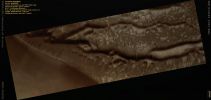
ESP_014185_1095_RED_abrowse.jpgUSGS Dune Database Entry Number 1784-704 (Natural Colors; credits: Lunexit)58 visitenessun commentoMareKromium
(4 voti)
|
|

ESP_014159_1670_RED_abrowse-02.jpg"Worm-like" Surface Feature in the Southern Highlands (EDM n. 2 - False Colors; credits: Dr G. Barca)71 visiteRingraziando gli Amici di Lunexit per gli interessanti commenti, dobbiamo precisare (onde evitare l'insorgere di spiacevoli malintesi) che, a nostro parere, questa Surface Feature non possiede nulla di "Biogenico".
Si tratta, sempre a nostro modo di vedere, del letto asciutto di un antichissimo torrente (o forse anche un laghetto, le cui acque erano comunque soggette a deboli correnti).
L'apparenza - da svariate centinaia di Km di altezza - è quella di un grosso "vermone", ma la sostanza ci dice che siamo davanti ad un antico rilievo di presumibili origini fluviali, sinuoso e (ovviamente) prosciugato, sul quale si elevano delle bizzarre (e sempre affascinanti) "ripples".
Relativamente a queste ripples, da notare la loro albedo (elevata) e la loro forma a "scafo", la cui origne, con ogni probabilità, può essere fatta risalire all'azione congiunta di correnti d'aria persistenti e periodicamente contrapposte.
La loro consistenza, a nostro parere, dovrebbe rendere queste ripples simili in tutto e per tutto a quei rilievi rocciosi - ma fragili - che prendono il nome di "yardangs".MareKromium
(4 voti)
|
|

ESP_014159_1670_RED_abrowse-01.jpg"Worm-like" Surface Feature in the Southern Highlands (EDM - Natural Colors; credits: Lunexit)67 visitenessun commentoMareKromium
(4 voti)
|
|
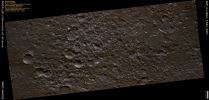
ESP_013810_1485_RED_abrowse.jpgRough and highly cratered Southern Terrain (Natural Colors; credits: Lunexit)58 visitenessun commentoMareKromium
(4 voti)
|
|

ESP_013785_1300_RED_abrowse.jpgColliding Sand Dunes in Aonia Terra (Natural Colors; credits: Lunexit)58 visiteMareKromium
(4 voti)
|
|

ESP_013958_1170_RED_abrowse.jpgDD Tracks in Aonia Terra (Natural Colors; credits: Lunexit)62 visiteThroughout this entire image in Aonia Terra, it is possible to make out regular polygonally shaped patterns. Here on Earth, wherever ice-rich permafrost occurs (soil which stays frozen throughout the year), the ground may crack and form similar patterns to those we see on Mars.
Despite remaining below freezing, changes in seasons and ground temperature cause significant thermal-contraction stress, enough so that the terrain fractures into a honeycomb network of subsurface cracks.
Criss-crossed dark paths wind throughout this Region. Dust Devils, turbulent whirlwinds fueled by rising ground-warmed Atmosphere, track across the Surface, stripping the ground of bright surface dust as they go. Comparable to miniature tornadoes, they efficiently transport Surface Materials on Mars. Left in their passing is the darker coarse-grained soil underneath.
In this image, the Sun is low on the horizon; the shadows make it easier to see the scattered rocks and boulders.
Sometimes, these boulders occur in rings, the remnants of an ancient impact whose crater has since eroded to a flat surface. The boulders are left behind, illustrating where the form of the crater once stood.MareKromium
(4 voti)
|
|

PIA12194.jpgGullies at the Edge of Hale Crater (Natural Colors; credits: NASA/JPL/Univ. of Arizona)58 visiteThis image from the High Resolution Imaging Science Experiment (HiRISE) camera on NASA's Mars Reconnaissance Orbiter shows Gullies near the edge of Hale Crater on Southern Mars. The view covers an area about 1 Km (0,6 miles) across and was taken on Aug. 3, 2009.
Martian Gullies carved into hill slopes and the walls of impact craters were discovered several years ago. Scientists are excited to study these features because, on Earth, they usually form through the action of liquid water -- long thought to be absent on the Martian Surface. Whether liquid water carves gullies under today's cold and dry conditions on Mars is a major question that planetary scientists are trying to answer.
The Gullies pictured here are examples of what a typical Martian Gully looks like. You can see wide V-shaped channels running downhill (from top to bottom) where the material that carved the gully flowed. At the bottom of the channel this material empties out onto a fan-shaped mound. The fans from each gully overlap one other in complicated ways. At the tops of the channels, large amphitheater-shaped alcoves are carved in the rock. The material removed from these alcoves likely flowed downhill to the aprons through the Gullies.
The terrain in this image is at 36,5° South Latitude and 322,7° East Longitude.
Gullies at this site are especially interesting because scientists recently discovered actively changing examples at similar locations. Images separated by several years showed changes in the appearance of some of these Gullies. Today, planetary scientists are using the HiRISE camera to examine Gullies such as the one in this image for change that might provide a clue about whether liquid water occurs on the Surface of Mars.
Full-frame images, catalogued as ESP_014153_1430, are at http://hirise.lpl.arizona.edu/ESP_014153_1430.
The image was taken at 2:21 p.m. Local Mars Time, with the sun 54° above the horizon (S.I.A. = 36°).
The season was Summer in the Southern Hemisphere of Mars.MareKromium
(4 voti)
|
|
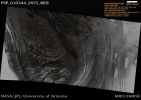
PSP_010344_2655_RED_abrowse.jpgScarp-fed Dark Dunes and NPLD (Natural Colors; credits: Lunexit)60 visiteMultiple levels within the North Polar Layered Deposits (NPLD) are visible in this HiRISE image.
The NPLD are a stack of dusty water-ice layers that are thought to record information about past Martian climates in the same way that Ice-Caps on the Earth record variations in our climate. These Martian layers are visible in the walls of troughs and scarps eroded into the stack.
One such scarp-face is visible on the far left of the full image and decreases in height from left to right.
Scientists continue to debate the length of time required to accumulate this stack of layers with estimates ranging from a few million years to about a billion years. Although we don’t yet know which layer corresponds to which time in Mars’ History, we can still use these layers to try to understand how the climate has changed over this period.
The topmost layers, which are the most recent (far left of the image), are brighter and appear gray-ish in this Natural Color view. They are interpreted to be a mixture of water ice and dust. The lower layering is more complex and appears to be a mixture of bright whiteiish layers (that we think are ice) and dark blue-ish layers (which we think are mostly sand).
A large pit in the center of the image penetrates deeply into this stack of layers and shows these alternating sandy and icy layers extending to depths of hundreds of meters (about 1000 feet).
Erosion of the dark sandy layers releases sandy material which collects into dunes such as the linear example that stretches across the middle of this image.MareKromium
(4 voti)
|
|

ESP_013751_1115_RED_abrowse.jpgDD Tracks in Thyles Rupes (Natural Colors; credits: Lunexit)60 visiteThe Dark Streaks are a result of a Surface-Atmosphere interaction that creates thermally-driven Vortices. These Martian Vortices are giant Dust Devils that “vacuum” the bright Surface dust revealing the darker Subsurface rock.
This image was taken in the late Southern Summer and shows that the Dust Devil direction of movement changes with the winds as the season progresses from Spring to Fall. Dust Devils are sensitive to changes in low-speed ambient winds and will follow the dominant daytime wind direction.
The direction of the Vortex is visible by the scallop pattern that is left behind as a Dust Devil will erase the front part of the circular track as it follows the wind.MareKromium
(4 voti)
|
|
PSP_006962_2215_RED_abrowse.jpgPolygonal Terrain (Natural Colors; credits: Lunexit)71 visitenessun commentoMareKromium
(4 voti)
|
|
| 2235 immagini su 187 pagina(e) |
 |
|
|
|
|
60 | |
|
|
|
|





