| Piú votate - Mars Reconnaissance Orbiter (MRO) |

ESP_014417_0940_RED_abrowse.jpgSouth Polar Residual Cap Monitoring (Natural Colors; credits: Lunexit)57 visitenessun commentoMareKromium
(7 voti)
|
|

ESP_014416_0950_RED_abrowse.jpgSouth Polar Layered Deposits (Natural Colors; credits: Lunexit)55 visitenessun commentoMareKromium
(7 voti)
|
|

ESP_014348_1345_RED_abrowse.jpgUSGS Dune Database Entry Number 0419-449 (Natural Colors; credits: Lunexit)55 visitenessun commentoMareKromium
(7 voti)
|
|

ESP_014351_1995_RED_abrowse.jpgSanta Fé Crater (Natural Colors; credits: Lunexit)58 visitenessun commentoMareKromium
(7 voti)
|
|
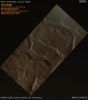
PSP_006980_2610_RED_abrowse~0.jpgChasma Boreale (Natural Colors; credits: Lunexit)59 visitenessun commentoMareKromium
(7 voti)
|
|

ESP_012934_1070_RED_abrowse.jpgTroughs and Scarps in Planum Australe (Natural Colors; credits: Lunar Explorer Italia)57 visiteThis image shows an outcrop of the South Polar Layered Deposits (SPLD). The SPLD consist of layers of ice and admixed dust and make up the bulk of the dome-shaped Planum Australe.
Planum Australe is, in some ways, analogous to the Antarctic ice sheet. Troughs and scarps carved into Planum Australe by erosional processes have exposed SPLD layers within it.
In this image, the darkest area at the bottom of the image is the bottom of the Scarp. Except for the dark material at the bottom of the slope, much of the changes in brightness in this image are due to the lighting angle, such as the direction from which the Sun is illuminating the slope.
Much like ice cores from Greenland and Antarctica and deep sea sediment cores, the icy-dusty layers of the SPLD may have preserved a record of recent Mars Climate History. Understanding that record is a complex process and involves, among many other types of analyses, examining the differences and similarities in appearance between each layer and attempting to classify layer types. This image shows nice examples of different layer textures. But what is especially interesting about this image are the Faults cutting through the Layers. These Faults appear as diagonal lines, on either side of which, the layering is offset.
Note that the Faults are not clean, single lines, but appear in long groups of short lines. What caused these Faults is still under investigation, but, among other possibilities, they could be related to an earlier time when temperatures were higher and the ice was flowing at a much faster rate than it is today.MareKromium
(7 voti)
|
|

ESP_012940_1655_RED_abrowse-01.jpgThe Floor of Eos Chasma (edm - Natural Colors; credits: Lunar Explorer Italia)57 visiteAn Eroded Crater exposes compositional differences below the Surface: the bluish tones are probably fresher, boulder-rich exposures of Basalt and the lighter-toned material near the base of the crater wall may have a different composition.
The bottom of the crater is filled with material that is similarly-toned to the Surface of Eos Chasma, and was likely eroded and transported there by the wind.MareKromium
(7 voti)
|
|

ESP_012774_1080_RED_abrowse-00.jpgDefrosting Dunes in Richardson Crater (ctx frame - Natural Colors; credits: Lunar Explorer Italia)57 visiteThis image shows a portion of the Dunes that fill Richardson Crater, a 55-Km-diameter crater in the South Polar Region of Mars and a frequent repeat target for the HiRISE camera.
During Southern Fall and Winter, these Dunes are coated with seasonal CO2 frost, which then sublimates into the Atmosphere as the temperature rises in Spring and Summer.
This Natural Color shows a boundary between Dunes that are mostly covered with Seasonal Frost and Dunes that have mostly thawed. The color of many dunes on Mars can change dramatically depending on the Season. Frost tends to be very bright in HiRISE images, particularly in the blue-green filter, but the Dune sand itself is very dark.
The dark streaks and spots on the frost-covered regions represent areas that are in the process of thawing out. In some areas, the frost has sublimated away. In others, a small avalanche of sand or dust may have spilled on top of the frost. Some of them may also be patches of coarse-grained ice that are relatively clear so that we can see the sand below. As Spring advances toward Summer in the South on Mars, these Dunes continue to appear darker and more red to HiRISE.
Dunes near the Polar Regions of Mars are studied both by scientists who are interested in the effects of this seasonal cycle of thawing and frosting over, and by scientists who wait for the frost to disappear so that they can study the dunes themselves.MareKromium
(7 voti)
|
|

ESP_011386_2065_RED_abrowse.jpgCollapse Pit in Tractus Fossae (Enhanced and Darkened Natural Colors; credits for the additional process. and color.: Dr Paolo C. Fienga - Lunar Explorer Italia)57 visiteMars Local Time: 15:46 (middle afternoon)
Coord. (centered): 26,1° North Lat. and 259,4° East Long.
Spacecraft altitude: 281,9 Km (such as about 176,2 miles)
Original image scale range: 28,2 cm/pixel (with 1 x 1 binning) so objects ~ 85 cm across are resolved
Map projected scale: 25 cm/pixel
Map projection: EQUIRECTANGULAR
Emission Angle: 6,7°
Phase Angle: 54,4°
Solar Incidence Angle: 61° (meaning that the Sun is about 29° above the Local Horizon)
Solar Longitude: 182,8° (Northern Autumn)
Credits: NASA/JPL/University of Arizona
Additional process. and coloring: Lunar Explorer ItaliaMareKromium
(7 voti)
|
|

PSP_010400_2265_RED_abrowse.jpgExtremely Fresh and Small Crater Cluster (Natural Colors; credits: Lunar Explorer Italia)56 visiteMars Local Time: 15:32 (middle afternoon)
Coord. (centered): 46,3° North Lat. and 176,9° East Long.
Spacecraft altitude: 307,4 Km (such as about 199,1 miles)
Original image scale range: 30,8 cm/pixel (with 1 x 1 binning) so objects ~ 92 cm across are resolved
Map projected scale: 25 cm/pixel
Map projection: EQUIRECTANGULAR
Emission Angle: 10,2°
Phase Angle: 44,0°
Solar Incidence Angle: 54° (meaning that the Sun is about 36° above the Local Horizon)
Solar Longitude: 141,9° (Northern Summer)
Credits: NASA/JPL/University of Arizona
Additional process. and coloring: Lunar Explorer ItaliaMareKromium
(7 voti)
|
|

PSP_010402_1485_RED_abrowse.jpgSample of Intermediate-Toned Area (Natural Colors; credits: Lunar Explorer Italia)55 visiteMars Local Time: 15:42 (middle afternoon)
Coord. (centered): 31,1° South Lat. and 130,7° East Long.
Spacecraft altitude: 255,9 Km (such as about 159,9 miles)
Original image scale range: 51,2 cm/pixel (with 1 x 1 binning) so objects ~1,54 mt across are resolved
Map projected scale: 50 cm/pixel
Map projection: EQUIRECTANGULAR
Emission Angle: 7,6°
Phase Angle: 76,9°
Solar Incidence Angle: 71° (meaning that the Sun is about 19° above the Local Horizon)
Solar Longitude: 142,0° (Northern Summer)
Credits: NASA/JPL/University of Arizona
Additional process. and coloring: Lunar Explorer ItaliaMareKromium
(7 voti)
|
|
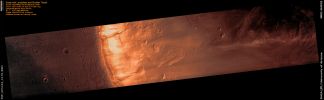
PSP_005343_2170_RED_abrowse-00~0.jpgScarp with Landslides and Boulder Tracks (context frame; natural colors - elab. Lunexit)54 visiteThis observation shows an equatorial scarp (cliff) with possible landslides and boulder tracks.
The cliff has several distinct layers visible near its top. There is a smoother, possibly fine-grained layer on top, underlain by a relatively bright and a dark layer. It is possible that the entire cliff face consists of layers but that erosion has not exposed others yet.
There are two main landslide scars, locations where a landslide has carved into the slope. Both of the scars have boulder tracks, several of which have boulders at their ends as they progress down the slope or reach the end of the slope.MareKromium
(7 voti)
|
|
| 2235 immagini su 187 pagina(e) |
 |
|
|
|
6 | |
|
|
|
|
|





