| Piú votate - Mars Reconnaissance Orbiter (MRO) |
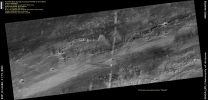
ESP_014380_1775_RED_abrowse-00.jpgExtremely Unusually-looking Skylight, N/E of Arsia Mons (CTX frame)64 visiteDopo il possibile Skylight recentissimamente individuato sulla Luna grazie ad immagini orbitali ottenute della Sonda Nipponica "Kaguya" e dopo i vari "Buchi su Marte" (pozzi da collasso) individuati dalla Sonda MRO nei mesi trascorsi, ecco un nuovo (possibile) Pozzo Marziano la cui forma - come meglio vedrete nei successivi EDM realizzati dal nostro sempre bravo e puntuale Dr Barca - è decisamente inusuale.
In realtà, il collasso non sembra essersi aperto su un normale "lava tube" (ossìa una galleria sotterranea attraverso la quale, un tempo, scorse della lava fusa), bensì sopra una grande caverna sul cui fondo pare proprio che sorga un "mound", ossìa un dosso, una collinetta dai fianchi dolci e smussati.
Una collinetta sotterranea che, come vedrete, occupa tutta la porzione Ovest del pozzo.
I margini del pozzo sono, come sempre, estremamente frastagliati (chiari segni di un cedimento tanto devastante, quanto improvviso) e - presumibilmente - scoscesi.
Attendiamo nuove immagini con diverse geometrie di illuminazione per poter vedere e quindi dire qualcosa di più su questa nuova e, come sempre, affascinante Martian Surface Feature.MareKromium
(4 voti)
|
|
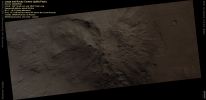
ESP_014410_1470_RED_abrowse.jpgUnnamed Crater with Rocky central Uplift (Natural Colors; credits: Lunexit)58 visitenessun commentoMareKromium
(4 voti)
|
|
ESP_014423_1870_RED_abrowse.jpgSegment of Corinto Crater (Natural Colors; credits: Lunexit)92 visitenessun commentoMareKromium
(4 voti)
|
|

ESP_014266_1385_RED_abrowse.jpgUnnamed Southern Crater with Gullies (Natural Colors; credits: Lunexit)57 visiteTitolo originale del frame:"Context for MOC Image E13-01405 View of Gullied Crater".MareKromium
(4 voti)
|
|
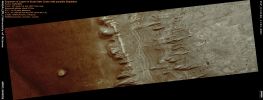
ESP_014186_1745_RED_abrowse.jpgExposures of Layers in South Gale Crater (Natural Colors; credits: Lunexit)58 visitenessun commentoMareKromium
(4 voti)
|
|
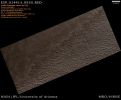
ESP_014413_0930_RED_abrowse-00.jpgRadial Channels carved by CO2 - a.k.a.: The "Spiders" (CTX Frame - Natural Colors; credits: Lunexit)58 visiteMars’ Carbon Dioxide-based Atmosphere partially condenses every Winter to form Polar Caps of Dry Ice (CO2). In the Spring, the evaporation/sublimation of the ice is a dynamic process and carves Channels into the ground as it escapes back into the Atmosphere.
Often these Channels are radial in nature and are colloquially refered to as “Spiders” although the prefered term for these radially-organized channels is “Araneiform” (which means spider-like).MareKromium
(4 voti)
|
|
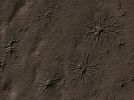
ESP_014413_0930_RED_abrowse-01.jpgRadial Channels carved by CO2 - a.k.a.: The "Spiders" (EDM - Natural Colors; credits: Lunexit)58 visiteIn this EDM we can see, now that all the seasonal frost is gone, the actual appearence of the "Spiders" and we can both use stereo images (when available) or shadows (if any) to measure the depth of the Channels carved into the ground (which, by the way, are usually 1 or 2 meters deep).MareKromium
(4 voti)
|
|

ESP_014169_0955_RED_abrowse.jpgSouthern Patchy Ice (Natural Colors; credits: Lunexit)104 visitenessun commentoMareKromium
(4 voti)
|
|

SubsurfaceIce-PIA12217.jpgSubsurface Ice (Natural Colors; credits: Lunexit)58 visiteThe High Resolution Imaging Science Experiment camera on NASA's Mars Reconnaissance Orbiter took these images of a fresh, 6-meter-wide (20-foot-wide) crater on Mars on Oct. 18, 2008, (left) and on Jan. 14, 2009. Each image is about 35 meters (115 feet) across.
This crater's depth is estimated to be 1,33 meters (4,4 feet).
Images (not shown here) taken by the Thermal Emission Imaging System camera on NASA's Mars Odyssey orbiter and by the Context Camera on the Mars Reconnaissance Orbiter show that the impact that excavated this crater occurred sometime between Dec. 22, 2008 and July 5, 2008.
The impact exposed water ice from below the Surface. It is the bright material visible in this pair of images. The change in appearance from the earlier image to the later one resulted from some of the ice sublimating away during the Martian Northern-Hemisphere Summer, leaving behind dust that had been intermixed with the ice. The thickening layer of dust on top obscured the remaining ice.
This crater is at 43,28° North Latitude and 164,22° East Longitude.MareKromium
(4 voti)
|
|
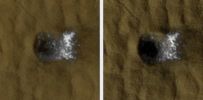
SubsurfaceIce-PIA12219.jpgSubsurface Ice (Natural Colors; credits: Lunexit)58 visiteThis 12-meter-wide (39-foot-wide) Impact Crater located in Mid-Latitude Northern Mars was created by an impact that occurred between July 3, 2004, and June 28, 2008, as bracketed by before-and-after images (not shown here).
The images shown here were taken by the High Resolution Imaging Science Experiment camera on NASA's Mars Reconnaissance Orbiter on Nov. 19, 2008, (left) and on Jan. 8, 2009. Each image is about 35 meters (115 feet) across.
The impact that dug the Crater excavated water ice from below the Surface. It is the bright material visible in this pair of images. This Crater is at 46,16° North Latitude and 188,51° East Longitude.MareKromium
(4 voti)
|
|
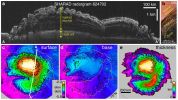
PIA12200.jpgRadar Mapping of Icy Layers Under Mars' North Pole57 visiteThis composite graphic illustrates the use of the Shallow Radar instrument on NASA's Mars Reconnaissance Orbiter for mapping underground ice-rich layers of the North Polar Layered Deposits existing on the North Pole of Mars.
The picture on top of the image-composite, is a radargram from the instrument, showing a cross-section of Mars' North Polar Cap, based on time lags of radio-wave echoes returning from different layers.
The penetrating radar reveals icy layered deposits overlying a basal unit in some areas.
The vertical dimension in the cross section is exaggerated one-hundred-fold compared with the horizontal dimension. The vertical scale bar is one kilometer (3281 feet).
The horizontal scale bar is 100 Km (62 miles).
The Shallow Radar instrument was provided by the Italian Space Agency. Its operations are led by the University of Rome and its data are analyzed by a joint U.S.-Italian science team. NASA's Jet Propulsion Laboratory, a division of the California Institute of Technology in Pasadena, manages the Mars Reconnaissance Orbiter for the NASA Science Mission Directorate, Washington. Lockheed Martin Space Systems, Denver, is the prime contractor for the project and built the spacecraft. The High Resolution Imaging Science Experiment is operated by the University of Arizona, Tucson, and the instrument was built by Ball Aerospace & Technologies Corp., Boulder, Colo.
MareKromium
(4 voti)
|
|
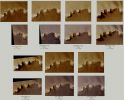
ESP_013954_1780_RED_abrowse-03~0.jpgFading Rover-Tracks near Victoria Crater61 visiteIn this composite image, we show a close-up of the Rover Tracks, as well as 6 previous HiRISE views acquired since June 2007, shortly after Opportunity’s drive.
The span encompasses over a full Mars year, from Southern Spring to the following Summer. Both the Natural Color images at the top of each sequence and the False Color below show a progressive fading of the Tracks over time.
It seems that the Tracks were initially fairly red and then become bluer; this curious effect of color-change might have been due to the weight of the Rover which caused its wheels to push dark granules of rocks and dust into the relatively bright and orangish Martian Soil.
Since then, dark sand has blown out of Victoria and partially covered the Tracks, darkening the Surface.MareKromium
(4 voti)
|
|
| 2235 immagini su 187 pagina(e) |
 |
|
|
|
|
59 | |
|
|
|
|





