| Piú votate - Mars Reconnaissance Orbiter (MRO) |
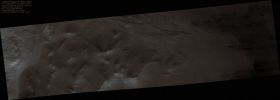
PSP_003176_1745_RED_browse-00~0.jpgLayered Region in Gale Crater (CTX Frame - Natural Colors; credits: Lunexit)57 visiteThis observation shows a portion of the Gale Crater Floor. Gale Crater is approx. 150 Km in diameter and it located in the Elysium Planitia, near the so-called "Dichotomy Boundary" - such as the Martian Region separating the Southern Highlands from the Northern Lowlands.
The paucity of Impact Craters indicates that the Layered Deposits are either very young or that erosion has removed evidence of past cratering.
Wind erosion, in particular, might have modified the Layers by creating relatively sharp edges and rounded depressions. In general, the fact that Layers are found on isolated mounds indicates that some process has eroded an originally more extensive Layered Deposit.
Large Dunes are also visible in the lower portion of the EDM. MareKromium
(4 voti)
|
|

PSP_003176_1745_RED_browse-01~0.jpgLayered Region in Gale Crater (EDM - Natural Colors; credits: Lunexit)59 visiteThis EDM shows several Light-Toned Layers.
The origin of the sediments composing the Layers is unknown and could have included deposition in an ancient flood or lake or the deposition of windblown particles such as Dust or Volcanic Ash.
The relatively uniform character of the Layers and the manner of erosion suggests that the sediments are fine-grained. MareKromium
(4 voti)
|
|
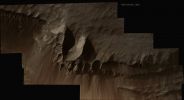
PSP_001456_1695_RED_abrowse-01.jpgLight Layered Deposits in Valles Marineris Region (EDM - Superdef. + Natural Colors; credits: Dr M. Faccin & Lunexit)59 visiteL'estrazione del dettaglio in formato JP2 e Superdefinizione è del Dr Faccin; la colorizzazione Multispettrale e la calibrazione sono del Dr Fienga. A nostro parere, il risultato si commenta da solo...MareKromium
(4 voti)
|
|
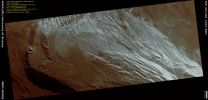
PSP_001456_1695_RED_abrowse-00.jpgLight Layered Deposits in Valles Marineris Region (CTX Frame - Natural Colors; credits: Lunexit)63 visiteThis image shows bright Layered Deposits near the junction of Coprates Chasma and Melas Chasma, both part of the Valles Marineris Canyon System.
The Outcrop visible in this frame is found in a wide Alcove located in the Northern Wall and it forms a broad mound which is several kilometers wide; dark, wind-blown materials cover it in places.
Similar light-toned rock occurs in many places of the Valles Marineris.
An important question is when these materials formed: were they deposited within the Troughs after they opened and then eroded, or are they remnants of the Wall Rock?
Analysis of the orientation of the layers using HiRISE images may help scientists answer this question.
There are no fresh Impact Craters preserved on the Outcrop Surface, suggesting that the Layered Deposits are being eroded rapidly enough to erase the Craters.
In many places, the light rocks have regular fractures called "Joints". Joints are common in Earthly rocks and HiRISE images show them in many places on Mars as well.
These Joints can provide information about the forces that affected - in time - the rocks of this area, and therefore they could also help us to (at least partially) unravel the Geologic History of Mars in general and this Outcrop in particular.MareKromium
(4 voti)
|
|

PSP_001510_2195_RED_abrowse.jpgAlba Patera (Natural Colors; credits: Lunexit)55 visiteThis HiRISE image shows a small portion of the Rim of the Caldera at the top of the Volcano Alba Patera. This Volcano has shallower slopes than most of the other large Volcanoes on Mars. Unfortunately, this image is not able to help us understand what is unique about Alba Patera because of the thick Dust Cover that covers almost every surface detail but, instead, it shows that the Dust has been carved into streamlined shapes by the wind, cut by small Landslides.
Interestingly, there are some isolated patches that appear smooth and undisturbed by the wind.MareKromium
(4 voti)
|
|

PSP_001942_2310_RED_abrowse-01.jpgSigns of Fluids and Ice in an Unnamed Crater in Acidalia Planitia (EDM - Absolute Natural Colors; credits for the additional process. and color.: Dr Paolo C. Fienga - Lunexit Team) 57 visiteThe South-looking (or Equator facing) walls of this Unnamed Crater are cut by numerous Gullies such as the ones shown here (500 x 600 mt or 550 x 650 yards), with well developed Alcoves, sinuous Channels and Terminal Fan Deposits.
These Gullies seem to originate at the same height, suggesting that the carving agent may have emanated from one single layer exposed in the Crater's Wall.
Contrastingly, no Gullies are observed in the North-looking (or Pole facing) wall of this Crater. Terrestrial Gullies very similar to the ones shown in this image are produced by surface water.
The arrows in this frame show fissures that may indicate detachment of surficial materials possibly held together by subsurface ice, sliding en masse down the crater's wall.MareKromium
(4 voti)
|
|

ESP_013557_1245_RED_abrowse-02.jpgThe "Argyre Lineae" (EDM n.1 - Natural Colors; credits: Dr G. Barca & Lunexit)58 visite...Probabilmente, anche se nel CTX Frame queste "Linee" apparivano più nette e più profonde, si tratta davvero solo di DD Tracks.
Molto probabilmente.MareKromium
(4 voti)
|
|

ESP_013557_1245_RED_abrowse-07.jpgThe "Argyre Lineae" (EDM n.4 - Natural Colors; credits: Dr G. Barca & Lunexit)58 visitenessun commentoMareKromium
(4 voti)
|
|

ESP_013557_1245_RED_abrowse-01.jpgThe "Argyre Lineae" and the "Lineae" seen on the Jovian moon "Europa": a comparison (CTX-Frame - image-mosaic by Lunexit)65 visitePer il momento, il nostro parallelo è solo un azzardo, giustificato - si fa per dire... - dalla notevole somiglianza esistente fra le linee che caratterizzano la Superficie della Luna Gioviana "Europa" (pensate, ad esempio, alla "Minos Linea" - in basso a Dx - che la NASA stessa ritiene essere la "Prova Geologica" dell'esistenza di un Oceano Sotterraneo - liquido! - situato ad un centinaio di Km di profondità) e queste "linee" che caratterizzano il Terreno Marziano intorno alla Latitudine 55° Sud. e 32° Est - Regione della Pianura di Argyre, a circa 2° di Lat. di distanza dal Distretto Montuoso di Charitum (il quale costituisce, nella sua interezza, il margine - Rim - Sud del Bacino di Argyre).
Certo, la NASA dice che queste "Linee Marziane" sono i soliti segni lasciati dal transito dei Dust Devils ma, se osservate con attenzione, potreste notare che esistono - invece - delle nette ed indubitabili differenze fra queste "Linee di Argyre" ed i DD-Tracks.
(nota: la definizione di questi segni della Superficie Marziana come "Argyre Lineae" è stata operata da Lunexit e non dalla NASA)MareKromium
(4 voti)
|
|

ESP_014262_1510_RED_abrowse.jpgEjecta Blanket - West Side of Zumba Crater (Natural Colors; credits: Lunexit)62 visitenessun commentoMareKromium
(4 voti)
|
|
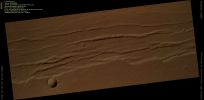
ESP_014278_2050_RED_abrowse.jpgContact between Lava Flows (Natural Colors; credits: Lunexit)58 visitenessun commentoMareKromium
(4 voti)
|
|
ESP_014296_1255_RED_abrowse.jpgClear signs of a recent Seepage (Natural Colors; credits: Lunexit)59 visitenessun commentoMareKromium
(4 voti)
|
|
| 2235 immagini su 187 pagina(e) |
 |
|
|
|
|
57 | |
|
|
|
|





