| Piú votate - Mars Reconnaissance Orbiter (MRO) |

ESP_016173_2005_RED_abrowse-3.jpgSmall Shield Volcano with "Summit Caldera" (Saturated and Enhanced Natural Colors; credits: Dr M. Faccin - Lunexit Team)56 visiteAlthough there are a few truly giant Shield Volcanoes on Mars, there are also many smaller ones.
There's a strong interest in imaging the Volcanic Vent Regions of Mars, in order to understand not only the Volcanic Processes themselves, but also to search for any signs of recent activity.
In fact, it has been suggested that active volcanism is one possible explanation for the Methane gas that has been detected in the Atmosphere of Mars.
This HiRISE image shows that the Summit Caldera of a small Shield Volcano is mantled by Dust and covered by tiny Impact Craters. And it is just this last element (such as the existence of Impact Craters all over the Caldera) the one that allows us to believe that there are basically no chances that the imaged Volcano was active recently enough to affect the Atmosphere of Mars through the release of any gas whatsoever.MareKromium
(4 voti)
|
|
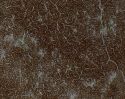
ESP_016160_2485_cut1.jpgPhoenix Lander in Springtime (Natural Colors; credits: Dr Paolo C. Fienga - Lunexit Team)59 visiteWith early Spring at the Phoenix Landing Site comes the progressive sublimation of the Carbon Dioxide frost that has blanketed the Lander and surrounding terrain throughout the Winter.
During the long Polar-Winter Night, atmospheric CO2 freezes onto the Surface building up a layer of frost roughly 30 cm (about one foot) thick.
In the Spring this frost returns to the Atmosphere as gas (sublimates) over the course of several months. This image, part of a seasonal frost monitoring sequence, shows some areas of bare ground are beginning to be exposed. However, extensive frost patches remain in the topographic lows, such as the Troughs of the local polygonally patterned surface.
Even when the frost has completely sublimated, it must be underlined that the Dust deposited during the Winter could actually obscure (and "erase", in a view from atop) any and all the "Man-Made Features" that are still barely visible here (Backshell and Parachute, Heat-Shield and Lander).
The Parachute that is attached to the Backshell, in fact, is not apparent in this image, and we'll see if it reappears in later images.
Also gone are the dark halos around Lander, Backshell and Heat-Shield - again, this is due to seasonal frost and/or dust.
This and future images will help calibrate expectations for finding the Mars Polar Lander hardware which encountered Mars in 1999.MareKromium
(4 voti)
|
|

PSP_007962_2635_RED_abrowse-00.jpgNorthern Dunes (CTX Frame - Possible Natural Colors; credits: Dr Paolo C. Fienga - Lunexit Team)57 visiteThere is a vast Region of Sand Dunes at high Northern Latitudes on Mars.
In Winter, a layer of CO2 ice covers the Dunes, and in the Spring - as the Sun warms the ice - it sublimates.
This is a very active process causing the sand to dislodge from the Dunes' Crests to cascade, often (NOT always!) forming Dark Streaks.MareKromium
(4 voti)
|
|
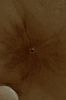
ESP_015962_1695_RED_abrowse-01.jpgRelatively fresh Impact Crater (EDM n.1 - Natural Colors; credits: Dr Paolo C. Fienga - Lunexit Team)62 visitenessun commentoMareKromium
(4 voti)
|
|
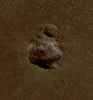
ESP_015962_1695_RED_abrowse-02.jpgRelatively fresh Impact Crater (EDM n.2 - Natural Colors; credits: Dr Paolo C. Fienga - Lunexit Team)62 visitenessun commentoMareKromium
(4 voti)
|
|
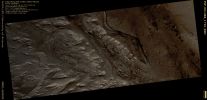
PSP_001488_1750_RED_abrowse.jpgEdge along Gale Craters's Interior Mound (Natural Colors; credits: Dr Paolo C. Fienga - Lunexit Team)58 visiteGale Crater is one of several craters around the Equator that show the presence of Light-Toned Layered Deposits (or LTLD). This HiRISE image covers the northern edge of the LTLD in the Central Mound of Gale Crater, as well as a small portion of the Crater Floor. The right side of the image shows a relatively flat surface with some Impact Craters.
Moving to the left (Southward), there is a large Canyon where Dark Sands have accumulated and formed Ripples and Dunes.
As one moves further to the South, the LTLD rises upward in topography and Layering is visible in some locations. The Surface of the LTLD is very fractured, producing meter-size blocks.
The fact that we don't see many loose rocks along the Surface suggests that the rocks are quickly being destroyed by winds due to their fragile nature.
Resistant Hills, on the other side, tend to be elongated, which is consistent with upslope or downslope winds eroding the rocks themselves.MareKromium
(4 voti)
|
|
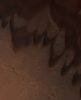
ESP_014404_1765_RED_abrowse-01.jpgEquatorial Martian Barchans (EDM - Natural Colors; credits: NASA/JPL/Univ. of Arizona)57 visiteBarchan Dunes are common on both Earth and Mars. These Dunes are very distinctive in shape, and are important because they can tell scientists about the environment in which they formed.
Barchans form in wind regimes that blow in one Dominant Direction. The ridged arcs of sand that define the Barchan Dunes end in horns that point downwind. Sand is transported up the broad, relatively shallow windward slopes and once it overtops the Dune Crest, the sand falls down a shorter steeper slope between the horns, known as the "Slip Face". Over time, the Barchans migrate downwind, following their horns.
This HiRISE image shows an example of several Barchans merging to form an even larger Barchan Dune. This can happen through a variety of circumstances, such as when smaller, faster dunes collide with larger, slower-moving dunes that absorb them, resulting in single, larger dunes. The distance between the merging horns of the large dune in this highlighted region is a little over 500 meters (about 1600 feet).
Coord.: 3,3° South Lat. and 307,6° East Long.
Spacecraft altitude: about 268 Km
M.L.T.: 14:17 (early afternoon)
S.I.A.: 36° (with the Sun about 54° abov the Local Horizon)
MareKromium
(4 voti)
|
|

PSP_001666_1530_RED.jpgHolden Crater (Natural Colors; credits: Lunexit)57 visitenessun commentoMareKromium
(4 voti)
|
|
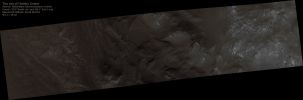
PSP_003710_1530_RED_browse~0.jpgHolden Crater's Rim (Natural Colors; credits: Lunexit)60 visiteThe formation of the approximately 150 Km diameter Holden Crater interrupted the Northward flowing Uzboi Vallis Channel System. Relief associated with the Rim of Holden effectively blocked the Channel.
HiRISE image PSP_003710_1530 covers the portion of Holden Crater's Rim where it was overtopped by water that had backed up in Uzboi Vallis to the South. Water flowing over the Rim in multiple locations eventually focused on a single Channel that then cut deeply into the Rim.
After the impounded water drained into the Crater, the steep Wall on the East side of the main Channel collapsed in a Landslide that remains visible along the Floor.
Several Outcroppings of variably bright material are visible in the scar produced by the Slide. MareKromium
(4 voti)
|
|
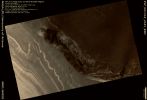
PSP_001334_2645_RED_abrowse-00.jpgNorth Polar Layered Deposits in Head Scarp of Chasma Boreale (CTX Frame - Natural Colors; credits: Lunexit)58 visitenessun commentoMareKromium
(4 voti)
|
|
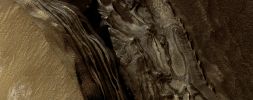
PSP_001334_2645_RED_abrowse-01.jpgNorth Polar Layered Deposits in Head Scarp of Chasma Boreale (EDM - Natural Colors; credits: Lunexit)58 visiteThis EDM shows the NPLD at top and darker materials at bottom exposed in a Scarp at the head of Chasma Boreale, a large canyon eroded into the Layered Deposits.
The Polar Layered Deposits appear of a brown/reddish color because of dust mixed within them, but they are ice-rich as indicated by previous observations. The water ice in the Layered Deposits is probably responsible for the pattern of fractures seen near the top of the scarp.
The darker material below the Layered Deposits may have been deposited as sand dunes, as indicated by the cross-bedding (truncation of curved lines) seen near the middle of the Scarp.
It appears that brighter, ice-rich layers were deposited between the dark dunes in places.
Exposures such as these are useful in understanding the recent climate variations that are likely recorded in the Polar Layered Deposits.MareKromium
(4 voti)
|
|
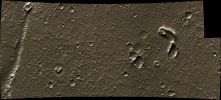
PSP_001578_2000-MF-LXT.jpgFaulting in Amazonis Planitia (Natural Colors; credits: Dr M. Faccin & Lunexit)57 visiteThis HiRISE image is centered on a long "Strike-Slip Fault" on the Young Plains of the Amazonis Planitai Region.
The most famous example of a Strike-Slip Fault on Planet Earth is probably the San Andreas Fault in California.
The Plains of Amazonis, as seen here, show only a few large and medium-sized craters, indicating that the Surface has been "remodeled" relatively recently.
The fact that the Fault visible here has cut the Plains, indicates that tectonic processes (as well as Marsquakes) have occurred even more recently (whereas that the word "recently", on Mars, is a relative term - since it is likely that both the Surface and the Fault are more than a billion years old.
Other interesting features that can be seen in this frame are "Moats" (---> fossi e fossati) - visible around Knobs (---> colline a ceppo) - and a few Impact Craters.MareKromium
(4 voti)
|
|
| 2235 immagini su 187 pagina(e) |
 |
|
|
|
|
56 | |
|
|
|
|





