| Piú votate - Mars Reconnaissance Orbiter (MRO) |
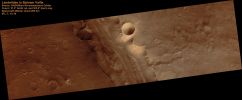
PSP_003605_2015_RED_browse~0.jpgLandslides along the Walls of Bahram Vallis (Absolute Natural Colors; credits for the additional process. and color.: Dr Paolo C. Fienga - Lunexit Team)59 visiteLandslides are one of the most spectacular mass wasting features on Mars in terms of their areal extent and volume. Some of the best preserved landslides are in the Valles Marineris canyon system, but that's not the only place we see evidence for landslides.
This image of Bahram Vallis, a valley along the edges of the circum-Chyrse Basin, has large mounds of material at the base of the valley floor. These deposits of material are different from those deposits seen at Valles Marineris. They do not have a "ribbed" surface of transverse ridges. They also do not have a semi-circular distal margin giving it a lobate appearance and they have not travelled for many kilometers away from their source region like most Valles Marineris landslides do.
These particular deposits have the characteristic shape of rotational landslides or slumps on Earth where material along the entire wall slumps down and piles debris at the base of the slope, much like a person who slumps down the back of a chair. Right at the cliff edge at the top of the slope, the shape of the area where the valley wall gave way to a landslide is not straight, but rather curved or semi-circular. This is typical of large landslides where the failure area has an arcuate "crown" shape. The fact that landslides have occurred here indicates that the valley walls are not stable and the materials respond to Martian gravity with mass movements.
Scientists studying landslides can use these images along with topographic data to model how the wall failed, which can give clues to the nature of the materials (type, strength, etc.) in this region. Another consequence of landslide activity in Bahram Vallis is that the overall width of the valley will increase over time. MareKromium
(4 voti)
|
|

PSP_001936_1370_RED_abrowse-01.jpgScarp and Channels in a Crater in Terra Cimmeria (Natural Colors; credits: Dr Paolo C. Fienga - Lunexit Team)63 visitenessun commentoMareKromium
(4 voti)
|
|

PSP_001816_1410_RED_abrowse-00.jpgGullies and arcuate Ridges in Terra Cimmeria (Natural Colors; credits for the additional process. and color.: Dr Paolo C. Fienga - Lunexit Team)56 visitenessun commentoMareKromium
(4 voti)
|
|
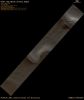
PSP_002804_0930_RED_abrowse.jpgSouth Polar Trough (Natural Colors; credits for the additional process. and color.: Dr Paolo C. Fienga - Lunexit Team)58 visiteThis image is taken in one of the Troughs that are typical within the stack of Martian South Polar Layered Deposits (SPLD).
Viewed at low resolution, sequences of layers of different albedos, or brightnesses, and/or textures can be seen. At full resolution, the different tones and textures can be seen to be due to different shapes and sizes of polygonal fractures, surface knobiness, and surface cover and concentration of frost, often within polygonal fractures.
Faint criss-crossing Troughs and Dimples can be discerned on even the smoothest surfaces. Perhaps the most notable features in the image are the distinct round to heart-shaped to blob-shaped depressions scattered throughout the smooth areas, dubbed "Swiss-Cheese Terrain".
The smooth material is solid CO2 ice representing the uppermost layer of the South Polar Residual Cap. The retention of CO2 ice throughout the year by the Southern Polar Cap is one characteristic that distinguishes it significantly from Mars' North Polar Cap. The Swiss-Cheese depressions are areas in which sublimation of the CO2 ice was initiated at a particular location and spread laterally from that point, creating rounded depressions typically several to 10 meters deep.
In HiRISE images, it is evident that this CO2-rich material is actually comprised of several individual horizontal layers. In this particular location, several images had been acquired over the previous decade by the Mars Orbiter Camera (MOC) at slightly lower resolutions. In a series of those MOC images, the Swiss-Cheese depressions were seen to enlarge radially, or grow over a time period of several years.
Part of the HiRISE imaging campaign includes continued monitoring of these features (at higher resolution) to understand their growth rates and patterns. In turn, we can better comprehend the role of CO2 — the main component of the Martian Atmosphere — in the current Martian Climate Regime.MareKromium
(4 voti)
|
|

ESP_017900_2185_RED_abrowse.jpgUnnamed Impact Crater cut by Faults (Natural Colors; credits: Dr Paolo C. Fienga - Lunexit Team)56 visiteThis image reveals an interesting coincidence of two important Planetary Processes: Cratering by Impacts and Tectonism.
Here we have an Impact Crater (the large round feature, approx. 6,2 Km, or 3,9 miles, across) that intersects a series of Faults (the linear features). The Faults are seen to cut the circular Rim of the Impact Crater. Also, the impact did not destroy the adjacent faults. These observations tell us that the Fault was active after the impact occurred.
In addition, by measuring the distance of offset of the different pieces of the Crater Rim separated by the Fault Line (assuming that when the Crater formed, the Rim was continuous around its circumference), the amount of movement along the Fault can be estimated, laterally and vertically. Faults like these cause Troughs to form, called "Graben", of which the heavily shadowed one is a good example. The center (shadowed) section has been dropped downwards relative to the surrounding Terrain, forming the Trough.
It is also clear that parts of the Crater Rim are lower than others where the Graben intersects the Crater. The sides of the Graben (the Faults forming the Walls of the Trough) are sloped, so that the dropped-down part of the Crater Rim has also moved horizontally away from its higher part. The combined down-dropping and moving apart indicates that the land here is being stretched and pulled apart, called "extension". By measuring the amount of offset on all the Faults, we can estimate how much extension has occurred in this part of the Planet.
This location is especially helpful because, as mentioned above, we have a good knowledge of the “before-faulting” configuration of the land, in which the Crater Rim was continuous. Finally, it is interesting that there is no sign of the Fault on the Floor of the Crater – its Floor has not been faulted and no part is down-dropped and stretched apart as the Rim has been. This indicates that some infilling of the Crater (perhaps by Lava or Airborne Sediment) has likely occurred since the Fault was active, burying the trace of the Fault and representing a third stage of geologic history in this area.MareKromium
(4 voti)
|
|

PSP_002419_1675_RED_abrowse-00.jpgLayers and Dark Debris in Melas Chasma (CTX Frame - Natural Colors; credits for the additional process. and color.: Dr Paolo C. Fienga - Lunexit Team)104 visitenessun commentoMareKromium
(4 voti)
|
|

North_Polar_Layered_Deposits-PIA12997.jpgNorth Polar Layered Deposits (Natural Colors; credits for the additional process. and color.: Dr Paolo C. Fienga - Lunexit Team)69 visiteThe Martian North Polar Layered Deposits (NPLD) are an ice sheet much like the Greenland ice sheet on the Earth. Just as with the ice sheet in Greenland this Martian ice sheet contains many layers that record variations in the Martian Climate. Sometimes icy layers can be ablated away during warm climates. Later the ice sheet can be buried by new ice layers and grow in size again. It's likely that many of these cycles have occurred over the ice sheet's history.
The High Resolution Imaging Science Experiment (HiRISE) camera on NASA's Mars Reconnaissance Orbiter recorded this image of NPLD on March 11, 2010. The target for this observation was a suggestion submitted by Greg Clements through the camera team's HiWish public-suggestion program. For more information about how to submit target suggestions, see http://uahirise.org/hiwish/.
Fluctuations in the thickness of the ice sheet are most pronounced at the edges of the sheet, where this HiRISE image was taken. The ice sheet ends here in a gentle scarp that slopes about 8° downhill from bottom to top in this image. The layering within the ice is exposed on this Sloping Surface. The thickness of the ice here is about 1 Km (approx. 3300 feet). Scientists are analyzing these layers to see what information they might hold regarding previous Martian Climates.
This image covers a swath of ground about 1 Km (approx. two-thirds of a mile) wide.
It is a portion of HiRISE observation ESP_016973_2595, which is centered at 79,30° North Latitude and 351,46° East Longitude.
The season on Mars is Northern-Hemisphere Spring.MareKromium
(4 voti)
|
|

ESP_016276_2575_RED_abrowse.jpgTranslucent Ice-Patches in the Northern Plains (possible Natural Colors; credits: Dr Paolo C. Fienga - Lunexit Team)57 visitenessun commentoMareKromium
(4 voti)
|
|
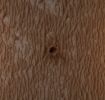
ESP_016644_1780_RED_abrowse-01.jpgOn the Edge of Concepción (EDM - Natural Colors; credits: Dr Paolo C. Fienga - Lunexit Team)57 visiteThis EDM shows the Mars Exploration Rover Opportunity perched on the edge of Concepción Crater in Meridiani Planum, Mars.
Concepción Crater is a fresh, 10 meter-diameter crater with dark rays that clearly overprint the North trending Aeolian Ripples.
The dark rays are produced by shadows cast by blocky ejecta and the presence of the rays and similar relationships with other fresh craters in Meridiani Planum indicate that this is likely the youngest crater visited by either Rover on Mars (estimated to have impacted thousands to tens of thousands of years ago).MareKromium
(4 voti)
|
|
Polar_Polygons-PIA07354.jpgPolar Polygons (Natural Colors; credits: Dr Paolo C. Fienga - Lunexit Team)62 visitenessun commentoMareKromium
(4 voti)
|
|

Slope_Streaks-MRO.jpgSlope Streaks (Natural Colors; credits: Dr Paolo C. Fienga - Lunexit Team)58 visitenessun commentoMareKromium
(4 voti)
|
|

PSP_001700_2505_RED_abrowse-00.jpgThe "Frozen pseudo-Lake" of Vastitas Borealis (CTX Frame - Natural Colors; credits: Dr Paolo C. Fienga - Lunexit Team)71 visiteThe right side (Dx) of this observation shows a portion of a "Frost Patch" on a mound inside a Northern Hemisphere Crater. This is the same frosted mound shown in this image. The Frost Patch has remained largely stable at least since the Viking era (late 1970s).
The bright frost region is bounded by a Dunefield on the N/E. Several sizes of Dunes are visible. The size classes probably represent generations of dunes that formed under a variety of dominant wind conditions.
The EDM shows the Dunes and Frost Boundary up-close. The Frost is largely absent over the Dunes and is more stable over the ground that does not have dune-shaped landforms.
Note Lunexit: il Cratere, che la NASA stessa si affrettò a battezzare "Louth" (nonostante fosse ancora pending l'approvazione del nome da parte dell'International Astronomical Union (IAU) - un'Entità tanto enorme e pesante quanto, nei fatti, inutile...), è tornato ad essere un Cratere senza Nome dell'Emisfero Nord.
Il "presunto" Lago ghiacciato è diventato un "Frost Patch" (lett.: una "chiazza di brina") e le sue caratterizzazioni - ed implicazioni, come a suo tempo espresse dall'ESA - sono...sparite! Nelle pagine NASA (ed ESA, recenti) non vi è traccia di investigazioni o analisi più approfondite su questo - comunque intrigante - Rilievo Superficiale. Nulla.
Il possibile Laghetto del Cratere Louth, Regione di Vastitas Borealis - Marte -, di fatto non solo non esiste (e su questo potremmo anche essere d'accordo, sebbene a malincuore), ma non è MAI esistito (e su questo modo di pensare e di agire, invece, NON SIAMO ASSOLUTAMENTE D'ACCORDO: perchè è scorretto, intrinsecamente contraddittorio, nonchè scientificamente e logicamente viziato).
Curioso, quindi, (e "curioso" è un puro eufemismo) il modo in cui tutta questa storia è stata (mal)trattata dalle "Potenze Spaziali"... Veramente curioso.MareKromium
(4 voti)
|
|
| 2235 immagini su 187 pagina(e) |
 |
|
|
|
|
55 | |
|
|
|
|





