| Piú votate - Mars Reconnaissance Orbiter (MRO) |
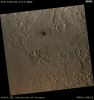
ESP_019195_2175_RED_abrowse.jpgRecent Impact (Natural Colors; credits for the additional process. and color.: Dr Paolo C. Fienga - Lunexit Team)134 visiteAcquisition Date: 31 August 2010
Mars Local Time (MLT): 15:22 (Early Afternoon)
Latitude (centered): 37,3° North
Longitude (East): 182,2°
Range to Target Site: 298,4 Km (such as about 186,5 miles)
Original image scale range: 29,8 cm/pixel (with 1 x 1 binning) so objects ~90 cm across are resolved
Map projected scale: 25 cm/pixel
Map projection: EQUIRECTANGULAR
Emission angle: 2,5°
Sun-Mars-Spacecraft (or Phase) Angle: 52,0°
Solar Incidence Angle: 49° (with the Sun about 41° above the Local Horizon)
Solar Longitude: 141,1° - Northern SummerMareKromium
(4 voti)
|
|
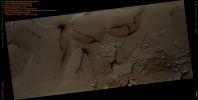
PSP_003597_1765_RED_abrowse-PCF-LXTT2.jpgPossible Smoke Emissions in Elysium Planitia (Natural Colors; credits for the additional process. and color.: Dr Paolo C. Fienga - Lunexit Team)124 visiteCaption NASA:"This observation shows fractured Mounds on the Southern Edge of Elysium Planitia. The Mounds are typically a few Km in diameter and about 200 feet tall. The fractures that crisscross their Surfaces are dilational (extensional) in nature, suggesting that the Mounds formed by localized uplift (i.e., they were pushed up from below).
The Mounds are probably composed of solidified Lava. They are contiguous with, and texturally similar to, the flood Lavas that blanket much of Elysium Planitia, and, where dilation cracks provide cross-sectional exposure, the uplifted material is rocky.
Patches of mechanically weak and disrupted material overlie the rocky mound material. This is particularly conspicuous in the Northeast corner of the HiRISE image. These patches may be remnants of a layer that was once more continuous but has been extensively eroded. Smooth Lava Plains fill the low-lying areas between the Mounds. They are riddled with sinuous pressure ridges.
The entire area is covered by a relatively thin layer of Dust and Sand".
Nota Lunexit: l'elemento più suggestivo dell'intero frame, completamente tralasciato dal commento NASA "Ufficiale", attiene quelle che a noi sembrano delle (evidenti e, riteniamo, anche piuttosto recenti) "emissioni di fumi", ben visibili in corrispondenza di quasi tutti i maggiori punti di fratturazione. E' proprio il dato, confermato dalla NASA stessa, per cui l'intera area ripresa è coperta da un sottile strato di sabbia e polvere (la quale dovrebbe conferire un colore denso e, soprattutto, uniforme a tutto il paesaggio) che ci fa ritenere recenti (se non recentissime) le summenzionate zone più scure ("macchiate", di fatto) e, dunque, molto probabilmente interessate da eventuali e persistenti emissioni di fumi, vapori (sulfurei?) e ceneri vulcaniche.MareKromium
(4 voti)
|
|

PSP_003647_1745_RED_browse-00.jpgCanditate Cavern Entrance (CTX Frame - Absolute Natural Colors; credits for the additional process. and color.: Dr Paolo C. Fienga - Lunexit Team)89 visiteThis image shows a very dark spot on an otherwise relatively bright dusty Lava Plain to the North-East of Arsia Mons, one of the four giant Tharsis volcanoes.
This is NOT an Impact Crater as it lacks a Raised Rim or Ejecta Blanket. What's amazing is that we cannot see any detail in the shadow. The HiRISE camera is very sensitive and we can see details in almost any shadow on Mars, but not here.
We also cannot see the deep walls of the Pit. The best interpretation is that this is a Collapse Pit into a Cavern or at least a pit with Overhanging Walls. We cannot see the Walls because they are either perfectly vertical and extremely dark or, more likely, overhanging.
The Pit must be very deep to prevent detection of the floor from skylight, which is quite bright on Mars.MareKromium
(4 voti)
|
|
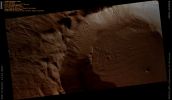
ESP_018495_1410_RED_abrowse.jpgGullied Crater Wall (Natural Colors; credits for the additional process. and color.: Dr Paolo C. Fienga - Lunexit Team)56 visitenessun commentoMareKromium
(4 voti)
|
|
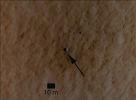
ESP_018273_2245_RED_abrowse-01.jpgPossible Water-Ice in a "fresh" Crater (EDM - Natural Colors; credits for the additional process. and color.: Dr Paolo C. Fienga - Lunexit Team)58 visitenessun commentoMareKromium
(4 voti)
|
|
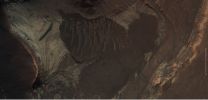
ESP_014287_1685_RED_abrowse-MF-LXTT.jpgNoctis Labyrinthus (EDM - possible True Colors; credits for the additional process. and color.: Dr Marco Faccin - Lunexit Team)75 visitenessun commentoMareKromium
(4 voti)
|
|

PSP_002946_1765_RED_abrowse-01.jpgInterior Layered Deposits (ILD) in Juventae Chasma (EDM - Natural Colors; credits for the additonal process. and color.: Dr Paolo C. Fienga - Lunexit Team)57 visitenessun commentoMareKromium
(4 voti)
|
|

PSP_002840_1855_RED_abrowse-00.jpgMeanders in Nanedi Valles (Natural Colors; credits for the additional process. and color.: Dr Paolo C. Fienga - Lunexit Team)59 visiteThis observation shows a portion of Nanedi Valles, an equatorial Martian valley network.
Valley networks are thought to have formed by groundwater sapping either in conjunction with an ice layer to cover the running water or during a past warmer, wetter climate regime on Mars. Glacial activity has also been proposed to form the valley networks.
Groundwater sapping is the leading theory because of the morphology of the valleys. They commonly have approximately constant width along their reaches, as seen here, as well as theater shaped heads, as seen in the tributary valley in the bottom right of the scene. The meandering nature of valleys suggests persistent or repeated flow as required to form meanders in streams on Earth.
The subimage shows a potential remnant channel seen on the floor of Nanedi Valles just below the center of the image. If this is a remnant channel, it suggests that there was either repeated or waning flows in this valley. Winding dunes and abundant impact craters are found throughout the valley, as well as within this putative channel.
Dunes are thought to be transient features on Mars, although no movement has been detected to date. It is interesting to note that some of the dunes are superposed by craters indicating that the dunes were stable long enough for craters to form and not be erased.
It is possible that the craters on top of the dunes are secondary craters that formed as a product of a larger impact. Secondary craters from a single impact are clustered in space and form almost simultaneously, implying that the dunes were stable for a time period—long enough for a single crater, rather than multiple craters, to form.
MareKromium
(4 voti)
|
|
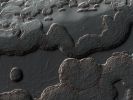
SPLD-PIA13269-0.jpgSouth Polar Layered Deposits and Residual Cap (Natural Colors; credits for the additional process. and color.: NASA/JPL-Caltech and Univ. of Arizona)58 visiteThis image from NASA's Mars Reconnaissance Orbiter (MRO) shows a variety of surface textures within the South Polar Residual Cap of Mars.
It was taken during the Southern Spring, when the Surface was covered by seasonal CO2 Frost, so that Surface relief is easily seen. Illumination is from the bottom left, highlighting long Troughs at to the right and round pits and irregular Mesas to the left of center.
These unique landforms are common in the South Polar Residual Cap, which is known from previous Mars Global Surveyor images to be eroding rapidly in places. Right of center, SPLDs are exposed on a Sun-facing Scarp. These Deposits are older than the Residual Ice Cap, and the Layers are thought to record climate variations on Mars similar to ice ages on Earth. MareKromium
(4 voti)
|
|
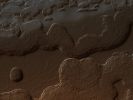
SPLD-PIA13269-PCF-LXTT2.jpgSouth Polar Layered Deposits and Residual Cap (Absolute Natural Colors; credits for the additional process. and color.: Dr Paolo C. Fienga - Lunexit Team)75 visiteThis image from NASA's Mars Reconnaissance Orbiter (MRO) shows a variety of surface textures within the South Polar Residual Cap of Mars.
It was taken during the Southern Spring, when the Surface was covered by seasonal CO2 Frost, so that Surface relief is easily seen. Illumination is from the bottom left, highlighting long Troughs at to the right and round pits and irregular Mesas to the left of center.
These unique landforms are common in the South Polar Residual Cap, which is known from previous Mars Global Surveyor images to be eroding rapidly in places. Right of center, SPLDs are exposed on a Sun-facing Scarp. These Deposits are older than the Residual Ice Cap, and the Layers are thought to record climate variations on Mars similar to ice ages on Earth. MareKromium
(4 voti)
|
|
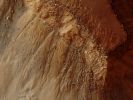
Gullies-_Gorgonum_Chaos-PIA13267.jpgGullies in Gorgonum Chaos (Natural Colors; credits for the additional process. and color.: Dr Paolo C. Fienga - Lunexit Team)58 visiteThis observation from NASA's Mars Reconnaissance Orbiter (MRO) shows part of Gorgonum Chaos, a large cluster of Chaotic Terrain found in the Southern Hemisphere.
Many Regions of Chaotic Terrain are found at the head of large Outflow Channels that were scoured by ancient floods. Gorgonum Chaos is one Region that is NOT associated with an Outflow Channel.
Chaotic Terrain can form when Subsurface Volatiles (such as water) are catastrophically released and the overlying surface collapses. It is not known whether isolated Chaotic Terrain -- such as that shown in this image -- formed in the same way that the ones near the Outflow Channels did. However, some wind-erosion activity might have played a role in their formation.
Gorgonum Chaos is an especially interesting area because Gullies thought to have been eroded by liquid water are located on its Mesas. The Gullies have a wide range of orientations and many appear to emanate from a distinct layer in the Mesas. It is not known why Gullies form on one slope rather than another, but the "Insolation" (sucgh as the amount of sunlight received), availability of water, and regional slope are possible contributing factors.MareKromium
(4 voti)
|
|
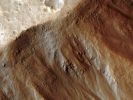
Kasei_Valles-PIA13265.jpgFeatures of Kasei Valles (EDM - Saturated Natural Colors; credits for the additional process. and color.: Dr Paolo C. Fienga - Lunexit Team)57 visiteThis observation from NASA's Mars Reconnaissance Orbiter (MRO) shows the very steep side of a Plateau, part of the Northern Limit of the Kasei Valles System, which is one of the largest Outflow Channel Systems on Mars. The difference in elevation here between the mostly flat Channel's Floor (bottom right) and the top of the Plateau (top left) is over 1300 meters (about 0,8 miles), comparable in height to the Grand Canyon Walls. The Kasei Valles System is much wider than the Grand Canyon, though, getting to be in places approx. 500 Km (such as about 300 miles) wide. (The Grand Canyon's maximum width is approx. 30 Km, or about 18 miles).
This EDM shows numerous paths with the appearance of dotted lines, criss-crossing the steep side of the Plateau. The carving agents can be found at the end of some of these paths: rocky blocks such as the ones in this subset, up to 2 meters (2,2 yards) across (4 meters or 4,4 yards across elsewhere in the image). Some of these blocks traveled downhill several hundred meters (yards) as they rolled and bounced leaving behind a trail of indentations or poke marks in the surface's fine-grained, light-toned soils. The raised borders in some of these poke marks indicate they are relatively recent features, unaffected by wind erosion, or that this soil has cohesive properties, such as if it was cemented.
The sound of these blocks falling did not travel very far, though. According to computer simulations sound in Mars travels only 1,5% (per-cent) the distance it would travel on Earth. (No Martian sound has ever been officially recorded) Hence, the same sound which would travel one Km (0,6 miles) on Earth, would travel only 15 meters (16 yards) on Mars. This is due to the lower Martian Atmospheric Pressure, which is approximately 1% of that of the Earth.MareKromium
(4 voti)
|
|
| 2235 immagini su 187 pagina(e) |
 |
|
|
|
|
54 | |
|
|
|
|





