| Piú votate - Mars Reconnaissance Orbiter (MRO) |

Dunes_and_DD_Tracks-PIA13538-PCF-LXTT-002.jpgSouthern Dunes and DD Tracks (Absolute Natural Colors; credits for the additional process. and color.: Dr Paolo C. Fienga - Lunexit Team)86 visitenessun commentoMareKromium
(4 voti)
|
|
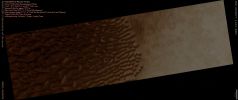
PSP_004077_1325_RED_abrowse-PCF-LXTT.jpgLarge Dunefield inside Proctor Crater (Absolute Natural Colors; credits for the additional process. and color.: Dr Paolo C. Fienga - Lunexit Team)86 visiteImage PSP_004077_1325 shows the edge of a Dark Dunefield on the Floor of Proctor Crater, an about 150 Km diameter Crater located in the Southern Highlands of Mars.
The Dark Dunes are composed of Basaltic Sand that has collected on the bottom of the Crater. Dark Dune "Slip Faces" - such as the steeper (---> più ripido) sides of the Dunes - are located on the Eastern side of the Dunes and are believed to have formed in response to Fall and Winter Westerly Winds caused by geostrophic forces (winds balanced by Coriolis and pressure gradient forces).
Superimposed on their Surface are smaller Secondary Dunes that are commonly seen on terrestrial Dunes of this size.
Many smaller and brighter bedforms, most likely small Dunes or granule Ripples, cover the substrate between the larger Dark Dunes as well as most of the Floor of Proctor Crater. The Dark Dunes overlie the small bright bedforms indicating that they formed more recently.
In several areas, however, the dark dunes appear to influence the orientation of the small bright Dunes, possibly by Wind flowing around the larger ones, suggesting that both dark and bright bedforms are coeval.
The Dunes in Proctor Crater may still be active today, moving in response to Martian Winds. MareKromium
(4 voti)
|
|
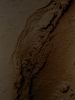
PSP_004072_1845_RED_abrowse-03.jpgThe "End" of Lethe Vallis (EDM n.2 - Enhanced Absolute Natural Colors; credits for the additional process. and color.: Dr Paolo C. Fienga - Lunexit Team)99 visitenessun commentoMareKromium
(4 voti)
|
|

ESP_019191_1750_RED_abrowse.jpgFeatures of Juventae Chasma (Absolute Natural Colors; credits for the additional process. and color.: Dr Paolo C. Fienga - Lunexit Team)90 visitenessun commentoMareKromium
(4 voti)
|
|
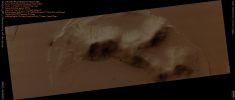
PSP_003570_1915_RED_abrowse-PCF-LXTT.jpgColourful Slope-Streaks in Marte Vallis (Natural Colors; credits for the additional process. and color.: Dr Paolo C. Fienga - Lunexit Team)73 visiteThis image of a large Hill in Marte Vallis has numerous dark- and light-toned Streaks along its Slopes, showing a variety of characteristics observed in other areas with these features.
For example, several dark Streaks have formed "fingers" at their Termini (such as the point where where the Streaks end).
Their formation may be due to the material "feeling" the roughness of the ground as it reaches shallower slopes near the base of the Hill. The dark Streaks also appear to travel over many obstacles along their paths, such as impact craters, small boulders, and rock outcrops. This indicates that the Slope Streaks have sufficient "momentum" and energy early in their descent downslope that they are not affected by such features or the ground.
The Slope Streaks also do not start at a common elevation along the sides of the Hill, suggesting that they are not related to any particular layer(s) of material.
Dark Slope Streaks are thought to fade over time by deposition of a new bright Dust Layer over the old streaked Surface. The presence of light-toned Streaks relative to their surrounding darker-toned surface is particularly interesting.
Scientists have wondered: if dark Streaks fade over time by deposits of new Dust, then how can there be light-toned streaks? Does this mean light-toned Streaks are formed differently? Are the materials of a light-toned Streak different from dark-toned Streaks?
Slope Streaks have been discovered and studied since the early Mariner and Viking Missions to Mars in the '60s and '70s. Scientists are hoping to resolve some of these questions using HiRISE images with its high spatial resolution compared to these previous Mars datasets.MareKromium
(4 voti)
|
|
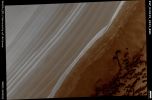
ESP_019195_2655_RED_abrowse.jpgNorth Polar Boundary (Absolute Natural Colors; credits for the additional process. and color.: Dr Paolo C. Fienga - Lunexit Team:)106 visiteMars Local Time: 14:09 (early afternoon)
Coord. (centered): 85,3° North Lat. and 160,3° East Long.
Spacecraft altitude: 324,6 Km (such as about 202,9 miles)
Original image scale range: 32,5 cm/pixel (with 1 x 1 binning) so objects ~97 cm across are resolved
Map projected scale: 25 cm/pixel
Map projection: POLAR STEREOGRAPHIC
Emission Angle: 10,8°
Sun-Mars-Spacecraft (or Phase) Angle: 61,9°
Solar Incidence Angle: 71° (meaning that the Sun is about 19° above the Local Horizon)
Solar Longitude: 141,1° (Northern Summer)
Credits: NASA/JPL/University of Arizona
Additional process. and coloring: Dr Paolo C. Fienga - Lunexit TeamMareKromium
(4 voti)
|
|
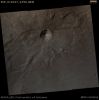
ESP_019197_2290_RED_abrowse-00.jpgExtremely unusually-looking Unnamed Northern Crater (Absolute Natural Colors; credits for the additional process. and color.: Dr Paolo C. Fienga - Lunexit Team)114 visiteAcquisition Date: 31 August 2010
Mars Local Time (MLT): 15:25 (Early Afternoon)
Latitude (centered): 48,7° North
Longitude (East): 127,6°
Range to Target Site: 311,5 Km (such as about 194,7 miles)
Original image scale range: from 31,2 to 62,3 cm/pixel (with 2 x 2 binning)
Map projected scale: 25 cm/pixel
Map projection: EQUIRECTANGULAR
Emission angle: 12,5°
Sun-Mars-Spacecraft (or Phase) Angle: 41,3°
Solar Incidence Angle: 53° (with the Sun about 37° above the Local Horizon)
Solar Longitude: 141,1° - Northern SummerMareKromium
(4 voti)
|
|

ESP_019186_1955_RED_abrowse-PCF-LXTT.jpgTrough in Syris Major (Natural Colors; credits for the additional process. and color.: Dr Paolo C. Fienga - Lunexit Team)94 visitenessun commentoMareKromium
(4 voti)
|
|

ESP_019256_1530_RED_abrowse-01.jpgThe "White Cliffs" of Holden Crater (EDM - Natural Colors; credits for the additional process. and color.: Dr Paolo C. Fienga - Lunexit Team)61 visitenessun commentoMareKromium
(4 voti)
|
|

ESP_019213_2210_RED_abrowse.jpgPossible Alpine-like Glacier (Natural Colors; credits for the additional process. and color.: Dr Paolo C. Fienga - Lunexit Team)94 visitenessun commentoMareKromium
(4 voti)
|
|
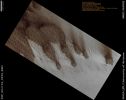
PSP_003734_0950_RED_abrowse-00.jpgSouthern Spring's Features (CTX Frame - Absolute Natural Colors; credits for the additional process. and color.: Dr Paolo C. Fienga - Lunexit Team)86 visitenessun commentoMareKromium
(4 voti)
|
|

ESP_019060_1330-LXTT2.jpgSouthern Gullies (EDM n.2 - Enhanced True Colors; credits for the additional process. and color.: Elisabetta Bonora - Lunexit Team)67 visitenessun commentoMareKromium
(4 voti)
|
|
| 2235 immagini su 187 pagina(e) |
 |
|
|
|
|
53 | |
|
|
|
|





