| Piú votate - Mars Reconnaissance Orbiter (MRO) |

ESP_021892_1775_RED_abrowse-PCF-LXTT-2.jpgFeatures of the N/W Rim of Endeavour Crater (EDM - Absolute Natural Colors; credits for the additional process. and color.: Dr Paolo C. Fienga - Lunexit Team)513 visitenessun commentoMareKromium
(4 voti)
|
|
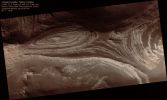
PSP_001596_1525_RED_browse-01-PCF-LXTT.jpgLayering inside Terby Crater (Absolute Natural Colors; credits: Dr Paolo C. Fienga - Lunexit Team)251 visiteImage PSP_001596_1525 shows a sequence of predominantly light-toned, layered, sedimentary rocks exposed by erosion on the floor of Terby Crater. Terby Crater is ~165 Km (~100 miles) in diameter. It's located on the northern rim of the Hellas impact basin in the Southern Hemisphere of Mars.
The layered sequence is ~2 Km (~1,2 miles) thick and consists of many repetitive, relatively horizontal beds. The beds appear to be laterally continuous, which means you can identify a given layer in many locations across the area.
Details in the layering seen in this HiRISE image reveal variations in the brightness of the layers and may indicate differing mineralogies. Based on the ease with which wind appears to erode these layers, they are believed to be composed mostly of fine-grained sediments.
However, one or more of the beds is weathering to form meter(yard)-scale boulders that have accumulated downslope in fans of debris.
These larger boulders indicate the material in the layers may be stronger than just fine-grained sediments.
It's not clear how these layers formed, but it may have involved deposition by wind or volcanic activity. Another theory involves all or part of the Hellas basin being filled with ice-covered lakes at one time in the past. The layers we see may have formed as material that was suspended in the water dropped down to the bottom of the lake. MareKromium
(4 voti)
|
|

PSP_005581_1815_RED_abrowse-PCF-LXTT.jpgPossible MSL Landing Site in Northern Meridiani Planum (Enhanced Absolute Natural Colors; credits for the additional process. and color.: Dr Paolo C. Fienga - Lunexit Team)234 visitenessun commentoMareKromium
(4 voti)
|
|

Craters-Huygens_Crater-PIA13800-PCF-LXTT.jpgFractures and Layers in Carbonate-bearing Rocks at Mars' Huygens Basin (Absolute Natural Colors; credits: Dr Paolo C. Fienga - Lunexit Team)277 visiteCaption NASA:This image from orbit covers an area about 460 meters (approx. 1500 feet) across, in which Carbonate Minerals have been identified from spectrometer observations. Fractures and possible Layers are visible in the light-toned Rock exposure containing the Carbonates.
The location is inside an Unnamed Crater about 35 Km (approx. 21,73 miles) in diameter that lays on the Uplifted Rim of the extremely wide Huygens Crater, which is about 467 Km (approx. 290 miles) in diameter. The excavations by the impacts that dug first Huygens and then the smaller crater have exposed material in this image that had been buried an estimated 5 Km (3,1 miles) deep.
The Carbonates may be from part of an extensive Buried Layer that could hold much of the Carbon that was once in a thick Martian Atmosphere of Carbon Dioxide, some researchers propose.
Mars now has a thin Atmosphere that is mostly Carbon Dioxide, but evidence that liquid water was once widespread on the Surface suggests the Atmosphere was much thicker billions of years ago. The High Resolution Imaging Science Experiment (HiRISE) camera on NASA's Mars Reconnaissance Orbiter provided this image.
Identification of Iron or Calcium Carbonates at this site, and also of Clay Minerals indicating a formerly wet environment, comes from an observation by the Compact Reconnaissance Imaging Spectrometer for Mars (CRISM) on the same Orbiter.
The point is that in the presence of water and other (favourable) conditions, the CO2 (Carbon Dioxide) that is present in the Martian Atmosphere can be captured into Carbonate Minerals.
The image is from HiRISE observation ESP_012897_168, made on April 27, 2009, and centered at 11,6° South Lat. and 51,9° East Long.".MareKromium
(4 voti)
|
|

ESP_015900_1465_RED_abrowse-01-PCF-LXTT.jpgUnnamed Southern Crater with Gullies, Rolling Boulders and Dunes (EDM n. 1 - Absolute Natural Colors; credits for the additional process. and color.: Dr Paolo C. Fienga - Lunexit Team)362 visitenessun commentoMareKromium
(4 voti)
|
|

ESP_020891_2065_RED_abrowse-PCF-LXTT.jpgFeatures of Calahorra Crater (Absolute Natural Colors; credits for the additional process. and color.: Dr Paolo C. Fienga)401 visitenessun commentoMareKromium
(4 voti)
|
|

ESP_020812_1530_RED_abrowse-PCF-LXTT-2.jpgThe "Dragon" of Holden Crater137 visitenessun commentoMareKromium
(4 voti)
|
|

ESP_020827_1595_RED_abrowse-PCF-LXTT.jpgOlivine-rich Terrain (Absolute Natural Colors; credits for the additional process. and color.: Dr Paolo C. Fienga - Lunexit Team)104 visitenessun commentoMareKromium
(4 voti)
|
|

ESP_020812_1530_RED_abrowse-PCF-LXTT-1.jpgPossible MSL Landing Site inside Holden Crater (Absolute Natural Colors; credits for the additional process. and coloring: Dr Paolo C. Fienga - Lunexit Team)126 visitenessun commentoMareKromium
(4 voti)
|
|

ESP_020797_1280_RED_abrowse-01.jpgPossible Active Gullies' Activity on a Southern Dunefield (Natural Colors; credits for the coloring: Dr Paolo C. Fienga - Lunexit Team)111 visitenessun commentoMareKromium
(4 voti)
|
|

ESP_020799_1385_RED_abrowse.jpgFeatures of Argyre Basin (Absolute Natural Colors; credits for the additional process. and color.: Dr Paolo C. Fienga - Lunexit Team)69 visitenessun commentoMareKromium
(4 voti)
|
|

PSP_005703_1750_RED_abrowse-PCF-LXTT-1.jpgLayered Sediments in Tithonium Chasma (Absolute Natural Colors; credits for the additional process. and color.: Dr Paolo C. Fienga - Lunexit Team) 63 visitenessun commentoMareKromium
(4 voti)
|
|
| 2235 immagini su 187 pagina(e) |
 |
|
|
|
|
51 | |
|
|
|
|





