| Piú votate - Mars Reconnaissance Orbiter (MRO) |
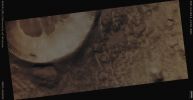
ESP_023814_1970_RED_abrowse-PCF-LXTT-00.jpgPossible Olivine-Rich Terrain in Isidis Planitia Region (Absolute Natural Colors; credits for the additional process. and color.: Dr Paolo C. Fienga - Lunexit Team)198 visiteMars Local Time: 14:08 (Early Afternoon)
Coord. (centered): 16,7° North Lat. and 80,1° East Long.
Spacecraft altitude: 279,9 Km (such as about 174,9 miles)
Original image scale range: 56,0 cm/pixel (with 2 x 2 binning) so objects ~ 1 mt and 68 cm across are resolved
Map projected scale: 50 cm/pixel
Map projection: EQUIRECTANGULAR
Emission Angle: 0,2°
Sun-Mars-Spacecraft (or "Phase") Angle: 38,0°
Solar Incidence Angle: 38° (meaning that the Sun is about 52° above the Local Horizon)
Solar Longitude: 350,6° (Northern Winter)
Credits: NASA/JPL/University of Arizona
Additional process. and coloring: Dr Paolo C. Fienga - Lunar Explorer ItaliaMareKromium
(4 voti)
|
|
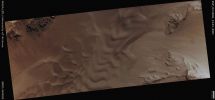
ESP_023806_1645_RED_abrowse-PCF-LXTT.jpgFeatures of Coprates Chasma (Saturated and Enhanced Natural Colors; credits for the additional process. and color.: Dr Paolo C. Fienga - Lunexit Team) 180 visiteMars Local Time: 14:13 (Early Afternoon)
Coord. (centered): 15,2° South Lat. and 302,3° East Long.
Spacecraft altitude: 261,6 Km (such as about 163,5 miles)
Original image scale range: 52,3 cm/pixel (with 2 x 2 binning) so objects ~ 1 mt and 57 cm across are resolved
Map projected scale: 50 cm/pixel
Map projection: EQUIRECTANGULAR
Emission Angle: 2,3°
Sun-Mars-Spacecraft (or "Phase") Angle: 37,0°
Solar Incidence Angle: 35° (meaning that the Sun is about 55° above the Local Horizon)
Solar Longitude: 350,3° (Northern Winter)
Credits: NASA/JPL/University of Arizona
Additional process. and coloring: Dr Paolo C. Fienga - Lunar Explorer ItaliaMareKromium
(4 voti)
|
|
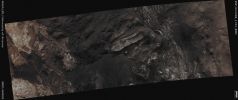
ESP_023398_1725_RED_abrowse-00.jpgFeatures of Jus Chasma (Absolute Natural Colors; credits for the additional process. and color.: Dr Paolo C. Fienga - Lunexit Team) 222 visiteMars Local Time: 14:03 (Early Afternoon)
Coord. (centered): 7,5° South Lat. and 279,7° East Long.
Spacecraft altitude: 275,9 Km (such as about 172,5 miles)
Original image scale range: 27,6 cm/pixel (with 1 x 1 binning) so objects ~ 83 cm across are resolved
Map projected scale: 25 cm/pixel
Map projection: EQUIRECTANGULAR
Emission Angle: 15,9°
Sun-Mars-Spacecraft (or "Phase") Angle: 46,6°
Solar Incidence Angle: 31° (meaning that the Sun is about 59° above the Local Horizon)
Solar Longitude: 333,5° (Northern Winter)
Credits: NASA/JPL/University of Arizona
Additional process. and coloring: Dr Paolo C. Fienga - Lunar Explorer ItaliaMareKromium
(4 voti)
|
|
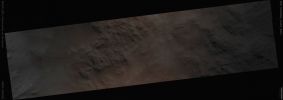
PSP_009660_2020_RED~0.jpgWest Olympus Mons (Absolute Natural Colors; credits for the additional process. and color.: Dr Paolo C. Fienga - Lunar Explorer Italia) 131 visiteMars Local Time: 15:25 (early afternoon)
Coord. (centered): 21,5° North Lat. and 221,9° East Long.
Spacecraft altitude: 280,3 Km (such as about 175,2 miles)
Original image scale range: 28,0 cm/pixel (with 1 x 1 binning) so objects ~56,1 cm across are resolved
Map projected scale: 25 cm/pixel
Map projection: EQUIRECTANGULAR
Emission Angle: 0,4°
Phase Angle: 47,5°
Solar Incidence Angle: 47° (meaning that the Sun is about 43° above the Local Horizon)
Solar Longitude: 114,3° (Northern Summer)
Credits: NASA/JPL/University of Arizona
Additional process. and coloring: Dr Paolo C. Fienga - Lunar Explorer Italia MareKromium
(4 voti)
|
|
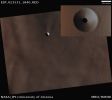
ESP_023531_1840-00.jpgSkylight on the Dusty Slopes of Arsia Mons (CTX Frame and EDM - Absolute Natural Colors; credits for the additional process. and color.: Dr Paolo C. Fienga - Lunexit Team)224 visiteMars Local Time: 14:08 (Early Afternoon)
Coord. (centered): 3,7° North Lat. and 248,5° East Long.
Spacecraft altitude: 263 Km (such as about 164,4 miles)
Original image scale range: 26,3 cm/pixel (with 1 x 1 binning) so objects ~ 79 cm across are resolved
Map projected scale: 25 cm/pixel
Map projection: EQUIRECTANGULAR
Emission Angle: 4,1°
Sun-Mars-Spacecraft (or "Phase") Angle: 30,4°
Solar Incidence Angle: 34° (meaning that the Sun is about 56° above the Local Horizon)
Solar Longitude: 339,1° (Northern Winter)
Credits: NASA/JPL/University of Arizona
Additional process. and coloring: Dr Paolo C. Fienga - Lunar Explorer ItaliaMareKromium
(4 voti)
|
|

ESP_020470_1755_RED_abrowse.jpgLayered Mound in Juventae Chasma (Natural Colors; credits for the additional process. and color.: Dr Paolo C. Fienga - Lunexit Team)207 visitenessun commentoMareKromium
(4 voti)
|
|

ESP_023094_1640_RED_abrowse.jpgThe Wall of Coprates Chasma (Enhanced and Darkened Absolute Natural Colors; credits for the additional process. and color: Dr Paolo C. Fienga/Lunar Explorer Italia/Italian Planetary Foundation)238 visitenessun commentoMareKromium
(4 voti)
|
|
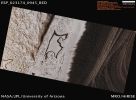
ESP_023174_0945_RED_abrowse-PCF-LXTT.jpgSouth Polar Summer (Absolute Natural Colors; credits for the additional process. and color.: Dr Paolo C. Fienga - Lunar Explorer Italia)245 visitenessun commentoMareKromium
(4 voti)
|
|
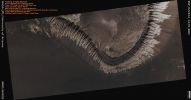
ESP_022632_1670_RED_abrowse-PCF-LXTT-00.jpgFeatures of the Valles Marineris (Absolute Natural Colors; credits for the additional process. and color: Dr Paolo C. Fienga - Lunexit Team)208 visitenessun commentoMareKromium
(4 voti)
|
|
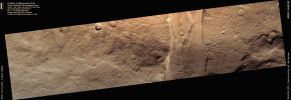
PSP_005442_1660_RED_abrowse-PCF-LXTT.jpgGraben in Memnonia Fossae (Natural Colors; credits for the additional process. and color.: Dr Paolo C. Fienga - Lunexit Team)135 visiteThis HiRISE image shows a Graben (roughly 2,5 Km or 1,6 miles wide) cutting a Ridge near Memnonia Sulci, a Region of Mars West of the massive Tharsis Volcanic Province. A Graben is a Trough created when 2 normal Faults (Faults dipping at an angle, with the overhanging wall sliding downwards) opposite each other lower the block of rock in between them. They are commonly associated with the tectonically-driven extension of a region and are also found in volcanic areas. Graben occur on many planets and moons, including Earth.
In this case, the Graben (running roughly East-West, indicating extension in the North-South direction) is cutting a Ridge, showing that it is more recent. The Ridge may also be tectonic in origin, therefore representing a different epoch and different type of tectonic activity.
Relationships like this can be used to determine the sequence of events in the history of the Region. The Graben Walls can also expose the local rocks at depth; in this case there is no obvious indication of Layering.MareKromium
(4 voti)
|
|
ESP_022657_1260_RED_abrowse-PCF-LXTT-02.jpgUnnamed Crater in Noachis Terra (EDM n.2 - Absolute Natural Colors; credits for the additional process. and color.: Drr Gianluigi Barca and Paolo C. Fienga - Lunexit Team) 133 visiteUno SPLENDIDO esempio di Cratere Secondario di modeste (anzi: modestissime) dimensioni e "relativamente" recente. Con ogni probabilità, ed a nostro umilissimo parere, questo "minimal secondary crater" non è correlato al Cratere Senza Nome di cui al CTX Frame.MareKromium
(4 voti)
|
|
ESP_022949_1650_RED_abrowse-PCF-LXTT.jpgLayering in Valles Marineris (Absolute Natural Colors; credits for the additional process. and color.: Dr Paolo C. Fienga - Lunexit Team)154 visitenessun commentoMareKromium
(4 voti)
|
|
| 2235 immagini su 187 pagina(e) |
 |
|
|
|
|
49 | |
|
|
|
|





