| Piú votate - Mars Reconnaissance Orbiter (MRO) |

PSP_003595_2115_RED_browse.jpgOlympus' Aureole (False Colors; credits for the additional process. and color.: Dr Paolo C. Fienga - Lunexit Team) 114 visiteThis image samples the rugged central portion of the mysterious "aureole" that extends to the West and North of Olympus Mons.
While many ideas for its formation have been advanced over the decades, these days it is generally thought to be a giant landslide deposit. The scene here fits that model with kilometer-scale (mile-sized) rocky hummocks and blocks strewn about. The blocks themselves are now covered with dust that is slumping off in small landslides or avalanches. These leave dark streaks on the sides of the blocks.MareKromium
(5 voti)
|
|
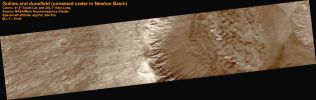
PSP_003464_1380_RED_browse-00.jpgGullies and Dunes in a Crater in Newton Basin (context image)57 visiteThis frame shows gullies associated with distinct layers located at multiple elevations along one crater wall as well as multiple generations of dunes that are eroding or covering a more coherent rock structure. The gullies in this crater appear to originate at the layers that cover a large extent of the slope. Gullies can be seen emanating from layers in two distinct sets, each at a different elevation. Gullies are often, but not always, form near layers.
Many of the gullies seen here have sinuous, or wavy, channels.
The bends are called meanders and, on Earth, meanders form in streams that have sustained and/or repeated flow. Not all of the gullies seen in this image extend the same distance downslope. This could result from differences in water supply, sediment supply, slope angle, and time of formation, among other factors.
Dunes are also visible in this image; they indicate the prevailing wind direction.
What is particularly interesting about this dune field is that there is exposed rock in the middle of it. This rock is either being exposed as the wind moves the dunes away from it or it is being covered. The dunes appear to outline the shape of the rock, which suggests that the rock has been uncovered long enough for dunes to form around it.
As the dunes shift over time, they will probably expose more of the underlying rock.MareKromium
(5 voti)
|
|

Psp_001691_1320_red~0.jpgGullied Trough in Noachis Terra (extra-detail mgnf - false colors)57 visiteThe majority of the gullies on both sides of the trough appear to originate at a boulder-rich layer seen in this subimage.
The layer appears dark on the sunlit slope because the boulders sticking out from the slopes cast shadows. If these gullies formed by water from the subsurface, then it is possible that this layer is a permeable layer that conducted water to the surface.
The layer is deteriorating and traveling down slope in the form of boulders.
These boulders can clearly be seen in the alcoves of the gullies on both sides of the trough.
Note that the alternating stripes on the lower right (Dx) side of the image are an artifact from camera noise. They are not real features.
(5 voti)
|
|

Psp_002538_1720_red.jpgJust like Thaumasia: more "bright" dunes in Ius Chasma57 visiteIus Chasma is one of several canyons that make up Valles Marineris, the largest canyon system in the Solar System.
The canyons likely formed by extension in association with the development of the Tharsis plateau and volcanoes to the West. Wind and possibly water have modified the canyons after they formed.
This HiRISE image shows the floor of Ius Chasma. The floor is bounded to the North and South by higher standing wallrock, with a few exposures of wallrock seen in the North (Sx) of the picture. Much of the floor is covered by ripples that are oriented approximately North-South, indicating an East to West wind flow, parallel to the orientation of Ius Chasma.
Layered deposits and bright patches of material are also seen along portions of the Ius Chasma floor. The layered deposits appear distinct in morphology from the nearby wallrock. These layered deposits could be lava flows, sediments deposited in a former lake, or fines that settled out from the atmosphere over time, such as dust or volcanic ashes.
The bright outcrops visible further south in the image have been seen elsewhere in Valles Marineris as well as other locations on Mars and tend to have mineral signatures consistent with sulfates. Data from the CRISM instrument (also on Mars Reconnaissance Orbiter) of the composition of these bright patches in Ius Chasma could shed insight into their origin. MareKromium
(5 voti)
|
|

Psp_001503_2180_red-00.jpgTricks of the Light, Tricks of the Surface... (context image - 1)59 visitenessun commento
(5 voti)
|
|

Martian_Lakes_in_Vastitas_Borealis_and_Solis_Planum.jpgWet Craters and Dry Craters: a Visual Comparison57 visitenessun commento
(5 voti)
|
|

North_Polar_Layers-PSP_001334_2645_RED.jpgIcy North Polar Layers (natural colors)62 visitenessun commentoMareKromium
(5 voti)
|
|

Craters-Holden_Crater-04.jpgThe beautiful "Holden Crater" (4)60 visitenessun commentoMareKromium
(5 voti)
|
|

North_Polar_Layered_Deposits-PIA01925.jpgNorth Polar Layers71 visiteCaption NASA originale:"This view shows the basal layers of Mars' north polar layered deposits. The floor of Chasma Boreale is at the bottom of the image. This is a sub-image of a larger view imaged by the High Resolution Imaging Science Experiment (HiRISE) on NASA's Mars Reconnaissance Orbiter on Oct. 1, 2006. The resolution is 64 cm (about 25") per pixel, and the scene is 568 mt (approx. 621 yards) wide".
(5 voti)
|
|
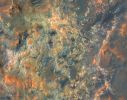
Mawrth_Vallis-PIA01924.jpgThe colors of Mawrth Vallis (False Colors; credits: NASA/JPL-Caltech/Univ. of Arizona)62 visiteCaption NASA originale:"This view shows diverse materials and morphologies in the region south of Mawrth Vallis on Mars. The color is composed of infrared, red, and blue-green color images, and has been enhanced to accentuate the color differences. The bright material may be rich in clays and date back to a time when Mars had a wetter environment. This is a sub-image of a larger view imaged by the High Resolution Imaging Science Experiment (HiRISE) on NASA's Mars Reconnaissance Orbiter on Oct. 1, 2006. The resolution is 25 centimeters (10 inches) per pixel, and the scene is 352 meters (385 yards) wide".
(5 voti)
|
|

Craters-Becquerel_Crater_mound_6m-04.jpgBeautiful Becquerel Crater (5)60 visitenessun commento
(5 voti)
|
|

Craters-Becquerel_Crater_mound_6m-03.jpgBeautiful Becquerel Crater (4)59 visitenessun commento
(5 voti)
|
|
| 2235 immagini su 187 pagina(e) |
 |
|
|
|
|
44 | |
|
|
|
|





