| Piú votate - Mars Reconnaissance Orbiter (MRO) |

PSP_003292_2025.jpgCollapse Pits (natural colors + MULTISPECTRUM; credits: Dr M. Faccin e Lunexit)70 visitenessun commentoMareKromium
(5 voti)
|
|

PSP_005946_0975_RED_abrowse-01.jpgUnconformity in the South Polar Layered Deposits (SPLD) - (extra-detail mgmf - natural colors; elab. Lunexit)77 visiteThe layers in the upper center/right end abruptly (truncate) at a curve in the layers that extend along the left side of the image.
This type of truncation (termed "unconformity" in Geology) is usually due to erosion, wherein the layers in the lower right were eroded, followed by later deposition of the rest of the layers on top of the older layers (layer age likely increases from left to right). It is also possible that flow of these icy layers played a part in the complicated layer geometry exhibited in this extra-detail mgnf".MareKromium
(5 voti)
|
|
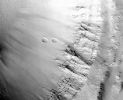
PSP_005343_2170_RED_abrowse-01.jpgScarp with Landslides and Boulder Tracks (extra-detail mgnf)58 visiteThis subimage - or extra-detail mgnf - (approx. 480 meters across) shows boulder tracks from the landslide scar on the left side of the image.
Some boulders can be seen forming trails along the slope at the top part of the subimage, while others can be seen at the end of their trails (...).MareKromium
(5 voti)
|
|

PSP_005680_1525_RED_abrowse-00.jpgPossible ancient Salt Deposits in Terra Cimmeria (Extremely Saturated and ENhanced Natural Colors - credits for the additional process. and color.: Dr Paolo C. Fienga - Lunexit Team)57 visiteThe ancient cratered highlands of the Southern Hemisphere of Mars has an intriguing and complex history as it has been riddled with impact craters and modified by volcanic processes and by the wind.
Additionally, it is one of the most heavily dissected terrains on Mars exhibiting the densest population of Valley Networks: old dried up channels and valleys that may have been formed by surface runoff, the seepage of ground water, or both.
Recently, the Thermal Emission Imaging System (THEMIS) aboard Mars Odyssey, in conjunction with spectral data from the Thermal Emission Spectrometer (TES) aboard the Mars Global Surveyor (MGS) have revealed the presence of a unique surface deposit that may be rich in chloride salts formed from the presence of liquid water. Three separate missions (MGS, MO and MRO) have come to reveal the composition and nature of these unique deposits, which, although they occur as relatively small deposits (less than 25 square Km) are widely distributed in Noachian (most ancient) terrains with fewer occurrences in the Hesperian (middle geologic time) terrains.
The deposit appears to be relatively thin and occurs in low-lying areas. It is also heavily pockmarked and discontinuous, possibly from removal of the material by erosion. Both of these aspects suggest that the deposit is indeed very old.
The presence of such salts is intriguing, and strongly suggests that conditions were favorable for water near or at the surface in the geologic past.
Polygonal cracks can be observed in this image and other images of these deposits elsewhere on Mars (see PSP_003160_1410) and are similar to desiccation cracks (formed from the rapid evaporation and drying of a wet surface) and indicate that these may were more likely deposited at the surface.
However, the volume and duration the water required for these deposits is still being investigated. MareKromium
(5 voti)
|
|

PSP_005419_1380_RED_browse-00.jpgFlow-like Features in Promethei Terra (context frame)58 visiteThis image, part of the south-facing slopes of a massif in Promethei Terra in the Southern Highlands, shows flow-like features (tongue-shaped lobes, parallel ridges) that indicate movement of surface materials downhill and towards the South-West, following the regional slope.
The difference in elevation between the ridge (near the top or northern-most portion of the image) and the valley (to the South) is over 2200 meters (7,200 feet).
These flow-like features are reminiscent of those observed in terrestrial landslides and rock glaciers , in which the downhill movement of rocks and soils is facilitated by an agent (most commonly water in landslides, ice in glaciers) that acts as a lubricant and provides cohesion. Theoretical calculations predict that under current and recent Martian climate conditions, neither water nor ice would be stable near the surface for extended periods of time in this Region.
The temperatures are so low that water would freeze, and then quickly sublime, because the air is very thin and dry. Ice could, though, be stable at present approximately 1 meter (3 feet) or more below the surface.
MareKromium
(5 voti)
|
|
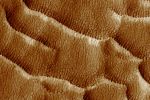
PSP_005419_1380_RED_browse-01.jpgFlow-like Features in Promethei Terra (extra-detail mgnf)57 visiteThe subimage (approx. 390 x 260 meters) shows in detail some of the ridges developed in the slope deposits. Numerous fissures cut through the surface, forming polygons 5 to 10 mt (5,5 to 11 yards) across.
Such well-preserved polygons indicate that the downhill flow had stopped before they formed. Polygonal features similar to these are common in terrestrial periglacial regions such as Antarctica, where ice is present at or near the surface. Antarctica's polygons formed by repeated expansion and contraction of the soil-ice mixture due to seasonal temperature oscillations.MareKromium
(5 voti)
|
|
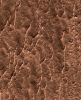
PSP_003639_1345_RED_browse-01.jpgDebris Apron South of Euripus Mons (extra-detail mgnf - possible natural colors; elab. Lunexit)61 visiteA closer view of the upper portion of the image (see here), reveals that rough sharp scalloped ridges are particularly prominent.
This scalloping may have resulted from sublimation of ice below the surface.MareKromium
(5 voti)
|
|
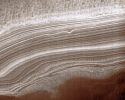
PSP_004917_1080_RED_browse-01.jpgComplex Geology in the South Polar Layered Deposits (extra-detail mgnf)59 visiteAbove and right of center, the layers appear wavy and in places, layers are cut off by other layers. Such structures may be formed by flow or faulting, but in this case they are more likely to be due to erosion of the lower part of the layered deposits before the upper part was laid down over it. For example, deposition may have halted long enough for channels to be eroded into the layered deposits.
When deposition resumes, new layers deposited in the channels could form the structures visible here. However, without more precise topographic information than is currently available, other hypotheses cannot be excluded.MareKromium
(5 voti)
|
|
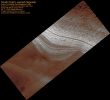
PSP_004742_0990_RED_browse.jpgGeologic History Recorded in the South Polar Layered Deposits (Extremely Enhanced Natural Colors; credits for the additional process. and color.: Dr Paolo C. Fienga - Lunexit Team)59 visiteThe Polar Layered Deposits on Mars are thought to be composed of varying amounts of water ice and dust. The variations in the relative amounts of ice and dust are probably caused by recent climate changes on Mars, similar to ice ages on Earth.
This image of the South Polar Layered Deposits shows many layers, some of which are cut off or truncated against other layers (near the center of the image). These truncations are probably due to periods of erosion separating periods of deposition.
After nearly horizontal layers are deposited, they can be partly eroded (perhaps by winds) before more layers are deposited over them. In this image, there is evidence for at least two such episodes of erosion and burial. These types of observations are useful to Mars scientists as they try to unravel the climate history of Mars. MareKromium
(5 voti)
|
|
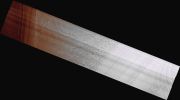
PSP_004664_0955_RED_browse.jpgOutcrops of Layers in the South Polar Layered Deposits59 visiteThis image spans a section of the South Polar Layered Deposits (SPLD). The SPLD are composed of layers of water ice mixed with impurities (probably mostly dust). The most similar terrestrial analog to the SPLD are ice sheets, like those covering most of Greenland and Antarctica.
The materials of ice sheets are deposited by freezing of atmospheric water vapor on dust particles and precipitation of those water/dust particles (snow), by direct condensation (freezing) of atmospheric water vapor onto the surface, and by fallout of dust. Together, these processes cause an ice sheet to undergo accumulation (build-up). Ablation (removal of material, also called erosion) of an ice sheet can also occur. If more accumulation happens than ablation, the ice sheet grows; if reversed, the ice sheet shrinks, as is the case for many of Earth’s glaciers due to global warming. Each year, the amount of accumulation and ablation varies, so layers of different thicknesses and different amounts of impurities (dust) will be deposited onto the ice sheet.
Volcanic eruptions anywhere on the planet can also potentially spew ash high into the atmosphere, where it can travel great distances and fall onto an ice sheet surface. Later accumulations of water ice can then trap this volcanic ash as a layer within the ice sheet. Thus, layers in an ice sheet can originate through a variety of means and occur at a variety of scales (thicknesses).
This particular image is interesting because many layers are exposed and because more than one outcrop (exposure of layering) is visible—at the top of the image and at the bottom. You can imagine the outcrops at the top and bottom of the image as if you are looking down on a staircase. The approximately horizontal lines are the edges of the layers (the risers), and the flat areas between them are the layer surfaces (the flat parts of the steps). The middle of the image is the top of the staircase. At the bottom, the staircase of layers goes down again.
The layers in this image are on the scale of meters (several to tens of feet) in thickness and are much thicker than one might expect from annual accumulation (which might be about 0.5 millimeters per year, or 0.02 inch per year). So the layers we see in this image may be packages of thinner, annual layers. The reason that we can distinguish between different packages of annual layers (in other words, the reason that we can see layering at this scale) is because the rates of accumulation and ablation change not only yearly, but also on much longer time scales. Imagine drilling into the SPLD and looking at the walls of the hole with a microscope. Within the large-scale layering we see in this image, we might see annual accumulation layers, dusty layers created during large dust storms, and maybe even volcanic ash layers.MareKromium
(5 voti)
|
|
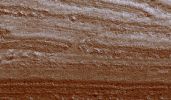
PSP_004708_1000_RED_browse-01.jpgFault in the South Polar Layered Deposits (EDM - Extremely Enhanced Natural Colors; credits for the additional process. and color.: Dr Paolo C. Fienga - Lunexit Team)58 visiteThe figure shown here is a cutout of the previous frame (1,8 Km across, or about 1,1 mile) showing a very interesting and smewhat rare feature: a fault. The fault is the thin, diagonal line that cuts through most of the image, from near the lower left corner to near the upper right corner. On each side of the fault, the layers that cross the fault are slightly off-set from one other; in other words, the layers don't line-up with each other anymore. The relationship between the angles at which the layers and fault are exposed and the movement along the fault is complex, but, in general, the layers on the left side of the fault are slightly lower than those on the right.MareKromium
(5 voti)
|
|
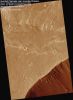
PSP_003223_1755_RED_browse.jpgInverted Channels Near Juventae Chasma59 visiteThis image shows several long, sinuous features on the plains near Juventae Chasma. These features have been explained as former stream channels now preserved in inverted relief.
Inverted relief occurs when a formerly low-lying area becomes high-standing. For instance, depressions may become filled with lava that is more resistant to erosion. In the case of stream channels, there are several possible reasons why the channel might stand out in inverted relief. The streambed may contain larger rocks, which remain while fine material is blown away by the wind, or it could be cemented by some chemical precipitating from flowing water.
These features are old, since several impact craters cut the ridges. They provide important information about past processes on Mars. Understanding how streams could have formed is an important issue in understanding the history of water on Mars.MareKromium
(5 voti)
|
|
| 2235 immagini su 187 pagina(e) |
 |
|
|
|
|
43 | |
|
|
|
|





