| Piú votate - Mars Reconnaissance Orbiter (MRO) |
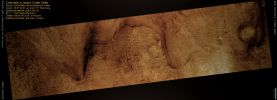
PSP_007925_1990_RED_abrowse-00.jpgChannels in Jezero Crater Delta (context frame - MULTISPECTRUM; credits: Lunexit)78 visiteBillions of years ago, this water-carved channel in Nili Fossae Region transported sediments across the Martian Surface and deposited them on the floor of an impact crater just south of this image.
The sediments were deposited in a delta-like mound on the floor of Jezero Crater, suggesting that the crater may have contained a lake at the time.MareKromium
(5 voti)
|
|
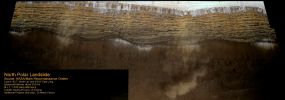
PSP_007338_2640.jpgNorth Polar Landslide (Special Processing by Dr M. Faccin)57 visitenessun commentoMareKromium
(5 voti)
|
|
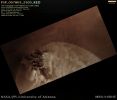
PSP_007805_2505_RED_abrowse-00.jpgThe "Frozen Lake" of Vastitas Borealis, alias Louth Crater (context frame - MULTISPECTRUM; credits: Lunexit)86 visiteThis image shows the changing seasonal frost patterns on Louth Crater, located at latitude 70° North. This crater contains a mound covered by water frost that persists throughout the year, which is unusual for this latitude.
The seasonal Carbon Dioxide frost deposited during Northern Winter can also reach this Latitude. At the time this image was acquired in Northern Spring, the CO2 frost is in the process of sublimating back into the atmosphere.
There are sand dunes near the edge of the mound, which become clear of frost in the Summer.
Per avere qualche Informazione in più...
Geophysical Research Abstracts,
Vol. 10, EGU2008-A-10434, 2008
SRef-ID: 1607-7962/gra/EGU2008-A-10434
EGU General Assembly 2008
© Author(s) 2008
Louth crater: Water vapour distribution as seen by CRISM/MRO
R. Melchiorri (1); T.L. Roush (1); R.M. Haberle (1); A. J. Brown (2) ; T. Encrenaz
(3); CRISM team
1) NASA AMES Research Center, Moffet Field, CA, 94035, USA
2) SETI Institute, 515N. Whisman Rd, Mountain View, CA 94043, USA
3) LESIA Observatoire de Meudon 5, place Jules Janssen, 92195 Meudon, France
“Louth” crater (70.5°N, 103.2°E, name submitted to IAU for consideration) has been identified to have a greater resemblance to the polar cap than previously expected [1 and 2]. This crater is a conveniently small and contains a central water ice deposit that is suitable for testing models of volatile stability in the Martian north polar region. A sensitive detector for water stability is the study of water vapour distribution, which could reveal the presence of interactions between the surface and atmosphere by identifying possible sources and sinks. By adapting the water vapour analysis already developed and tested for the
OMEGA/Mars Express data [3 and 4] we have been able to retrieve the total amount of water vapour from the CRISM/MRO data. This retrieval was performed on two independent high spectral-spatial resolution observations of Louth crater.
For the first time a water vapour distribution at the 1/1000 of a degree scale is presented. Opening the possibility of studying atmospheric water dynamics at very high spatial resolution, like on the boundary of the ice mound, and thus providing hints
regarding the presence and extent of the ice under the close dusty regions.
We present the method and some preliminary results of the analysis, showing in detail the distribution of water vapour on and near the ice mound and near the northern crater rim.
References:
[1] A.J. Brown et al; ICARUS (in press) 2008
[2] A.J. Brown et al; LPCI 2008
[3] R. Melchiorri et al ; Plan and Space Sci. 55 (2007) 333–342
[4] T. Encrenaz et al A&A 441, L9–L12 (2005)MareKromium
(5 voti)
|
|
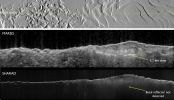
SHARAD-2.jpgUnder the Ice... (2)79 visiteTwo complementary Radar Sounder Instruments work together to discover hidden Martian secrets. They are the Mars Advanced Radar for Subsurface and Ionospheric Sounding (MARSIS) on the European Space Agency's Mars Express orbiter and the Shallow Subsurface Radar (SHARAD) on NASA's Mars Reconnaissance Orbiter.
MARSIS was designed to penetrate deep and it has delivered on its promise. This figure shows the base of Mars' South Polar Layered Deposits at the deepest recorded point of 3,7 Km (2,3 miles).
In contrast, SHARAD was designed as a High-Resolution Radar for a maximum penetration of 1 Km (0,6 mile) has difficulty detecting the base of these layered deposits.
MARSIS was funded by NASA and the Italian Space Agency and developed by the University of Rome, Italy, in partnership with NASA's Jet Propulsion Laboratory, Pasadena, Calif. Italy provided the instrument's digital processing system and integrated the parts. The University of Iowa, Iowa City, built the transmitter for the instrument, JPL built the receiver and Astro Aerospace, Carpinteria, Calif., built the antenna. JPL is a division of the California Institute of Technology in Pasadena. Additional information about Mars Express is at www.esa.int/marsexpress.
SHARAD was provided by the Italian Space Agency (ASI). Its operations are led by the University of Rome and its data are analyzed by a joint U.S.-Italian science team. JPL, a division of the California Institute of Technology, Pasadena, manages the Mars Reconnaissance Orbiter for the NASA Science Mission Directorate, Washington.MareKromium
(5 voti)
|
|

PSP_006284_1145_RED_abrowse-01.jpgOn the edge of the Dunefield... (MULTISPECTRUM; credits: Lunexit)57 visitenessun commentoMareKromium
(5 voti)
|
|

PSP_006284_1145_RED_abrowse-02.jpgOn the edge of the Dunefield... (MULTISPECTRUM; credits: Lunexit)66 visitenessun commentoMareKromium
(5 voti)
|
|
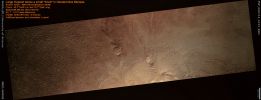
PSP_006714_2255_RED_abrowse.jpgLandslide Deposit below a small Knob in Deuteronilus Mensae (MULTISPECTRUM; credits: Lunexit)55 visiteThis image shows a possible Landslide Deposit originating from a mesa just East of the center of the scene in Deuteronilus Mensae.
The deposit is the lobe-shaped feature extending across the center of the image. Located at approx. 45° North, where ground ice is thought to be stable, it is possible that the deposit formed from "Mass Wasting" of ice-rich material.
Mass Wasting is a process driven by gravity that moves material downslope; the ice enhances the process.
The lobe has distinct textures. It is bouldery at some locations and pitted or wrinkled at others. The pitted texture may be due to desiccation (drying) of soil that can occur when ice from beneath the surface sublimates and leaves empty spaces into which the surface collapses.MareKromium
(5 voti)
|
|
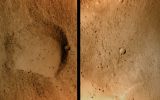
PSP_007547_1895_RED_abrowse-01.jpgRolling Rocks inside Shalbatana Vallis (EDM - False Colors; credits: Dr Paolo C. Fienga - Lunexit Team)59 visiteIn this extra-detail mgnf, the left frame shows boulders moving in two directions, indicating that they had different sources.
The right frame shows a boulder about 4 meters in diameter in the bottom left, having left a track that begins in the upper right. This boulder rolled down the hill, appears to have jumped the crater, bounced a few times, and then rolled to a halt.MareKromium
(5 voti)
|
|
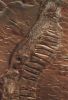
PSP_007219_1720_RED_abrowse-01.jpgFinely-Layered Rocks in Ius Chasma (extra-detail mgnf - MULTISPECTRUM; credits: Lunexit)57 visiteMuch of this Region has been covered by dust and sand, which appears brownish-red. This material is eroded by wind over time and allows us to see the light-toned rock underneath the surface.
There are also dunes that obscure portions of the outcrop.
Many outcrops within Ius Chasma and elsewhere on Mars are covered by such dunes and dust, but the high spatial resolution of instruments such as HiRISE and CRISM allow us to see the Geology and Mineralogy of regions between these dunes to help unravel the Geologic History of Mars.MareKromium
(5 voti)
|
|
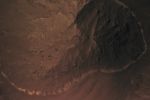
PSP_006969_1725_RED_abrowse-01.jpgThe Floor of Noctis Labyrinthus (extra-detail mgnf - MULTISPECTRUM; credits: Lunexit)58 visiteThe most striking feature of many of these knobs is a thin, bright band which often wraps around the edges near the bottom, as in this extra-detail mgnf. This image was acquired in order to investigate whether this is an exposed layer of rock or the shoreline of a former body of water.
HiRISE resolves details of the bright band that indicate that this is an unusual layer of rock, rather than an old shoreline. In several places, the band is broken up along cracks, sometimes forming boulders. This indicates that the band is solid rock, while material left on a shoreline should be loose sediments. It is now exposed as rings and arcs where erosion has cut deeply enough to expose the layer.
This band must indicate some unusual event in the geologic history of the region when a different type of rock was deposited; it is strikingly different in color from the other rocks. Although it is not a shoreline, it could be material that was deposited on the floor of a much older lake or sea and then buried by other rock; it could also have been laid down by other sedimentary processes or as volcanic ash.
MareKromium
(5 voti)
|
|

PSP_004965_0980_RED_abrowse-01.jpgSouth Polar Layered Deposits (SPLD; extra-detail mgnf - MULTISPECTRUM; credits: Lunexit)60 visiteThe exposure of South Polar Layered Deposits shown here also appears to be partly covered by additional debris.
The layers appear to have been offset by a fault near the upper right corner.
The faulting and burial visible here complicates the interpretation of the climate history of Mars based on observations of layering.MareKromium
(5 voti)
|
|

PSP_005388_1975_RED_abrowse-01.jpgPang Boche Crater (EDM; False Colors; credits for the additional process.: Dr Paolo C. Fienga - Lunexit Team)59 visiteThe interior of Pang Boche Crater contains material that likely slumped off the walls during late stages of its formation. The north wall of the crater has material that has not slumped to the floor, instead forming a terrace.
Also noteworthy is the abundance of small craters that surround, but do not occur within, Pang Boche. These are mostly Secondary Craters that formed when ejecta from an impact hit the surface. If the small craters were Primary Craters (formed from an impactor from space), then they would be expected to be within Pang Boche as well. Secondaries commonly occur in clumps as seen in this extra-detail mgnf (which is approx. 2 km across).
The strong clustering indicates that these craters are Secondaries.MareKromium
(5 voti)
|
|
| 2235 immagini su 187 pagina(e) |
 |
|
|
|
|
42 | |
|
|
|
|





