| Piú votate - Mars Reconnaissance Orbiter (MRO) |

PSP_008963_1650_RED-01.jpgMER Spirit Rover at Martian Mid-Winter (edm - natural, but enhanced, colors; credits: Lunexit)60 visitenessun commentoMareKromium
(5 voti)
|
|

PIA10141-AraneiformTerrain~0.jpgAraneiform and Lace Terrains (MULTISPECTRUM; credits: Lunexit)58 visiteThe South Polar Terrain on Mars contains landforms unlike any that we see on Earth, so much that a new vocabulary is required to describe them. The word "araneiform" means "spider-like".
There are radially organized channels on Mars that look spider-like, but we don't want to confuse anyone by talking about "spiders" when we really mean "channels", not "bugs."
This picture shows an example of "connected araneiform topography", such as terrain that is filled with spider-like channels whose arms branch and connect to each other. Gas flows through these channels until it encounters a vent, where is escapes out to the atmosphere, carrying dust along with it. The dark dust is blown around by the prevailing wind.
This image also shows a different Region where the channels are not radially organized. In this Region they form a dense tangled network of tortuous strands. We refer to this as "lace". MareKromium
(5 voti)
|
|

PIA10142-SeasonalDryIce~0.jpgTranslucent Seasonal Ice (MULTISPECTRUM; credits: Lunexit)64 visiteIn a Region near the South Pole of Mars, translucent Carbon Dioxide ice covers the ground seasonally. For the first time we can "see" the translucent ice by the affect it has on the appearance of the surface below.
Dark fans of dust from the surface drape over the top of the seasonal ice.
The surface would be the same color as the dust except that the seasonal ice affecting its appearance. Bright bluish streaks are frost that has re-crystallized from the atmosphere.
Sunlight can penetrate through the seasonal layer of translucent ice to warm the ground below. That causes the seasonal ice layer to sublime (evaporate) from the bottom rather than the top. MareKromium
(5 voti)
|
|
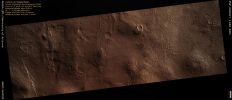
PSP_008427_1380_RED_abrowse-00.jpgAutumn in Hellas Basin (ctx frame - MULTISPECTRUM-2; credits: Lunexit)87 visiteIt is now fall in the Southern Hemisphere and in the giant impact crater known as Hellas Basin small boulders cast long shadows. The long shadows emphasize small scale topographic features and wind erosion is responsible for much of the morphology in this Region.
MareKromium
(5 voti)
|
|
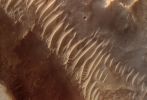
PSP_008523_2060_RED_abrowse-01.jpgSubchannels in Kasei Valles (EDM - MULTISPECTRUM; credits for the additional process. and color.: Dr Paolo C. Fienga - Lunexit Team)58 visiteCaption NASA:"This Region is very dusty, and therefore Dust Streaks can be seen covering the flat Mesas. Within the Channels, large Dunes of Dust have formed from Winds blowing through the Channels themselves. On the steep Slopes of the Dunes, smaller set of Ripples can be seen".MareKromium
(5 voti)
|
|
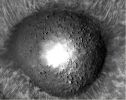
PSP_007055_2015_RED_abrowse-2.jpgVolcanic and Clay Materials near Nili Fossae (edm n. 2)59 visitenessun commentoMareKromium
(5 voti)
|
|
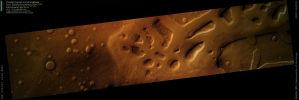
PSP_006567_2220_RED_abrowse-00.jpgFlooded Terrain in Terra Sabaea (MULTISPECTRUM; credits: Lunexit)58 visiteTwo distinctly different terrain types are visible in this image of the Northern Lowlands of Mars: an older, heavily cratered landscape has been inundated by much younger flows.
The valley floors are filled with flows that have relatively smooth surfaces and very few superposed impact craters.
In contrast, the mesas and hills making up the older terrain have blocky surfaces, perhaps fragmented by ancient impacts. MareKromium
(5 voti)
|
|
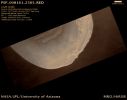
PSP_008161_2505_RED_abrowse.jpgLouth Crater (MULTISPECTRUM; credits: Lunexit)78 visitenessun commentoMareKromium
(5 voti)
|
|

PSP_006006_1715_RED_abrowse.jpgLayering in the Upper Walls of Valles Marineris (Enhanced and Saturated Natural Colors; credits for the additional process. and color.: Dr Paolo C. Fienga - Lunexit Team)57 visiteThis observation shows parts of the upper walls of Valles Marineris with layered rocks. These layers extend down to a smooth-appearing slope, that is likely material shed from the upper parts of the chasm walls; down-slope stripes are visible, indicating that material has fallen or slid downhill in a process termed Mass Wasting (nota Lunexit: anche noto come Gravity Wasting).
The layers, exposed in most rock outcrops in this image, are most likely lava flows from flood lavas that once erupted across the region. These layers are located in the upper walls of most of Valles Marineris and are sometimes exposed at depths well below the surrounding plateau, recording extensive volcanism in the history of the region. Similar, thick successions of lava flows are found at some sites on Earth (for example, the Columbia River flood basalts in the North-West of the U.S.).
Mass Wasting: is a geologic term that encompasses the rapid downhill movement of rocks and fine particles due to the force of gravity. One of the most common and generic types of mass wasting features on Earth are landslides, but there are many others such as rock falls, debris flows, soil creep, and debris avalanches. Landslides or any other mass wasting feature, require some type of triggering mechanism to induce the movement of particles under gravity. Some of these mechanisms include volume expansion of fractures (i.e. cracks) in rocks by freeze/thaw processes, increase in soil pore pressure (i.e. water content), undermining or removal of less-resistant material below a stronger material layer, and strong vibrational forces produced from above (e.g., meteorite impact) or below ground (e.g., volcanic eruption, earthquake). On Mars, two of the most common Mass Wasting features are landslides and dust avalanches (also referred to as Slope Streaks). Some of the most spectacular landslides in the Solar System are found in the Valles Marineris Canyon System on Mars and exhibit many of the classic characteristics of landslides on Earth. These characteristics include a semi-circular main scarp in the source region, a hummocky (i.e. irregular) or blocky surface in the upper portion of the deposit, surface ridges parallel to landslide flow direction in the middle portion of the deposit, and a lobate outer margin that has some significant thickness (e.g., tens to hundreds of meters). Dust avalanches are common on dune faces, crater interior walls, mesa slopes, and canyon scarps. The streaks are thought to occur when dust and/or other small particles on a sloped surface begins to move due to sublimation of a thin layer of water frost or by the oversteepening of slopes in localized dusty air fall deposits. MareKromium
(5 voti)
|
|

PSP_006237_1460_RED_abrowse.jpgLandforms of Dao Valles (MULTISPECTRUM-2; credits: Lunexit)56 visiteThis image in a section of Dao Valles contains a multitude of landforms that may result from the actions of ice. Aligned ridges on the valley floors are evidence of glacier-like flow of this material as it gets diverted around obstacles such as the valley walls and local mesas and knobs.
In some areas where the flow appears to have traveled over an obstacle instead of around, a series of fractures occur, analogous to crevasses that form in glaciers on Earth when ice flows over obstacles. The surface we see is covered with rocky debris and soil that may be protecting ice from sublimation.
Throughout the Region, the surface has been mantled by a smooth deposit that appears to have been eroded in a few locations. This sort of mantle is common at Martian High Latitudes and is thought to be a mixture of dust and ice, either ice-cemented soil or very dirty snow. The eroded areas could be due to ice loss trough sublimation, leaving the remaining surface to collapse or be eroded by the wind.
Many gullies are observed that appear to be carved into the valley walls by liquid water. Incised channels in places cut deeply into the surface and fans of debris with crisscrossing small channels indicate where the flow of water slowed and deposited material eroded from upstream. The source of water is as yet unknown. One theory has been proposed involving melting of surface ice or ice-rich soil in the cold Martian climate. Another theory suggests that an aquifer a few hundred meters (yards) below ground is feeding the gullies.
MareKromium
(5 voti)
|
|

PSP_008311_1835_RED_abrowse-01.jpgFeatures and Mineralogy of Aram Chaos (extra-detail mgnf - MULTISPECTRUM; credits: Lunexit)59 visiteIn this extra-detail mgnf, the lighter-toned area is a heavily fluted and pitted Capping Unit. This surface tends to trap dark sand in the lows.
The dark sand can also be seen to form dunes below the cliff.
Sulfates have been detected in the cliff walls in some areas within Aram Chaos, as well as Hematite. It has been suggested that these materials were deposited within a lake setting.MareKromium
(5 voti)
|
|
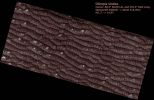
Psp_001736_2605_red.jpgThe Dunes of Olympia Undae (MULTISPECTRUM; credits: Lunexit)58 visiteThis HiRISE image shows dark dunes and light polygonal terrain in Olympia Undae, also known as the North Polar Erg.
Two sets of dunes are obvious. The major set trends ~North-South, indicating winds from the East or West. Between the crests of these dunes is a second set oriented mostly East-West.
Zooming in on the dunes, a rippled texture is apparent, probably due to redistribution of sand at the scale of meters and less. Near the crests of some dunes are channel-like features, with some branching downslope.
The origin of these channels is unknown, but they may result from the flow and displacement of sand that was fluidized by sublimating CO2 or water frost.
Bright patches of ground are found in some inter-dune areas, with many having a polygonal texture. Polygons on Earth form from contraction induced by stresses from dehydration, cooling, and other processes, so these features may have a similar origin.
The CRISM instrument on MRO and OMEGA on Mars Express indicates that many dunes in Olympia Undae are rich in the mineral gypsum. MareKromium
(5 voti)
|
|
| 2235 immagini su 187 pagina(e) |
 |
|
|
|
|
41 | |
|
|
|
|





