| Piú votate - Mars Reconnaissance Orbiter (MRO) |

PSP_009260_2050_red.jpgCharacterize Surface Hazards and Science of Possible MSL Rover Landing - Mawrth Vallis (natural colors; credits: Lunexit)69 visitenessun commentoMareKromium
(5 voti)
|
|

PSP_008469_2040_RED.jpgCharacterize Surface Hazards and Science of Possible MSL Rover Landing - Mawrth Vallis (natural colors; credits: Lunexit)57 visitenessun commentoMareKromium
(5 voti)
|
|

Psp_008680_2050_red.jpgCharacterize Surface Hazards and Science of Possible MSL Rover Landing - Mawrth Vallis (natural colors; credits: Lunexit)59 visitenessun commentoMareKromium
(5 voti)
|
|
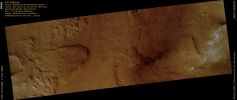
Psp_009368_1720_red.jpgIus Chasma (natural colors; credits: Lunexit)57 visiteThis image spans the floor of Ius Chasma’s Southern Trench. Ius Chasma is located in the Western Region of Valles Marineris, the Solar System’s largest canyon. This canyon is well known for its fine stratigraphic layers modified by wind and water.
The outcrops contain interchanging layers of dark and bright rocks. The layered deposits consist of dark basalt lava flows and bright sedimentary layers. The sediments are likely to be from atmospheric dust, sand, or alluvium from an ancient water source. The layers are visible on the gentle slopes above the canyon floor, in pitted areas, and in small mesa buttes. The floor of the canyon is littered with megaripples that are aligned in a North-South direction.
Ius Chasma is believed to have been shaped by a process called "sapping" that occurred when water seeped from the layers of the cliffs and evaporated before it reached the canyon floor. This process is thought to have dominated during the Amazonian Period.
Ius Chasma also has several structural features such as East trending normal Faults and Grabens that deformed the canyons. Recent geomorphological events include Mass Wasting (Avalanches) and minor Sapping from Gullies that continued to erode the canyon walls.MareKromium
(5 voti)
|
|

PSP_009233_2535_RED_abrowse-02.jpgEvolution of North Polar Dunes (edm - natural colors; credits: Lunexit)59 visiteThe circular shape of this Dunefield is interesting because the outer dunes reflect changing winds whereas the central dunes do not.
This could indicate several distinct stages in the formation of the Dunefield. On top of the dark dunes are tiny ripples similar to those seen on top of sand dunes on Earth.
It is likely that these dune ripples are active, as shown by avalanches (grainflow) from the crest of the dunes.MareKromium
(5 voti)
|
|
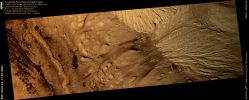
PSP_009149_1750_RED.jpgInverted Riverbed in Gale Crater (False Colors; credits: Lunexit)57 visiteGale Crater is a large, approximately 152 Km-diameter impact crater that lies near the Martian Equator. Contained within the crater is a massive central mound of layered material. With an average vertical thickness of almost 4 Km (about 2,4 miles), the Gale Crater Layered Deposits are twice as thick as the layers exposed along the Grand Canyon on Earth. Shown here is a portion of the mound with an inverted fluvial or river channel.
Topographic inversion occurs when sediments are cemented together, forming a harder layer that is resistant to later erosion. This later erosion has preferentially removed material outside the channel, leaving the former riverbed exposed as a ridge — such as a topographic high.
This inverted channel was originally detected by scientists using Mars Orbiter Camera (MOC) images onboard the Mars Global Surveyor Spacecraft.
Color variations visible in this image are mostly due to variable amounts of loose dark sediment that has accumulated unevenly across the scene.MareKromium
(5 voti)
|
|
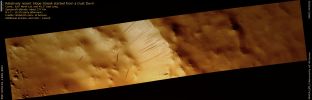
PSP_009192_1890_RED-00.jpgRelatively Recent Slope Streak started from a Dust Devil (ctx frame - natural colors; credits: Lunexit)61 visiteThis Slope Streak occurred in the time between a Viking image of the bottom of this crater (713A57, which saw no streak) and a MOC image (R12/01917, as reported by Schorghofer et al. (2007).
That paper suggested that the Slope Streak may have been caused by a Dust Devil that had passed by (its track is visible in the MOC image). Our HiRISE image shows that there isn’t a small hill or anything at this Slope Streak’s apex, but that the dust devil track really does intersect with the apex. It is likely that the Dust Devil may have caused this Slope Streak.
Dark Slope Streaks are visible in many places on the Martian surface, often where the dust cover is thick.
One explanation for Dark Slope Streaks is that they are little avalanches in the dust. The apexes of Slope Streaks (such as the point where they start from) are often at little hills or ridges on a larger slope, with the thinking that the dust here is already close to being too steep, and then any little perturbation will start one of these tiny avalanches.
Small craters have also been seen at slope streak apexes.MareKromium
(5 voti)
|
|
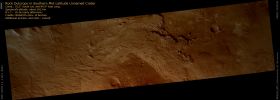
PSP_009151_1465_RED.jpgRock Outcrops in Southern Mid-Latitude Crater (natural colors; credits: Lunexit)59 visiteThis image shows part of the floor of a large Impact Crater in the Southern Hemisphere. The crater lies at the edge of the Hellas Impact Basin; although it is roughly 50 Km across, it is dwarfed by the giant Hellas structure, which has seen a varied and interesting geologic history.
This image captures a diverse range of rocks on the Crater Floor. A small cliff running across the middle of the image marks the edge of one rock unit, but variations in tone or texture in the northern part of the image suggest a varied history of deposition. Exposures of light, intermediate and dark materials may correspond to different types of deposition, or perhaps alteration after the rocks were laid down. Some units appear rich in boulders, suggesting that they are breaking up into blocks, while at other sites there are thin layers.
This diversity indicates a varied geologic history. Hellas Basin is a low Region, and may have once held lakes or seas where sediments could have been deposited.
This site is also just west of Hadriaca Patera, an old volcano. Sediment could also have been deposited by wind, or in streams on the surface. Unraveling the history of the region will require many images to illustrate the diversity of rocks and map out where they occur.MareKromium
(5 voti)
|
|
PSP_009138_2025_RED-01.jpgMineralogical Diversity in Nili Fossae (edm - natural colors; credits: Lunexit)59 visitenessun commentoMareKromium
(5 voti)
|
|

PSP_009160_2350_RED.JPGFresh Double-Layered Ejecta Crater (natural colors; credits: Lunexit)57 visiteThis scene features a High Latitude, Northern Hemisphere Crater with double-layered ejecta. The sharp rim and lack of small superposed craters indicates that this Crater is relatively young.
The semi-circular feature that parallels the Crater Rim is a terrace that probably formed as part of the Crater wall collapsed into the center. The circular mound in the center likely formed at the same time as the Crater itself.
Large craters on Mars can have central peaks; this Crater looks like it was on the cusp of having one. The linear features surrounding the Crater on its ejecta are striations that formed during the impact as material and wind exploded out from the center.
On the right side (Dx) of the scene, is a very distinct ejecta flow lobe (Lobate Ejecta). Lobate Ejecta is thought to form when an impact occurs on a surface with lots of volatiles — such as ices that quickly turn to gas when they are heated. The gases help make the ejecta flow like a fluid.MareKromium
(5 voti)
|
|

PSP_006271_2210_RED_abrowse.jpgPrimary and Secondary Craters in Arcadia Planitia (MULTISPECTRUM; credits: Lunexit)58 visiteThese unusual craters were spotted in Arcadia Planitia, which is part of an extensive region of Mars blanketed by a thick layer of bright dust.
Light southeasterly winds during southern spring and summer blow the dust towards the northwest (top left of the picture in the cutout above). The dust is trapped temporarily in the lee of crater rims, both inside the craters and along the outside rims where they form streamers that resemble St. Nick’s beard.
MareKromium
(5 voti)
|
|

PSP_008930_1880_RED.jpgStair-Stepped Mounds in Meridiani Planum (natural, but enhanced, colors; credits: Lunexit)58 visiteThis image shows layered sedimentary rocks that fill an impact crater in the Meridiani Planum Region of Mars.
These layered rocks may have formed through the accumulation of sediment (sand and dust) that were transported into this crater by blowing wind or flowing water. These sediments formed an extensive deposit that once covered the floor of the surrounding impact crater.
This crater is so large that the HiRISE image is entirely within it, and the crater rim is not visible. These sedimentary rocks were then eroded, likely by the wind. The original sand and dust were deposited in distinct layers within the crater; these layers now give the mounds their distinctive stair-stepped appearance, and are all that remain from this once extensive deposit.MareKromium
(5 voti)
|
|
| 2235 immagini su 187 pagina(e) |
 |
|
|
|
|
40 | |
|
|
|
|





