| Piú votate - Mars Reconnaissance Orbiter (MRO) |

PSP_009739_2580_RED_abrowse-2.jpgResidual Ice (edm - natural colors; credits: Lunexit)58 visiteIl dettaglio, palese tanto nella versione in b/n del frame, quanto in quella a colori naturali, è stato individuato dal bravissimo Dr Barca e, inizialmente, ci ha fatto pensare ad una possibile estrusione d'acqua la quale, poco dopo essere stata "espulsa", si è rapidamente congelata.
Ma sbagliavamo, poichè non si tratta, a nostro parere, del residuo di un fenomeno estrusivo.
Non lo è, perchè le estrusioni d'acqua (e fango) si manifestano - di solito, e "visivamente" - con accumuli caotici di blocchi di ghiaccio sporco di varie dimensioni intorno ad un'area di ghiaccio più limpido la quale è compatta e posizionata centralmente rispetto agli altri blocchi e blocchetti (provate a visualizzare, per capire bene, la conseguenza di uno "spruzzo" - tipo geyser - di acqua e fango, con l'acqua che poi gela rapidamente).
In Islanda, se volete, si può vedere qualcosa di simile.
Nel nostro caso di specie, comunque, si può dire che la posizione del dettaglio in oggetto è indicativa di un'area su cui si trova del semplice ghiaccio "sporco" (ghiaccio d'acqua, a giudicare dall'albedo e dal colore) residuale, sfuggito al disgelo grazie alla protezione offertagli dalla duna che lo sovrasta.
La configurazione delle dune che caratterizzano la zona, inoltre, ci dice che l'area gelata è posizionata su una superficie decisamente più bassa rispetto al Datum medio della regione, e quindi con niente (o poco) Sole che scioglie e niente (o poco) vento che "gratta & smuove".
Un accumulo di ghiaccio, quindi, destinato a "sopravvivere" MOLTO a lungo!...MareKromium
(5 voti)
|
|
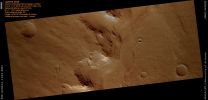
Psp_009601_1920_red.jpgLayered Shelf (possible natural colors; credits: Lunexit)59 visiteThis image shows the edge of a Layered Shelf in a large Impact Crater. Sediments form a bench with a flat top and steep edge along part of the interior wall. This site shows part of the steep edge of those deposits.
The bench is formed by an upper layer that is relatively hard and resistant, while lower rocks are soft. Once the upper cap layer is removed, the weaker material below is easily eroded. This structure can be seen here: at the very top of the bench is a relatively steep lip, while material below has a muted appearance. A few steep outcrops lower on the slope suggest that there could be other strong layers.
Because of pervasive dust cover, it is difficult to learn much about the nature of the rocks here. Dust builds up by settling out after the many large Martian Dust Storms. (The dark streaks running downhill are seen in many dusty parts of Mars and are thought to be traces of dust avalanches). However, some small-scale structures are visible through the dust. Some fine layering is also visible, particularly near the base of the slope.
The layers are probably still covered by dust, but not enough to completely obscure the underlying structure.MareKromium
(5 voti)
|
|
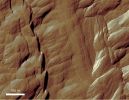
PSP_009927_1750_RED_abrowse-01.jpgExposed Layers in Gale Crater (EDM- Enhanced Natural Colors; credits: Lunexit)60 visiteThis edm is a small portion of a HiRISE image detailing the fine-scale layering evident in the upper mound. The layered deposits can be divided into 2 types: a lower mound with near-horizontal, flat layers, and an upper mound with more numerous, thinner layers (some of which have greater degree of tilt than the lower layers).
The origin of these thin, repetitive layers is unknown, but they likely reflect environmental changes that occurred while the layers were being deposited.
Today, erosion by wind scour has shaped them into the stair-step pattern that is reminiscent of parts of the American South-West.MareKromium
(5 voti)
|
|

PIA10148-LizardSkinTerrain~0.jpgLizard-Skin Surface Texture (natural colors; elab. Lunexit)57 visite The South Polar Region of Mars is covered seasonally with translucent CO2 ice.
In the Spring, gas subliming (evaporating) from the underside of the seasonal layer of ice bursts through weak spots, carrying dust from below with it, to form numerous Dust Fans aligned in the direction of the prevailing wind.
The dust gets trapped in the shallow grooves on the surface, helping to define the small-scale structure of the surface. The surface texture is reminiscent of lizard skin.MareKromium
(5 voti)
|
|
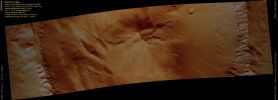
Psp_009677_2135_red.jpgBacolor Crater (natural colors; credits: Lunexit)59 visiteBacolor Crater is a pristine crater in the Northern Hemisphere. The linear striations visible at both sides (Sx and Dx) of the image are from the blast of the formation impact. This crater has a Central Peak, other mounds and terraces on its floor.
All of these features appeared during the final stages of crater formation.
The Northern Wall of the crater has landslides which have sculpted the Crater Rim. The Southern Wall has Gullies, thought to form by fluvial processes.
The Gullies here are more incised (cut into the slope) than the landslides are.MareKromium
(5 voti)
|
|
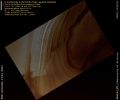
Psp_009390_2595_red.jpgUnconformity in North Polar Layered Deposits (natural colors; credits: Lunexit)59 visiteThis image features the North Polar Layered Deposits. The flat tongue-shaped feature at the bottom of the image is the surface of the cap.
The bright textured region near the top of the image is polygonal ground, which is commonly found in the Martian High-Latitudes. Polygonal ground formation is thought to relate to temperature cycles in ice-rich soil.
Just south of the polygonal ground, a bright layer within the cap can be seen eroding in the form of landslides, particularly near the center of the image.
The most noticeable part of the polar cap is visible in an unconformity, the horizontal break in the cap layers. An unconformity is caused by non-uniform erosion or deposition. In this case, non-uniform erosion or deposition might have occurred due to variable climate over geologic time.
MareKromium
(5 voti)
|
|

Psp_009502_1980_red.jpgDark Spot Near Olmpus Mons Volcano (natural colors; credits: Lunexit)57 visiteThis image covers a relatively dark-toned patch of ground West of the Olympus Mons volcano. This spot is one of several "Dark Areas" in this Region of Mars.
These Dark Spots are distinctive because much of the surrounding area appears to be covered by light-toned dust.
In pre-HiRISE images, the origin of this Dark Spot was ambiguous. This HiRISE image reveals that the dark color is likely the result of accumulations of Basaltic Sand (smooth, brown-colored material in this natural color view) on top of otherwise relatively dust-free bedrock.
Evidence of layering is also visible within the dark area. There are alternating bands of lighter- and darker-toned material, consistent with alternating layers of bedrock. These alternating bands are not apparent outside of the Dark Area. This may mean that alternating layers of bedrock only occur within the dark area, or that these bedrock layers occur throughout the region but are covered and obscured by light-toned dust outside of the Dark Area.MareKromium
(5 voti)
|
|

Psp_009501_1755_red.jpgTube-Fed Lava Flow Field (natural colors; credits: Lunexit)59 visiteThis Lava Flow Field is part of a Small Shield Volcano within the Lava Plains South of Pavonis Mons. It illustrates the importance of Lava Tubes in the formation of large lava flow fields.
Shield Volcanoes are often covered by a combination of open Lava Channels and partly enclosed Lava Tubes, through which lava once flowed when the volcano was active. Tubes are often located axial to topographic ridges, and after a Lava Flow ends, a tube can drain leaving an empty space into which the roof can collapse.
However, if a tube is filled to capacity or under pressure when the lava is flowing, narrow ridge-like features and/or small Lava Flow breakouts can form.
This scenario is one possible explanation for the Ridged Lava Flow in the center of this image.
Here, a narrow wall-like feature is axial to a larger topographic ridge that appears to be the source for a series of smaller Lava Flows.MareKromium
(5 voti)
|
|
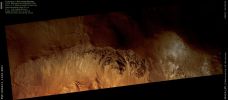
PSP_006672_1420_RED_abrowse~0.jpgFeatures of the Hellas Montes (MULTISPECTRUM; credits: Lunexit)60 visiteThe Hellas Montes are a group of mountains along the western rim of the giant Hellas Basin on Mars.
The Hellas Basin is the largest of the obvious impact craters on the Red Planet. It is very ancient and has been partially filled by sediments. The Hellas Montes are part of the eroded crater rim.
In the central part of this HiRISE image, we can see steep slopes where landslides have exposed a variety of rocks. The jumble of blocks, rather than stacks of layered sediments or lavas, is consistent with impact crater ejecta. On flatter slopes, the ground is covered with a mantling deposit that is generally considered to be ice-rich dust.
In the southern part of the image (Dx), a large circular depression — rimmed by a zone with many large boulders — is (barely) visible. This is an impact crater with a relatively thin mantling deposit on its rim.
MareKromium
(5 voti)
|
|
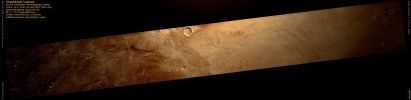
PSP_006677_1475_RED_abrowse~0.jpgStreamlined Features near Hale Crater (natural colors; credits: Lunexit)60 visiteThis image contains streamlined features located North-West of Hale Crater, a 120 x 150 Km diameter impact crater that is possibly the youngest of its size on Mars.
A streamlined feature is one that is raised, possessing sharp edges. It is narrower at the downstream end because of the flow that carved it. Any fluid — lava, water, mud, and even flowing ice — can form streamlined features. Many portions of the image are filled with craters, while others are rather smooth.
The streamlined features in this image tend to be smoother, suggesting they are relatively young.
Their origin might be related to the impact that formed the crater.
MareKromium
(5 voti)
|
|
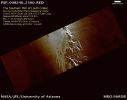
Psp_008240_2500_red.jpgLouth Crater South Rim (Extremely Enhanced Natural Colors; credits for the additional process. and color: Dr Paolo C. Fienga - Lunexit Team)59 visitenessun commentoMareKromium
(5 voti)
|
|

PSP_009115_2040_red.jpgCharacterize Surface Hazards and Science of Possible MSL Rover Landing - Mawrth Vallis (natural colors; credits: Lunexit)58 visitenessun commentoMareKromium
(5 voti)
|
|
| 2235 immagini su 187 pagina(e) |
 |
|
|
|
|
39 | |
|
|
|
|





