| Piú votate - Mars Reconnaissance Orbiter (MRO) |

PSP-20081120_spirit.jpgSpirit from orbit57 visiteThe solar system's most celebrated team of off-planet drivers cheered when they heard the news. Spirit had phoned home from Mars, ending four days of silence. The team had kept the rover safe, with help from a friend named "Marci."
Spirit had survived a fierce and sudden dust storm that had driven solar power to all-time lows. Without being able to notify Earth, Spirit had followed instructions the team sent to protect the rover.
The team had received warning from scientists who keep tabs on Martian weather with MARCI -- short for Mars Color Imager. From orbit, the instrument showed thick, swirling dust clouds advancing from the west. Engineers responded with instructions to conserve energy. They told Spirit to turn off a heater and do only two things each day -- check battery power and dust in the atmosphere.
As directed, Spirit contacted Earth on Nov. 13, 2008. MareKromium
(5 voti)
|
|
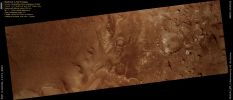
PSP_010206_1975_RED_abrowse-00.jpgAncient Bedrock and Megabreccia in Nili Fossae region (ctx frame - possible True Colors; credits: Lunexit)58 visiteThis image captures a record of changing environments on ancient Mars, as recorded in the rock record at Nili Fossae.
In addition to Megabreccia (see the edm that follows), the image shows layered rocks which have been shown by the orbiting spectrometers OMEGA and CRISM to contain Clay minerals. These minerals must have formed in the presence of water, and may have later been transported and deposited here in sedimentary layers.
Most of the layers appear to overlie the exposures of Megabreccia, but some Megabreccia blocks are themselves internally layered, suggesting that sedimentary processes were active here early in Martian History.
Above the clay-bearing layers is a dark, rough-textured rock unit that was emplaced later. Geologic mapping of the Nili Fossae Region has shown this deposit to be a Lava Flow from the Syrtis Major Volcano to the South. The minerals detected in the Lava Flow suggest that liquid water had become rare on the Martian Surface by the time the flow occurred.MareKromium
(5 voti)
|
|
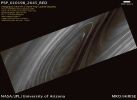
PSP_010198_2645_RED.jpgStratigraphy of the NPLD (possible True Colors; credits: Lunexit)57 visiteThis image shows an example of layers in the Martian NPLD. These Deposits, part of the Planum Boreum dome, are composed mainly of water ice and small amounts of dust.
The layers within these Deposits are exposed by shallowly-sloping troughs that cut into them. This image is particularly interesting because it crosses complicated trough geometry, making the layers appear curved and exposing multiple stratigraphic levels.
Note that layers of different thicknesses are visible. Layer thickness is directly related to the accumulation rate of the layer; a higher accumulation rate will lead to a thicker layer.
However, a myriad of factors work together to influence accumulation rate, such as the amount of Sunlight reaching the Surface and the amount of water vapor existing in the contemporaneous Atmosphere.MareKromium
(5 voti)
|
|
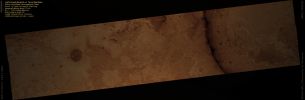
PSP_010222_1815_RED.jpgLight-toned Bedrock in Terra Meridiani (possible True Colors; credits: Lunexit)57 visiteThis observation shows part of a broad expanse of bare rock in Terra Meridiani. This is a large area with abundant sedimentary rocks forming a stack hundreds of meters thick, and now being eroded into a landscape reminiscent of the South-Western United States.
The timescale involved in depositing and eroding these layers is evident from the remnant impact craters preserved here. The large arc in the image is the rim of one crater; the smaller, circular dark spots are traces of other impacts. Light sediments are found both inside and outside the large crater, indicating that this crater formed during the period of sediment deposition. It is likely that this depression, which was probably more than a kilometer deep when it formed, was completely filled and buried and is now being exhumed. Crater densities are often used to estimate the age of surfaces on Mars, but here the rate of erosion is enough to erase small craters, reducing the apparent age of the surface. These rocks probably date from an early era of Martian History, but no fresh, pristine craters are visible.
The smaller circular patches are also impact craters seen somewhere in a complex cycle of burial and erosion. They are filled with dark material which probably mantled the region at one point, most likely after all of the light material was deposited. In some places this appears to have been hardened into rock, as in the large dark circle in the north-central part of the image. Material eroded from this hardened mantle may now be forming the ripples seen in many places as it is blown by the wind; the color of the ripples is similar to the slabs of dark mantle.
At the finest scale, the light sediments are intricately textured. A diverse assortment of fine cracks called joints are visible. The scale and density of these joints varies across the image; this suggests variations in the properties of the rocks. Although the image as a whole is a relatively flat plain, at small scale the surface is intricately rough. The balance between erosion and rock strength has left a surface with many small knobs, mesas, cliffs, and bumpy textures.
Further evidence for the diversity of rocks here comes from the enhanced color. The dark mantling materials are generally blue in the RGB color image while the sediments are generally pale, but a diverse range of hues indicates variations in the composition (or in the amount of sand and dust trapped on the surface by textures of varying roughness). This helps to highlight layering and shows which rocks are most similar to each other.MareKromium
(5 voti)
|
|

PSP_008598_2155_RED_abrowse~0.jpgLineated Valley Fill in Coloe Fossae (MULTISPECTRUM; credits: Lunexit)68 visiteThis Region consists of several relatively straight and narrow canyons located near the boundary between the high-standing, heavily cratered areas of the Southern Hemisphere and the low, uncratered plains that cover most of the Northern Hemisphere of Mars.
Transitional areas such as this are known as the “Fretted Terrain” and are characterized by a complicated mix of cliffs, mesas, buttes, and canyons.
This image reveals a canyon with relatively steep and smooth walls. The floor of the canyon displays a complex set of ridges and grooves that are generally parallel to the canyon walls.
The material comprising the canyon floor is common observed in Fretted Terrain and is called "Lineated Valley Fill" (LVF).
The cause of the LVF texture is not well understood but may result from patterns of ice rich soils or ice loss. The linear alignment may be caused by the downhill movement of ice-rich soil, or glacial flow in dirty ice or ice-rich soil.MareKromium
(5 voti)
|
|

PSP_007392_2650_RED_abrowse~0.jpgNorthern Hemisphere Ice Cap (False Colors; credits: Lunexit)58 visiteThis image shows layering within the Northern Hemisphere Ice Cap, which probably reflects seasonal variability in accumulation of the ice versus sublimation (going from solid to a gas).
The presence of sand dunes indicates transport of sedimentary materials by wind. Erosion of layering is apparent as a series of undulating ridges at the transition between the Layered Terrain and the Dune-Field.
Near the top of the image several vents occur where materials from the shallow subsurface are erupted onto the surface. MareKromium
(5 voti)
|
|
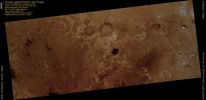
PSP_009929_2020_RED_abrowse-00.jpgAncient Layered Rocks in Nili Fossae (ctx frame - natural colors; credits: Lunexit)57 visiteThis image covers a flat plain in the Nili Fossae Region of Mars. The portion shown here is roughly 400 meters, or 1/4 of a mile, across.MareKromium
(5 voti)
|
|

PSP_009929_2020_RED_abrowse-01.jpgAncient Layered Rocks in Nili Fossae (edm - natural colors; credits: Lunexit)66 visiteBright, fractured Bedrock is visible underlying Dunes or Ripples of Wind-Blown Sand.
The parallel, dark brown curves across the Bedrock Surface (underneath the Dunes) that can be seen in this edm frame, are the edges of successive rock layers.
These may appear dark because dark sand has become trapped at the edges of the layers. Successive layers in the bedrock are also exposed in the walls of degraded impact craters elsewhere in the ctx image.
The Layered Rocks here are billions of years old, and infrared spectra from the CRISM instrument have inferred that they contain minerals such as Clays and Carbonate that likely formed when liquid water chemically altered these rocks.
This evidence for past water activity, combined with the general flatness of this particular location, make it a good candidate Landing Site for future Mars Rover missions.MareKromium
(5 voti)
|
|

PSP_010180_2645_RED_abrowse-01.jpgSmall and young Impact Crater in the NPLD (edm - natural colors; credits: Lunexit)56 visiteThe Impact Crater is about 66 meters (215 feet) in diameter. Ejecta from this Crater can be seen extending primarily to the North-West.
The asymmetry in the crater ejecta can be an effect of atmospheric winds associated with the impact itself but, in this case, is most likely the result of an oblique impact (a low impact angle with respect to the horizontal).
As impact angles decrease, the ejecta blanket is increasingly offset downrange.
The impactor that formed this crater approached the surface from the South-East. The slightly elliptical shape of the crater is also a result of an oblique impact.MareKromium
(5 voti)
|
|
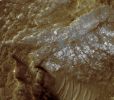
PSP_010012_2225_RED_abrowse-01.jpgDeep Rocks Unveiled at Bonestell Crater (edm; natural colors; credits: Lunexit)57 visiteThis edm (437x500 mt or 479x547 yards) of the HiRISE image shows a portion of Bonestell's Central Peak. HiRISE reveals details in the structure and color of these deep rocks that will help scientists decipher the origin and history of the Northern Lowlands.MareKromium
(5 voti)
|
|
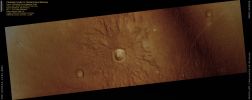
Psp_009654_2245_red.jpgPedestal Crater in Deuteronilus Mensae (natural colors; credits: Lunexit)59 visiteThis crater with spectacular ejecta is located in the Northern Mid-Latitudes in the Deuteronilus Mensae, located near the dichotomy boundary, where the Southern Highlands transition into the Northern Lowlands.
The crater has raised, fluidized ejecta. Scientists think that fluidized ejecta forms when an impact occurs into ice-rich material. The interior of the crater shows some material, particularly on the West wall, that has detached and is flowing into the crater center. This suggests the presence of ground ice.MareKromium
(5 voti)
|
|
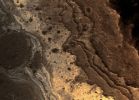
PIA11377.jpgMartian "Opal" (natural colors; credits: Lunexit)64 visiteNASA's Mars Reconnaissance Orbiter has revealed Martian rocks containing a hydrated mineral similar to Opal.
The rocks are light-toned and appear cream-colored in this natural-color image taken by the High Resolution Imaging Science Experiment (HiRISE) camera. Images acquired by the orbiter reveal that different layers of rock have different properties and chemistry.
The Opal minerals are located in distinct beds of rock outside of the large Valles Marineris Canyon System and are also found in rocks within the canyon. The presence of opal in these relatively young rocks tells scientists that water, possibly as rivers and small ponds, interacted with the surface as recently as two billion years ago, one billion years later than scientists had expected.
The discovery of this new category of minerals spread across large regions of Mars suggests that liquid water played an important role in shaping the Planet's Surface and possibly hosting life. MareKromium
(5 voti)
|
|
| 2235 immagini su 187 pagina(e) |
 |
|
|
|
|
38 | |
|
|
|
|





