| Piú votate - Mars Reconnaissance Orbiter (MRO) |
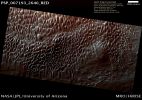
PSP_007193_2640_RED_abrowse-00~0.jpgDefrosting Northern Dunes (context frame - MULTISPECTRUM; credits: Lunexit)56 visiteIn Northern Winter a Seasonal Polar Cap composed of Carbon Dioxide (CO2) ice (dry ice) forms in the North Polar Region. This Cap covers a vast sea of dunes at high Northern Latitudes. In the spring the ice sublimates (evaporates directly from ice to gas) and this active process loosens and moves tiny dust particles.MareKromium
(5 voti)
|
|

ESP_011277_1825_RED_abrowse.jpgUnnamed Crater with Layers in Meridiani Planum (Natural Colors; credits: Lunar Explorer Italia)74 visiteMars Local Time: 15:47 (middle afternoon)
Coord. (centered): 2,2° North Lat. and 357,5° East Long.
Spacecraft altitude: 270,8 Km (such as about 169,2 miles)
Original image scale range: 27,1 cm/pixel (with 1 x 1 binning) so objects ~81 cm across are resolved
Map projected scale: 25 cm/pixel
Map projection: EQUIRECTANGULAR
Emission Angle: 3,9°
Phase Angle: 60,7°
Solar Incidence Angle: 57° (meaning that the Sun is about 33° above the Local Horizon)
Solar Longitude: 178,0° (Northern Summer)
Credits: NASA/JPL/University of Arizona
Additional process. and coloring: Lunar Explorer ItaliaMareKromium
(5 voti)
|
|

ESP_011331_1560_RED_abrowse.jpgTerrain in Eberswalde Crater (possible Natural Colors; credits: Lunar Explorer Italia)58 visiteMars Local Time: 15:54 (middle afternoon)
Coord. (centered): 23,9° South Lat. and 326,8° East Long.
Spacecraft altitude: 258,6 Km (such as about 161,6 miles)
Original image scale range: 25,9 cm/pixel (with 1 x 1 binning) so objects ~78 cm across are resolved
Map projected scale: 25 cm/pixel
Map projection: EQUIRECTANGULAR
Emission Angle: 1,3°
Phase Angle: 60,3°
Solar Incidence Angle: 61° (meaning that the Sun is about 29° above the Local Horizon)
Solar Longitude: 180,4° (Northern Autumn)
Credits: NASA/JPL/University of Arizona
Additional process. and coloring: Lunar Explorer ItaliaMareKromium
(5 voti)
|
|
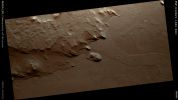
Psp_010829_1880_red.jpgFlat-topped Sinuous Ridge contacting Pedestal Crater (possible Natural Colors; credits: Lunar Explorer Italia)57 visiteMars Local Time: 15:42 (middle afternoon)
Coord. (centered): 7,8° North Lat. and 348,2° East Long.
Spacecraft altitude: 276,2 Km (such as about 172,6 miles)
Original image scale range: 27,6 cm/pixel (with 1 x 1 binning) so objects ~83 cm across are resolved
Map projected scale: 25 cm/pixel
Map projection: EQUIRECTANGULAR
Emission Angle: 1,3°
Phase Angle: 56,3°
Solar Incidence Angle: 55° (meaning that the Sun is about 35° above the Local Horizon)
Solar Longitude: 159,0° (Northern Summer)
Credits: NASA/JPL/University of Arizona
Additional process. and coloring: Lunar Explorer ItaliaMareKromium
(5 voti)
|
|

Craters-Wirtz_Crater-Psp_001349_1310_red~0.jpgHigh-Viscosity Flows inside Wirtz Crater (possible True Colors; credits: Lunar Explorer Italia)67 visitenessun commentoMareKromium
(5 voti)
|
|
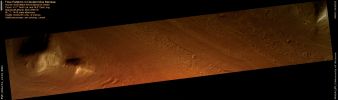
PSP_006252_2220_RED_abrowse.jpgLineated Valley Fill (MULTISPECTRUM; credits: Lunexit)57 visiteFlow patterns dominate this Region of Mars in Deuteronilus Mensae. Many of the valley floors in the area exhibit complex alignments of small ridges, hills, and pits – often called “lineated valley fill”. The cause of the small-scale texture is not known, but it may result from patterns in ice rich soils or the loss of ice.
The linear alignment we see is probably caused by downhill movement of ice-rich soil, or glacial flow in dirty ice or ice-rich soil.
The result is flow patterns, called “stream lines”, that follow the valleys and around obstacles. Many of the large knobs and mesas in this region are also surrounded by aprons of debris that appear to have flowed away from the knobs and may be ice-rich themselves. Around one large knob in this image the debris flow appears to lie on top of the lineated valley fill and is therefore probably a younger deposit.MareKromium
(5 voti)
|
|
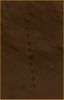
PSP_010047_1745_RED-01.jpgStar-like shaped Hill in Terra Tyrrhena (edm - possible True Colors; credits: Lunar Explorer Italia)57 visite...Pubblichiamo questo extra-detail magnification (edm) girando a Voi la domanda postaci dal nostro Caro Amico "Cano00": questa striscia di puntini (si direbbero dei mini-segmenti scuri) allineati, che cos'è? E' un intrigantissimo rilievo superficiale, oppure è un image-artifact?
Ed in ogni caso: COMPLIMENTI a Cano00 per l'occhio (straordinario) che ha avuto!...MareKromium
(5 voti)
|
|
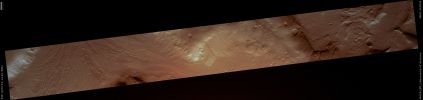
Psp_009719_2230_red.jpgFretted Terrain in Protonilus Mensae (possible True Colors; credits: Lunar Explorer Italia)56 visiteCaption NASA:"This observation shows Fretted Terrain in valleys located in Protonilus Mensae near the so-called "Crustal Dichotomy", such as the Region that separates the Southern Hemisphere Highlands from the Northern Hemisphere Lowlands.
Fretted Terrain is thought to involve movement of ice-rich material in its formation. The speckled texture of the valley fill (i.e. the Fretted Terrain) is probably due to sublimation, when ice goes directly from a solid to a gas, leaving behind empty space under the soil into which overlying material can collapse.
The linear striations in the valley fill mark the direction of movement. For example, in the valley near the top of the image (left), the material was moving across the scene.
Also in this scene, are several small craters in various stages of degradation".
§§§
Mars Local Time: 15:20 (early afternoon)
Coord. (centered): 42,4° North Lat. and 48,1° East Long.
Spacecraft altitude: 295,4 Km (such as about 184,6 miles)
Original image scale range: 59,1 cm/pixel (with 1 x 1 binning) so objects ~1,77 mt across are resolved
Map projected scale: 50 cm/pixel
Map projection: EQUIRECTANGULAR
Emission Angle: 0,4°
Phase Angle: 46,0°
Solar Incidence Angle: 46° (meaning that the Sun is about 44° above the Local Horizon)
Solar Longitude: 116,4° (Northern Summer)
Credits: NASA/JPL/University of Arizona
Additional process. and coloring: Lunar Explorer ItaliaMareKromium
(5 voti)
|
|
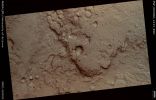
PSP_009960_2235_RED.jpgInverted Channel with Phyllosilicates (possible True Colors; credits: Lunar Explorer Italia)66 visiteMars Local Time: 15:26 (early afternoon)
Coord. (centered): 43,4° South Lat. and 309,2° East Long.
Spacecraft altitude: 303,5 Km (such as about 189,7 miles)
Original image scale range: 60,7 cm/pixel (with 1 x 1 binning) so objects ~1,82 mt across are resolved
Map projected scale: 50 cm/pixel
Map projection: EQUIRECTANGULAR
Emission Angle: 6,6°
Phase Angle: 42,0°
Solar Incidence Angle: 48° (meaning that the Sun is about 42° above the Local Horizon)
Solar Longitude: 125,2° (Northern Summer)
Credits: NASA/JPL/University of Arizona
Additional process. and coloring: Lunar Explorer ItaliaMareKromium
(5 voti)
|
|
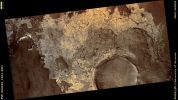
PSP_009945_1835_RED.jpgExhumed Impact Crater in Equatorial Layered Deposits (possible True Colors; credits: Lunar Explorer Italia)60 visiteMars Local Time: 15:30 (middle afternoon)
Coord. (centered): 3,4° North Lat. and 2,9° East Long.
Spacecraft altitude: 273,7 Km (such as about 171,1 miles)
Original image scale range: 27,4 cm/pixel (with 1 x 1 binning) so objects ~82 cm across are resolved
Map projected scale: 25 cm/pixel
Map projection: EQUIRECTANGULAR
Emission Angle: 6,2°
Phase Angle: 59,3°
Solar Incidence Angle: 54° (meaning that the Sun is about 36° above the Local Horizon)
Solar Longitude: 124,7° (Northern Summer)
Credits: NASA/JPL/University of Arizona
Additional process. and coloring: Lunar Explorer ItaliaMareKromium
(5 voti)
|
|
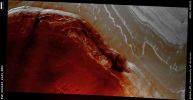
PSP_009945_2645_RED.jpgExposure of North Polar Basal Unit (possible True - but enhanced - Colors; credits: Lunar Explorer Italia)114 visiteMars Local Time: 14:37 (early afternoon)
Coord. (centered): 84,4° North Lat. and 343,5° East Long.
Spacecraft altitude: 330,4 Km (such as about 206,5 miles)
Original image scale range: 33,1 cm/pixel (with 1 x 1 binning) so objects ~99 cm across are resolved
Map projected scale: 25 cm/pixel
Map projection: EQUIRECTANGULAR
Emission Angle: 14,2°
Phase Angle: 53,9°
Solar Incidence Angle: 65° (meaning that the Sun is about 25° above the Local Horizon)
Solar Longitude: 124,7° (Northern Summer)
Credits: NASA/JPL/University of Arizona
Additional process. and coloring: Lunar Explorer ItaliaMareKromium
(5 voti)
|
|
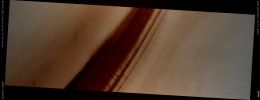
Psp_009589_2675_red.jpgHigh-Latitude Exposure of North Polar Layered Deposits (possible True Colors; credits: Lunar Explorer Italia)57 visiteMars Local Time: 15:35 (middle afternoon)
Coord. (centered): 87,5° North Lat. and 327,0° East Long.
Spacecraft altitude: 328,0 Km (such as about 205,0 miles)
Original image scale range: 32,8 cm/pixel (with 1 x 1 binning) so objects ~98 cm across are resolved
Map projected scale: 25 cm/pixel
Map projection: EQUIRECTANGULAR
Emission Angle: 15,8°
Phase Angle: 52,4°
Solar Incidence Angle: 64° (meaning that the Sun is about 26° above the Local Horizon)
Solar Longitude: 111,8° (Northern Summer)
Credits: NASA/JPL/University of Arizona
Additional process. and coloring: Lunar Explorer ItaliaMareKromium
(5 voti)
|
|
| 2235 immagini su 187 pagina(e) |
 |
|
|
|
|
36 | |
|
|
|
|





