| Piú votate - Mars Reconnaissance Orbiter (MRO) |

ESP_013545_1110_RED_abrowse-01.jpgSouthern Dust Devil (EDM - Natural Colors; credits: Lunexit)59 visitenessun commentoMareKromium
(5 voti)
|
|
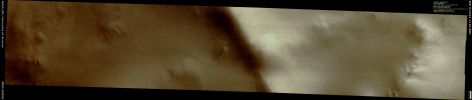
ESP_013545_1110_RED_abrowse-00.jpgSouthern Dust Devil (Ctx frame - Natural Colors; credits: Lunexit)58 visitenessun commentoMareKromium
(5 voti)
|
|

ESP_013954_1780_RED_abrowse-00.jpgOpportunity near Victoria Crater (Natural - but slightly enhaced - Colors; credits: Lunexit)58 visitenessun commentoMareKromium
(5 voti)
|
|

ESP_012584_1265_RED_abrowse-01.jpg"Hot Surprise" in Nia Vallis (EDM - credits: Dr M. Faccin)115 visiteUn inconfondibile "segno di calore" è apparso in quelle che, a nostro parere, sono le immediate vicinanze della Superficie: una piccola "fiamma" che, se non altro nella sua forma (a "Fiaccola", o "Flare"), nelle sue dimensioni (siamo nell'ordine del metro o poco più) e colore (la Fiaccola, guarda caso, è "Blu"...), ci ricorda la fantomatica Blue Flare che tanto ha intrigato ed intriga i Ricercatori di Anomalìe Lunari.
In questo frame, la nostra piccola "Blue Flare" aleggia/emerge sulla/dalla Superficie di Nia Vallis o nelle sue immediatissime vicinanze (ossìa potrebbe librarsi a pochi metri dal suolo).
La configurazione del dettaglio - una volta escluso l'image-artifact - ci suggerisce l'eventualità per cui si possa trattare di un fenomeno equiparabile ai cosiddetti "fuochi fatui", di terrestre (e, spesso, "lugubre") memoria, ossìa combustione di modesti quantitativi di gas derivanti da decomposizione di elementi organici (usualmente si tratta di Metano o Fosfano).
I luoghi "preferiti" per la verificazione di questo tipo di fenomeni sono i cimiteri, le aree ricche di acque stagnanti o semi-stagnanti (paludi e stagni) e le brughiere.
In questo caso...siamo su Marte e quindi, tutto sommato, i cimiteri ci sentiamo di escluderli come possibile causa della Flare.
Ed anche la brughiera non sembra un luogo attinente, vista la regione sorvolata dalla Sonda.
Ma come escludere la presenza di acque stagnanti sub-superficiali, magari ricchissime di elementi organici?
Cosa c'è - REALMENTE - nel sottosuolo di Marte?MareKromium
(5 voti)
|
|
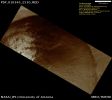
PSP_010345_2510_RED_abrowse.jpgUnnamed Crater in Vastitas Borealis (Natural Colors; credits: Lunar Explorer Italia)58 visitenessun commentoMareKromium
(5 voti)
|
|
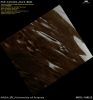
PSP_010369_2625_RED_abrowse.jpgDunes and Brown-Orange Streaks in Abalos Mensa (ctx frame - Natural Colors; credits: Lunexit)57 visitenessun commentoMareKromium
(5 voti)
|
|
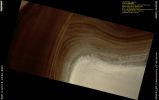
PSP_010374_2650_RED_abrowse.jpgNorth Polar Layers (Natural Colors; credits: Lunar Explorer Italia)59 visitenessun commentoMareKromium
(5 voti)
|
|

ESP_012572_1685_RED_abrowse.jpgLayering and Faulting in Melas Chasma Layered Deposits (Natural Colors; credits: Lunar Explorer Italia)56 visitenessun commentoMareKromium
(5 voti)
|
|

ESP_011884_2045_RED_abrowse-02.jpgUnusual Translucent Surface on the edge of a candidate Collapse Pit (edm frame - Natural Colors, credits: Lunar Explorer Italia)80 visitenessun commentoMareKromium
(5 voti)
|
|

ESP_011884_2045_RED_abrowse-01.jpgUnusual Translucent Surface on the edge of a candidate Collapse Pit (edm frame - inset in False Colors, credits: Dr M. Faccin; inset in Natural Colors, credits: Lunar Explorer Italia)107 visiteOsservate attentamente: appena visibile nell'inset in Colori Naturali, ma del tutto evidente in quello elaborato in Falsi Colori, potete vedere NITIDAMENTE il margine (bordo) inferiore del pozzo (caratterizzato da piccoli accumuli di sabbia e pietrisco) anche guardando ATTRAVERSO LA SUPERFICIE TRASLUCIDA (color ambra nella versione in Colori Naturali e color celeste nella versione in Falsi Colori) che sembra formare una sorta di "anello" (o un numero "9") intorno al bordo superiore del pozzo.
Di qualunque materia si tratti, questo fenomeno a noi sembra straordinario; e a Voi???MareKromium
(5 voti)
|
|
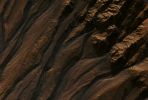
PSP_003583_1425_RED_browse-02.jpgGullies near Gorgonum Chaos (edm - Natural Colors; credits: Dr M. Faccin)58 visitePSP_003583_1425 shows incredible details of an Unnamed Crater with Gullies that provides strong evidence for gully formation involving fluid flow.
Of note is the variety of gully morphologies along the crater walls. The North and West Walls have Gullies, while the South Wall has only Landslides.
"Mass Wasting" is the more general term geologists use to describe Landslides, slumps, and other movements of the ground in response to gravity. It usually occurs on steep slopes when the force of gravity causes weak or loose material to travel downslope. Mass Wasting produces structures that are sometimes similar to gully channels, but which can usually be distinguished by their occurrence on steep slopes.
The Gullies on the North Wall have eroded all the way to the Crater Rim. They appear older than other nearby Gullies because they have existed long enough to be modified by permafrost processes as evidenced by the polgyonal fractures found on some of the channel and inter-gully walls.
Another noticeable difference among the gullies is channel lengths. The Gullies on the North Wall and the group just to the left of these have much shorter channels than the Gullies on the North-Western Wall. It is possible that the Gullies with shorter channels had less fluid flow through their systems. The Gullies appear to originate around a sequence of rocky layers near the Crater Rim.
Many of the gully channels appear to have boulders littered throughout. This is suggestive of a fluid flowing in these channels; a fluid would preferentially transport smaller particles and leave behind the larger ones, such as the boulders seen here.
There are many overprinted small channels in each gully, as can be seen in this edm. These are indicative of multiple flow events such that some channels experience flow, then are abandoned.
The edm also shows several channels merging.
Particularly interesting is the channel flowing from the top of the scene. There are several intertwining channels that merge into one just to the right of the center of the subimage. However, the way some channels truncate others suggests that there were at least three episodes of flow through this area. (written by Kerry Kolb)MareKromium
(5 voti)
|
|

ESP_012551_1750_RED_abrowse.jpgSulphate and Clay Strata inside Gale Crater (Natural Colors; credits: Lunar Explorer Italia)58 visitenessun commentoMareKromium
(5 voti)
|
|
| 2235 immagini su 187 pagina(e) |
 |
|
|
|
|
32 | |
|
|
|
|





