| Piú votate - Mars Reconnaissance Orbiter (MRO) |

PSP_002922_1725_RED_abrowse-00.jpgGlacier-like Flow on Arsia Mons (CTX frame - Natural Colors; credits for the additional process. and color.: Dr Paolo C. Fienga - Lunexit Team)57 visiteThis observation shows a "Glacier-like Flow" in a Depression located on the flanks of Arsia Mons.
Arsia Mons is one of the large Martian Volcanoes that sits near the Equator on the Tharsis Rise. Downslope is towards the upper right of CTX frame, and the Flow is in this direction. It is interesting to note that the Depression is not directly radial from the Volcano's Peak, but rather oriented approximately 45° away, along the Flanks of the Volcano.
The pitted texture of the material suggests that sublimation is occurring or has occurred. The Surface Temperature and Pressure on Mars are such that water in ice-rich material can easily sublimate leaving behind a depression where the volatiles were removed.MareKromium
(5 voti)
|
|
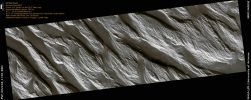
PSP_002244_1720_RED_abrowse.jpgWhite Rock (Saturated Natural Colors; credits for the additional process. and color.: Dr Paolo C. Fienga - Lunexit Team)56 visiteThis image shows a portion of a relatively bright landform named "White Rock" on the Floor of Pollack Crater, in the Sinus Sabaeus Region of Mars.
Data from the Mars Global Surveyor Thermal Emission Spectrometer (TES) indicates that this landform is not anomalously bright, relative to other bright Martian Regions. Further, the apparent brightness seen here is due to contrast with other materials on the Crater Floor.
Dunes and Ripples are visible in the dark material between the bright ridges. Their orientations appear to be influenced by wind directionally channeled by the ridges.
Material appears to have been shed from the white landform and deposited on the darker bedforms indicating that the light-toned outcrops break down into fine materials.
Its high albedo and location in a topographic basin have led to suggestions that White Rock is an erosional remnant of an ancient lacustrine evaporate deposit. Other interpretations include an eroded accumulation of compacted or weakly cemented aeolian sediment.MareKromium
(5 voti)
|
|
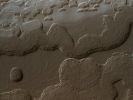
SPLD-PIA13269-PCF-LXTT3.jpgSouth Polar Layered Deposits and Residual Cap (Natural Colors; credits for the additional process. and color.: Dr Paolo C. Fienga - Lunexit Team)58 visiteThis image from NASA's Mars Reconnaissance Orbiter (MRO) shows a variety of surface textures within the South Polar Residual Cap of Mars.
It was taken during the Southern Spring, when the Surface was covered by seasonal CO2 Frost, so that Surface relief is easily seen. Illumination is from the bottom left, highlighting long Troughs at to the right and round pits and irregular Mesas to the left of center.
These unique landforms are common in the South Polar Residual Cap, which is known from previous Mars Global Surveyor images to be eroding rapidly in places. Right of center, SPLDs are exposed on a Sun-facing Scarp. These Deposits are older than the Residual Ice Cap, and the Layers are thought to record climate variations on Mars similar to ice ages on Earth.MareKromium
(5 voti)
|
|

ESP_018011_2565_RED_abrowse.jpgBetween Abalos and Olympia Undae... (Absolute Natural Colors; credits: Dr Paolo C. Fienga - Lunexit Team)55 visiteThis HiRISE image shows some large Sand Dunes near the North Pole of Mars. The picture was taken in summertime, with only small patches of ice remaining on the Surface: this show up as bright, somewhat blue, spots on slopes that provide some shading from the Sun.
Geologists would classify these Dunes as "sand-starved" because the ground between the Dunes has almost no sand; in addition, this ground shows a pattern of cracks that is typical of icy permafrost undergoing through seasonal expansion and contraction.
It is also possible that some Subsurface Ice exists inside the Dunes themselves; if so, the Dunes are not currently moving, and the ice is acting as a "stabilizer".
This idea is supported by the observation that there are small Landslide Gullies being cut into the Dunes, something not seen if the Dunes are rejuvenated as they move in the wind. However, to test this idea this area has been repeatedly imaged by multiple cameras on different spacecrafts.
With meticulous care it will be eventually possible to determine just how much the Dunes have moved or changed over the past years.MareKromium
(5 voti)
|
|
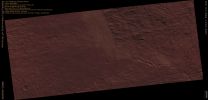
ESP_017888_1950_RED_abrowse.jpgOlympus' Lava Flows (Extremely Enhanced Natural Colors; credits for the additional process. and color.: Dr Paolo C. Fienga - Lunexit Team)55 visiteThe flanks of Olympus Mons are covered with Lava Flows (one on top of the other) Most of these Flows are relatively narrow, with a channel running down the middle. They appear similar to the Lava Flows found on Mt. Etna in Sicily (Italy).
However, in this image, we see these typical Flows partially covered by another, more recent one. This last one also shows a Central Channel, and it is about 10 times wider than the more typical Lava Flows. At the center of the HiRISE image the Channel disappears.
This is probably because the Channel was blocked here and Lava spilled out of it and covered a broad, fan-shaped, area. The eruption that produced this unusual flow was probably more vigorous and perhaps lasted longer than the more common ones.MareKromium
(5 voti)
|
|

Vastitas_Borealis-DD-PIA12876.jpgCaught in the Act (Natural Colors; credits: NASA/JPL-Caltech/University of Arizona - Additional process. and color.: Dr Paolo C. Fienga - Lunexit Team)75 visiteThis image was targeted to study Knobs in Mars' Northern Plains (Vastitas Borealis), just North of Scandia Crater. What surprised scientists was the presence of a Dust Devil passing by.
As on Earth, Dust Devils form when ground heated by sunlight warms the air above it. The hot air rises, forming an updraft accompanied by vortical motions.
Because warm ground is a requirement, Dust Devils on Mars generally form in late Spring to Summer, especially at high Latitudes.
This image was taken in early Spring (2010), at a latitude of about 61° North. No Dust Devil has been seen this far from the Equator at such an early season before.MareKromium
(5 voti)
|
|
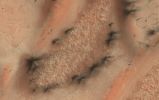
ESP_016032_2600_RED_abrowse-02.jpgNorthern Spring (EDM - Natural Colors; credits: NASA/JPL/Univ. of Arizona)57 visitenessun commentoMareKromium
(5 voti)
|
|
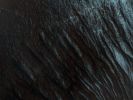
Gullies-Terra_Sirenum-PIA12881.jpgGullies in Terra Sirenum (credits: NASA/JPL-Caltech/University of Arizona)57 visiteThis observation shows part of an Unnamed Crater, located inside the much larger Newton Basin, in the Terra Sirenum Region of Mars.
This Unnamed Crater is approx. 7 Km in diameter (over 4 miles) and some 700 meters (760 yards) deep.
Numerous Gully Systems are visible on the East- and South-facing Walls of the Crater; their characteristics are astonishingly diverse.
This EDM covers an area of nearly 610 x 740 meters (670 x 800 yards). North is up; illumination is from the North-West.
This EDM depicts several Gullies carved in the South-West-facing Wall of the Crater.
These troughs are extremely rectilinear, lack tributaries, and do not seem to have Terminal Fan Deposits: they terminate rather abruptly, some of them in a spatula-like shape.
Their characteristics contrast sharply with those of other Gully Systems located elsewhere in this same Crater, which are sinuous, have numerous tributaries, and show distinct Fan Deposits.MareKromium
(5 voti)
|
|
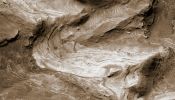
Gale_Crater-PIA12508.jpgLayers in lower formation of Gale Crater Mound (Natural Colors; credits NASA/Dr Paolo C. Fienga - Lunexit Team)113 visiteLayers of rock exposed in the lower portion of a tall Mound near the center of Gale Crater on Mars exhibit variations in layer thickness and range between dark and light tones. The Crater's Mound of layered material is over 4 Km (approx. 2,4 miles) high, making it more than twice as thick as the stack of rocks exposed in the Grand Canyon on Earth.
Gale Crater is approx. 152 Km (about 94 miles) in diameter.
This view of layering in the Mound's lower formation covers an area about 950 meters (3100 feet) wide. It was taken by the High Resolution Imaging Science Experiment (HiRISE) camera on NASA's Mars Reconnaissance Orbiter on April 23, 2009.
Observations of the lower formation by the Compact Reconnaissance Imaging Spectrometer for Mars, on the same orbiter, have indicated the presence of Sulfate Salts and clay minerals in these rock layers. The changes in composition from the lower (older) to the upper (younger) layers in the Gale Crater Mound may record stages in water loss and the drying out of Mars.
This image is one product from HiRISE observation ESP_012841_1750, centered at 4,9° South Lat., 137,2° East Long.MareKromium
(5 voti)
|
|

PSP_001503_1645_RED_abrowse-01.jpgEroding Layers in an Unnamed Southern Crater (EDM - Natural Colors; credits: Dr Paolo C. Fienga - Lunexit Team)56 visiteThis EDM is approx. 250 meters wide.
Boulders are visible on the Slopes of the Ridges along with thin Dark Layers including the Cap Layer, but they are absent on the Spurs, where the resistant cover has been eroded.
This demonstrates that the Boulders come only from the Dark Layers, and are not embedded in the rest of the Deposit.MareKromium
(5 voti)
|
|

PSP_001503_1645_RED_abrowse-00.jpgEroding Layers in an Unnamed Southern Crater (CTX Frame - Natural Colors; credits: Dr Paolo C. Fienga - Lunexit Team)56 visiteThis image shows a stack of Rocky Layers on the Floor of an Unnamed Impact Crater, roughly 30 Km across. Many of the layers appear to be extremely thin, and barely resolved.
In broad view, it is clear that the deposit is eroding into a series of Ridges, likely due to the wind.
Below the Ridges, additional dark-toned Layered Deposits crop out. These exhibit a variety of textures, some of which may be due to transport of material.
The light Ridges are often capped by thin Dark Layers, and similar Layers are exposed on the Flanks of the Ridges. These Layers are likely harder than the rest of the material, and so armor the surface against erosion. They are shedding boulders which roll down the slope, as shown in the following EDM.
Although these Cap Layers are relatively resistant, the boulders do not seem to accumulate at the base of the slope, so it is likely that they also disintegrate relatively quickly. MareKromium
(5 voti)
|
|

PSP_001700_2505_RED_abrowse-01.jpgThe "Frozen pseudo-Lake" of Vastitas Borealis (EDM - Natural Colors; credits: Dr Paolo C. Fienga - Lunexit Team)61 visiteLa parte realmente "interessante" del frame è proprio nella texture della porzione più chiara e profonda del "Frost Patch", perchè è in quel punto della Surface Feature che, volendo, si riesce a vedere qualcosa di significativo e quindi si può anche provare a ragionare e ad osservare con estrema attenzione eppure...eppure la NASA ci mostra le dunette (fangose?) che lo delimitano ed ignora il resto.
Beh, vorrà dire che l'Analisi sulla porzione più "bianca e profonda" del Frost Patch la faremo noi, con calma.
E che i Signori di Pasadena ci scusino tanto per aver osato dubitare della correttezza del loro (pseudo) "Metodo Scientifico"!MareKromium
(5 voti)
|
|
| 2235 immagini su 187 pagina(e) |
 |
|
|
|
|
27 | |
|
|
|
|





