| Piú votate - Mars Reconnaissance Orbiter (MRO) |

Volcanoes-Arsia_Mons-PIA13540-1.jpgLayers in the lower West Flank of Arsia Mons (Natural Colors; credits for the additional process. and color.: Dr Paolo C. Fienga - Lunexit Team)118 visiteMareKromium
(5 voti)
|
|

Volcanoes-Arsia_Mons-PIA13540-2.jpgLayers in the lower West Flank of Arsia Mons (Absolute Natural Colors; credits for the additional process. and color.: Dr Paolo C. Fienga - Lunexit Team)122 visiteCaption NASA:"This image - dated July, 18th, 2007) covers a Pit in the lower West Flank of Arsia Mons, one of the four Giant Volcanoes of the Tharsis Volcanic District.
Many Layers are exposed in the Pit, probably marking individual Lava Flows, and they can provide useful information about the nature of some of the many Martian Volcanic Eruptions.
This image was acquired in the middle of a large Regional Dust Storm, but the Atmosphere over this image is only moderately dusty because the altitude is 6,5 Km higher than the Planetary Mean, so the air is quite thin and cannot hold as much Dust. Although the Atmosphere was not too dusty, the Surface is buried by a Dust Layer which is probably several meters thick.
These high-altitude locations on Mars have thick Dust Deposits because the thin air cannot blow away the Dust, or at least not as fast as it accumulates. On Earth the oceans serve as "Dust Traps", but on Mars, it is a job for the highest Volcanoes".MareKromium
(5 voti)
|
|

ESP_019197_2290_RED_abrowse-01.jpgExtremely unusually-looking Unnamed Northern Crater (EDM n.1 - Absolute Natural Colors; credits for the additional process. and color.: Drr Gianluigi Barca and Paolo C. Fienga - Lunexit Team)109 visitenessun commentoMareKromium
(5 voti)
|
|
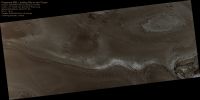
PSP_003907_1780_RED_browse-1.jpgProposed MSL Site in Iani Chaos (Natural Colors; credits for the additional process. and color.: Dr Paolo C. Fienga - Lunexit Team)60 visitenessun commentoMareKromium
(5 voti)
|
|

PSP_003618_1725_RED_abrowse-PCF-LXTT.jpgGanges Chasma (Absolute Natural Colors; credits for the additional process. and color.: Dr Paolo C. Fienga - Lunexit Team)60 visitenessun commentoMareKromium
(5 voti)
|
|

PSP_003695_1250_RED_abrowse-01.jpgUnnamed Southern Crater with Large Dunefield and DD Streaks (EDM - Natural Colors; credits for the additional process. and color.: Dr Paolo C. Fienga - Lunexit Team)65 visiteThis EDM, approx. 750 mt across, shows Dust Devil Tracks near the South-West edge of the Dunefield. The bright protruding rocks on the lower side of the image are either being exposed or being buried, as the Dunes migrate. MareKromium
(5 voti)
|
|
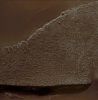
PSP_002892_1760_RED_abrowse-01.jpgLayered Deposits in Aureum Chaos (EDM - Absolute Natural Colors; credits: Dr Paolo C. Fienga - Lunexit Team)56 visitenessun commentoMareKromium
(5 voti)
|
|

ESP_018522_2270-7-EB-LXTT.jpgBull's Eye Impact Crater (RAW Natural Colors; credits for the additional process. and color.: Elisabetta Bonora - Lunexit Team)56 visiteWhat caused the Central Pit within this Impact Crater: unusual Subsurface Layering or a lucky second impact? Impacts into layers of alternately strong and weak material – for example, ice rich versus non-ice-rich – produce terracing such as that seen between the Inner Pit and the Outer Rim. Scientists have used Terraced Craters to estimate the thickness of Lava Flows on the Moon and elsewhere. Uneven Sublimation and Periglacial Erosion of exposed ice-rich material in the interior of the Crater may explain why the small Central Pit is slightly offset from center relative to the Terrace and Rim of the larger Crater.
The Pit in the center of the main feature could also be from a later Impact Crater striking inside and slightly off-center from the original. It has a Raised Rim, which is characteristic of impact craters and is difficult to explain with a layered target. While no ejecta from this later impact can be seen, the ejecta could have been removed by extensive periglacial modification.
Additionally the Floor Fill around the Inner Crater resembles impact ejects elsewhere at this latitude, and some of the "Landslides" to the East could be flow-back of ejecta off the Walls of the larger crater.
MareKromium
(5 voti)
|
|
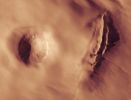
PSP_002922_1725_RED_abrowse-02.jpgPossible Volcanic "Mouth", on Arsia Mons' Flank (EDM - RAW Natural Colors - credits for the additional process.: Dr Marco Faccin)60 visitenessun commentoMareKromium
(5 voti)
|
|
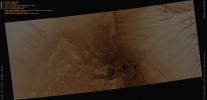
ESP_014287_1685_RED_abrowse-00.jpgNoctis Labyrinthus (Natural Colors; credits for the additional process. and color.: Dr Paolo C. Fienga - Lunexit Team)57 visiteThis image spans the floor and two walls of a pit in Noctis Labyrinthus, a System of deep, steep-walled Valleys on the Western Edge of Valles Marineris.
The Valleys themselves are tectonic features known as "Graben" (---> trench-like features that form in response to extension (or stretching) of the Crust). In the case of Noctis Labyrinthus, volcanic activity in the Tharsis Region may have formed a bulge, which then stretched and fractured the Crust above it.MareKromium
(5 voti)
|
|

PSP_001910_2215_RED_abrowse-00.jpgUnnamed Crater in Utopia Planitia (Natural Colors; credits for the additional process. and color.: Dr Paolo C. Fienga - Lunexit Team)56 visiteThis observation shows an Unnamed Impact Crater located in Utopia Planitia; this Crater is more than 10 Km (6,25 miles) in diameter and approx. 700 meters (765 yards) deep. Different features in and around this Crater may indicate the presence of fluid beneath the Surface.
Linear features radiating outward from the Crater's Rim are evident. Closer examination shows these features are formed by rocks and finer soils that are located along a straight line; technically, they are "Spokes" produced immediately after the impact by very fast outward-moving materials ejected from the contact-zone. Because these Ejecta came from deep under the Crater, their composition will tell us what type of rocks are under the Surface.
A MOC context image of this Crater shows its Ejecta Materials form an elevated "Pedestal," shaped like a pancake. The Pedestal is approx. 20 Km (about 12,5 miles) in diameter. "Pedestal craters" such as this may have formed because ice beneath the Surface melted when the impact occurred.MareKromium
(5 voti)
|
|

PSP_001970_1655_RED_abrowse.jpgLandslide in Coprates Chasma (Natural Colors; credits for the additional process. and color.: Dr Paolo C. Fienga - Lunexit Team)56 visiteThis observation shows a Landslide in the Coprates Chasma Region of Valles Marineris that occurred when a large unstable area of rock broke away from the Cliffs that can be seen on the right side of the frame. This mass of falling rock broke into many small pieces as it slid downhill and came to rest at the base of the Cliff, forming the Lobate (curved) Mound visible on the left part of the image.
The smooth textured Ripples that can be seen in the central part of the frame are Sand Dunes. Sand Dunes form as wind-blown particles roll across the Surface and accumulate. Since the air on Mars is very thin, Sand Dunes take much longer to form on Mars than they do on Earth.
The presence of large Sand Dunes - along with many small Impact Craters - on top of this Landslide indicates that movement of the slide occurred a very long time ago; perhaps hundreds of millions of years.
This Landslide was probably caused by a strong Marsquake, but a nearby (significant) impact could have generated a deep shock-wave that was sufficiently strong to cause it. Alternatively, movement along nearby Faults may have triggered the Landslide.
The Valles Marineris Region is cut by many Faults and in fact contains many more Landslides such as this one. Some scientists believe that these Landslides represent a record of seismic activity in this area.
It is obvious that a better understanding of the history of seismic activity in this specific Region may help scientists to predict the likelihood that Marsquakes still occur on the Planet.MareKromium
(5 voti)
|
|
| 2235 immagini su 187 pagina(e) |
 |
|
|
|
|
26 | |
|
|
|
|





