| |

| Piú votate - Mars Reconnaissance Orbiter (MRO) |

Craters-Unnamed_Crater_in_Terra_Sirenum_12m-01.jpgCrater in Terra Sirenum (2) - natural colors60 visiteDuring its first week of observations from low orbit, NASA's newest Mars spacecraft is already revealing new clues about both recent and ancient environments on the red planet.
Scientists hope the Mars Reconnaissance Orbiter will answer questions about the history and distribution of Mars' water by combining data from the orbiter's high-resolution camera, imaging spectrometer, context camera, ground-penetrating radar, atmospheric sounder, global color camera, radio and accelerometers.
Between Sept. 29 and Oct. 6, science instruments on the spacecraft viewed dozens of sites that reflect different episodes in Mars' history. The diverse sites provide a good test for the capabilities of the spacecraft instruments. The orbiter will begin its primary science mission phase in early November when Mars re-emerges from passing nearly behind the sun.
The instruments are seeing details in the shapes and icy composition of geologically young layering near the Martian north pole. Other views offer details of a mid-latitude valley whose upper layers have been eroded away, revealing an underlying clay layer that formed a few billion years ago, when wet conditions produced the clay. Observations of a southern-hemisphere crater show fine-scale details of more recent gullies, adding evidence that they were carved by flowing water.
"In this opening phase we have tested the instruments, and they are working perfectly," said Dr. Steve Saunders, Mars Reconnaissance Orbiter program scientist at NASA Headquarters, Washington. "The teams are getting amazing science data. They are ready to fulfill the mission's science objectives and to support other Mars missions. One image is already helping the Mars Exploration Rover team choose a route to explore Victoria Crater. Others will help guide the selection of a safe site for the future Phoenix Mars Lander."
In Chasma Boreale, a vast valley that juts into the north polar ice cap, the orbiter's spectrometer sees layers that vary in soil composition and in how much ice is mixed with the soil. A dark underlying layer contains little ice, but just beneath it lies ice-rich material resembling higher layers. The spectrometer takes pictures both in visible-light and infrared wavelengths useful for identifying what a target is made of.
"You see more-ice-rich and less-ice-rich layers, which tells you that conditions changed from the time one layer was deposited to the time another layer was deposited," said Dr. Scott Murchie of Johns Hopkins University Applied Physics Laboratory, Laurel, Md. Murchie is the principal investigator for the spectrometer on the spacecraft. "These layers are geologically young -- on the order of thousands or millions of years -- and may hold clues about climate cycles."
A lower-latitude target was Mawrth Vallis. The European Mars Express spacecraft previously discovered ancient deposits of clay minerals that could form only if water were present for a long time at Mawrth Vallis. The Mars Reconnaissance Orbiter's spectrometer has resolved smaller-scale compositional features and detected differing clay mineral content. The clay-rich areas show some of the best evidence for conditions possibly favorable for life on ancient Mars, Murchie said.
The mission's High Resolution Imaging Science Experiment camera has shown unprecedented detail in orbital images of Mars. An example was released recently showing the Opportunity rover at Victoria Crater. The camera imaged 64 areas on Mars during the testing week. "These images are truly beautiful, and since they resolve features the size of people, you can visualize yourself hiking around in these diverse terrains," said the camera's principal investigator, Dr. Alfred McEwen of the University of Arizona, Tucson.
The high-resolution camera, the imaging spectrometer and the orbiter's wider-looking Context Camera all observed Mawrth Vallis. Details visible in the new observations, such as small channels, are consistent with past wet conditions, McEwen said.
Another observation of an unnamed southern crater shows relatively young gullies, like those seen in many Mars locations viewed by NASA's Mars Global Surveyor orbiter. Braided channels characteristic of sediment-rich streams are visible in the new observations. This reinforces the interpretation that these geologically young gullies formed at least in part from erosion by flowing water. Original discovery of the many geologically young gullies on Martian slopes was by Dr. Michael Malin of Malin Space Science Systems, San Diego.
The Mars Reconnaissance Orbiter is managed by the Jet Propulsion Laboratory, Pasadena, Calif., for NASA's Science Mission Directorate, Washington.

(6 voti)
|
|

North_Polar_Cap_oct2006.jpgThe "North Polar Cap" of Mars55 visiteDuring the last week of September and the first week or so of October, 2006, the Mars Reconnaissance Orbiter (MRO) scientific instruments were turned on to acquire test information leading up to full science operations to begin the first week of November 2006, following superior conjunction (superior conjunction is where a planet goes behind the sun as viewed from the Earth). Since it is very difficult to communicate with a spacecraft when it is close to the Sun as seen from Earth, this checkout of the instruments was crucial to being ready for the Primary Science Phase (PSP) of the mission.
Throughout the Transition Phase of operations, the Mars Color Imager (MARCI) acquired terminator (transition between nighttime and daytime) to terminator swaths of color images on every dayside orbit, as the spacecraft moved northward in its orbit. The south polar region was deep in winter shadow, but the north polar region was illuminated the entire martian day. During the primary mission, these swaths will be assembled into global maps that portray the state of the martian atmosphere -- its weather -- as seen every day and at every place at about 3 PM local solar time. After the Transition Phase was completed, most of the instruments were turned off, but the Mars Climate Sounder and MARCI have been left on. Their data will be recorded and played back to Earth following the communications blackout associated with conjunction and just prior to the start of the PSP.
Combined with Mars Global Surveryor (MGS) Mars Orbiter Camera (MOC) wide angle image mosaics taken at 2 PM local solar time, the MARCI maps will be used to track motions of clouds.
The image shown above is a composite mosaic of four polar views of Mars, taken at midnight, 6 AM, noon, and 6 PM local martian time. This is possible because during summer the sun is always shining in the polar region. It shows the mostly water ice perennial cap (white area), sitting atop the north polar layered materials (light tan immediately adjacent to the ice), and the dark circumpolar dunes. This view shows the region poleward of about 72 degrees north latitude. The data were acquired at about 900 meters per pixel. Three channels are shown here (425 nm, 550 nm, and 600 nm).
(6 voti)
|
|

Q-V-Atmosphere.jpgMars' Atmosphere64 visiteAs part of the checkout of the Mars Reconnaissance Orbiter (MRO) payload after the 10 March 2006 orbit insertion, the Mars Color Imager (MARCI) acquired a seven band color wide angle view of Mars on 24 March 2006. Illustrated here are some of these test images. Note that the linear banding seen in these images are artifacts resulting from incomplete removal of the detector pixel to pixel variations. Such deviations from ground testing calibration are an important reason for taking checkout images.
In the first figure (MARCI2-2a), three views acquired by MRO MARCI are compared to a color composite of two views acquired about 4 hours later by the Mars Global Surveyor (MGS) Mars Orbiter Camera (MOC). MRO imaging occurred during the early morning on Mars, while the MGS observations were made at around 2 PM local solar time. The region of Mars imaged by MRO on this day was south of the Valles Marineris and includes the large Argyre Basin, its interior plains, Argyre Planitia, and the mountains that comprise the basin rim, Nereidum Montes to the northwest (middle of images) and Charitum Montes to the southeast (bottom of images).
The ultraviolet (UV) image (260 nm in MARCI2-2a) shows how the planet appears in an ozone absorption band. Relatively darker areas in this band normally will indicate the presence of ozone, and relatively lighter areas will indicate the absence of ozone. Water vapor on Mars is anticorrelated with ozone, meaning that lighter areas can be used to track water vapor. The term "relatively" is used here because Mars itself is very dark in the UV owing to absorption of UV light by iron-bearing minerals, and sunlight is deficient in UV relative to visible light, so in general Mars will always look dark in the UV. A second UV band on MARCI (not shown in the figure above) at a longer wavelength allows these differences to be quantified. The MOC wide angle image shows wispy, light water-ice clouds to the northwest of Argyre in the afternoon, but we cannot as yet correlate these clouds with the UV information (especially because the times of day are different). When in its final mapping orbit, MRO will view the same area as MGS separated by only 1 hour, and such correlations will be much more direct.
(6 voti)
|
|

Chasma-Echus_Chasma-Fractures-PIA17704-PCF-LXTT-IPF.jpgFeatures of Echus Chasma (EDM - Absolute Natural Colors; credits for the additional process. and color.: Dr Paolo C. Fienga/Lunar Explorer Italia/Italian Planetary Foundation)98 visiteIn this Extra Detail Magnification (or "EDM" for short) - taken from an Original NASA - Mars Reconnaissance Orbiter's False Colors and NON-Map Projected sub-frame -, we can see, with a really great detail, a so-called "Intersection Area" existing between two Fractures (or, perhaps, Fissures and/or Water or Lava-carved narrow Channels) which are both located on the Floor of Echus Chasma (an Equatorial Chasma found in the Lunae Planum High Plateau Region of Mars, slightly to the North of the gigantic Valles Marineris Canyon System, and approx. 100 Km long and 10 Km wide).
Echus Chasma contains several Valleys which range - as far as their depth is concerned - from about 1 to 4 Km, and it is now considered, by Planetary Scientists, to be the Water Source Region that allowed the formation and then the (relevant) water-supply of the Kasei Valles Outflow Channel: a large Valley that extends for thousands of kilometers towards the North of the Red Planet.
Mars Local Time: 14:36 (Early Afternoon)
Coord. (centered): 0,377° North Lat. and 279,483° East Long.
Spacecraft altitude: 269,1 Km (such as about 161,111 miles)
Original image scale range: 53,8 cm/pixel (with 2 x 2 binning) so objects ~ 1 mt and 62 cm across are resolved
Map projected scale: 50 cm/pixel
Map projection: EQUIRECTANGULAR
Emission Angle: 7,7°
Phase Angle: 47,6°
Solar Incidence Angle: 40° (meaning that the Sun was about 50° above the Local Horizon at the time the picture was taken)
Solar Longitude: 27,0° (Northern Spring - Southern Fall)
Credits: NASA/JPL/University of Arizona
Additional process. and coloring: Lunar Explorer Italia
This picture (which is a crop taken from a NASA - Original Mars Reconnaissance Orbiter False Colors and NON-Map Projected sub-frame identified by the serial n. ESP_033591_1805-1) has been additionally processed, magnified, contrast enhanced, Gamma corrected, and then re-colorized in Absolute Natural Colors (such as the colors that a human eye would actually perceive if someone were onboard the NASA - Mars Reconnaissance Orbiter and then looked down, towards the Surface of Mars), by using an original technique created - and, in time, dramatically improved - by the Lunar Explorer Italia Team.MareKromium
(5 voti)
|
|

ESP_025231_1720-PCF-LXTT-IPF.jpgFeatures of Jus Chasma (Absolute Natural Colors; credits for the additional process. and color.: Dr Paolo C. Fienga/Lunar Explorer Italia/Italian Planetary Foundation)106 visiteThis image, taken by the NASA - Mars Reconnaissance Orbiter in December 2011, shows us a portion of Jus Chasma, a segment of the massive Martian Canyon System known as Vallis Marineris; the most important detail visible in the picture is given by the presence, within the Chasma, of a Fault (which, by the way, it had been previously imaged by the NASA - Mars Global Surveyor (MGS) - Mars Orbiter Camera (MOC).
If you look carefully towards the centre/right (Dx) side of the picture, you will also notice that a small Valley cuts across the Ridge. Planetary Scientists have asked themselves if what we see here could be the final result of the action of some Tectonic Process, and a Study that was carried out about this topic in the AD 2012, suggested that Mars actually possesses Tectonic Plates! However, and even admitting that what has been suggested by the aformentioned Study is actually true, the question about how these processes worked (or are still working, even though in just a "residual way"...) here and, perhaps, elsewhere on the Red Planet, is still unanswered.
Mars Local Time: 14:56 (Early Afternoon)
Coord. (centered): 7,899° South Lat. and 279,399° East Long.
Spacecraft altitude: 287,5 Km (such as about 178,53 miles)
Original image scale range: 28,8 cm/pixel (with 1 x 1 binning) so objects ~ 86 cm across are resolved
Map projected scale: 25 cm/pixel
Map projection: EQUIRECTANGULAR
Emission Angle: 24,3°
Phase Angle: 33,4°
Solar Incidence Angle: 50° (meaning that the Sun was about 40° above the Local Horizon at the time the picture was taken)
Solar Longitude: 43,2° (Northern Spring - Southern Fall)
Credits: NASA/JPL/University of Arizona
Additional process. and coloring: Lunar Explorer Italia
This picture (which is a NASA - Original Mars Reconnaissance Orbiter NON_Map Projected CTX b/w frame identified by the serial n. ESP_025231_1720 and a NASA - Original Mars Reconnaissance Orbiter EDM false-color frame identified by the serial n. ESP_025164_1655-1) have been additionally processed and then colorized (and re-colorized, respectively) in Absolute Natural Colors (such as the colors that a human eye would actually perceive if someone were onboard the NASA - Mars Reconnaissance Orbiter and then looked down, towards the Surface of Mars), by using an original technique created - and, in time, dramatically improved - by the Lunar Explorer Italia Team.MareKromium
(5 voti)
|
|

Nereidum_Montes-Dunefield-ESP_029608_1390-PCF-LXTT-IPF-1.jpgDunefield in Nereidum Nontes (CTX Frame - Absolute Natural Colors; credits for the additional process. and color.: Dr Paolo C. Fienga/Lunar Explorer Italia/IPF)58 visiteMars Local Time: 15:43 (Middle Afternoon)
Coord. (centered): 40,495° North Lat. and 309,939° East Long.
Spacecraft altitude: 254,8 Km (such as about 159,3 miles)
Original image scale range: 25,5 cm/pixel (with 1 x 1 binning) so objects ~ 76 cm across are resolved
Map projected scale: 25 cm/pixel
Map projection: EQUIRECTANGULAR
Emission Angle: 1,0°
Phase Angle: 57,3°
Solar Incidence Angle: 56° (meaning that the Sun was about 34° above the Local Horizon at the time the picture was taken)
Solar Longitude: 209,9° (Northern Autumn - Southern Spring)
Credits: NASA/JPL/University of Arizona
Additional process. and coloring: Lunar Explorer ItaliaMareKromium
(5 voti)
|
|

Nereidum_Montes-Dunefield-ESP_029608_1390-PCF-LXTT-IPF-2.jpgDunefield in Nereidum Nontes (EDM - Absolute Natural Colors; credits for the additional process. and color.: Dr Paolo C. Fienga/Lunar Explorer Italia/IPF)58 visiteMars Local Time: 15:43 (Middle Afternoon)
Coord. (centered): 40,495° North Lat. and 309,939° East Long.
Spacecraft altitude: 254,8 Km (such as about 159,3 miles)
Original image scale range: 25,5 cm/pixel (with 1 x 1 binning) so objects ~ 76 cm across are resolved
Map projected scale: 25 cm/pixel
Map projection: EQUIRECTANGULAR
Emission Angle: 1,0°
Phase Angle: 57,3°
Solar Incidence Angle: 56° (meaning that the Sun was about 34° above the Local Horizon at the time the picture was taken)
Solar Longitude: 209,9° (Northern Autumn - Southern Spring)
Credits: NASA/JPL/University of Arizona
Additional process. and coloring: Lunar Explorer ItaliaMareKromium
(5 voti)
|
|
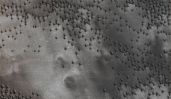
ESP_027378_2540-PCF-LXTT-IPF-1A.jpgNorthern Dunes (CTX Frame "A" - Absolute Natural Colors; credits for the additional process. and color.: Dr Paolo C. Fienga/Lunexit Team)87 visiteThis Field of crescent-shaped Dunes (located at Lat. 73,62° North and 328,215° East Long.) is located just South of the North Polar Layered Terrain. These Dunes, known as "Barchan Dunes", usually form where there is a moderate supply of Sand and a Prevailing Wind Direction (meaning that they form in Regions where there are Dominant Winds). The "Arms" (or "Horns") of the Barchan Dunes point in the downwind direction and in this case this circumstance indicates that the Dominant Winds blow towards the North/West.
Mars Local Time: 14:42 (Early Afternoon)
Coord. (centered): 73,622° North Lat. and 328,215° East Long.
Spacecraft altitude: 316,7 Km (such as about 198,0 miles)
Original image scale range: 63,4 cm/pixel (with 2 x 2 binning) so objects ~ 1 mt and 90 cm across are resolved
Map projected scale: 50 cm/pixel
Map projection: POLAR STEREOGRAPHIC
Emission Angle: 1,9°
Sun - Mars - MRO (or "Phase") Angle: 57,6°
Solar Incidence Angle: 56° (meaning that the Sun is about 34° above the Local Horizon)
Solar Longitude: 117,4° (Northern Summer - Southern Winter)
Credits: NASA/JPL/University of Arizona
Additional process. and coloring: Lunar Explorer ItaliaMareKromium
(5 voti)
|
|

ESP_027378_2540-PCF-LXTT-IPF-1B.jpgNorthern Dunes (CTX Frame "B" - Absolute Natural Colors; credits for the additional process. and color.: Dr Paolo C. Fienga/Lunexit Team)91 visiteThis Field of crescent-shaped Dunes (located at Lat. 73,62° North and 328,215° East Long.) is located just South of the North Polar Layered Terrain. These Dunes, known as "Barchan Dunes", usually form where there is a moderate supply of Sand and a Prevailing Wind Direction (meaning that they form in Regions where there are Dominant Winds). The "Arms" (or "Horns") of the Barchan Dunes point in the downwind direction and in this case this circumstance indicates that the Dominant Winds blow towards the North/West.
Mars Local Time: 14:42 (Early Afternoon)
Coord. (centered): 73,622° North Lat. and 328,215° East Long.
Spacecraft altitude: 316,7 Km (such as about 198,0 miles)
Original image scale range: 63,4 cm/pixel (with 2 x 2 binning) so objects ~ 1 mt and 90 cm across are resolved
Map projected scale: 50 cm/pixel
Map projection: POLAR STEREOGRAPHIC
Emission Angle: 1,9°
Sun - Mars - MRO (or "Phase") Angle: 57,6°
Solar Incidence Angle: 56° (meaning that the Sun is about 34° above the Local Horizon)
Solar Longitude: 117,4° (Northern Summer - Southern Winter)
Credits: NASA/JPL/University of Arizona
Additional process. and coloring: Lunar Explorer ItaliaMareKromium
(5 voti)
|
|

ESP_025579_2580-PCF-LXTT-00.jpgDefrosting Northern Dunes (CTX Frame and EDM - Absolute Natural Colors; credits for the additional process. and color.: Dr Paolo C. Fienga - Lunexit Team)133 visiteMars Local Time: 13:57 (Early Afternoon)
Coord. (centered): 77,982° North Lat. and 115,529° East Long.
Spacecraft altitude: 318,6 Km (such as about 199,1 miles)
Original image scale range: 63,7 cm/pixel (with 2 x 2 binning) so objects ~ 1 mt and 91 cm across are resolved (with 4 x 4 binning)
Map projected scale: 50 cm/pixel
Map projection: POLAR STEREOGRAPHIC
Emission Angle: 5,0°
Sun - Mars - MRO (or "Phase") Angle: 63,1°
Solar Incidence Angle: 59° (meaning that the Sun is about 31° above the Local Horizon)
Solar Longitude: 55,2° (Northern Spring/Southern Fall)
Credits: NASA/JPL/University of Arizona MareKromium
(5 voti)
|
|

ESP_025665_1825-PCF-LXTT-00.jpgUnnamed Crater with Layers of Water-deposited Sediments (CTX Frame - Absolute Natural Colors; credits for the additional process. and color.: Dr Paolo C. Fienga - Lunexit Team)77 visiteMars Local Time: 14:56 (Early Afternoon)
Coord. (centered): 2,317° North Lat. and 307,960° East Long.
Spacecraft altitude: 269,9 Km (such as about 168,7 miles)
Original image scale range: 54,0 cm/pixel (with 2 x 2 binning) so objects ~ 1 mt and 62 cm across are resolved (with 4 x 4 binning)
Map projected scale: 50 cm/pixel
Map projection: EQUIRECTANGULAR
Emission Angle: 2,3°
Sun - Mars - MRO (or "Phase") Angle: 48,9°
Solar Incidence Angle: 47° (meaning that the Sun is about 43° above the Local Horizon)
Solar Longitude: 58,1° (Northern Spring/Southern Fall)
Credits: NASA/JPL/University of ArizonaMareKromium
(5 voti)
|
|

ESP_026061_1435-PCF-LXTT-002.jpgLayering on an Unnamed Southern Crater Rim (EDM - Absolute Natural Craters; credits for the additional process. and color.: Dr Paolo C. Fienga - Lunexit Team)84 visiteMars Local Time: 15:13 (early afternoon)
Coord. (centered): 36,4° South Lat. and 302,3° East Long.
Spacecraft altitude: 251,9 Km (such as about 157,4 miles)
Original image scale range: 50,4 cm/pixel (with 2 x 2 binning) so objects ~ 1 mt and 51 cm across are resolved (with 4 x 4 binning)
Map projected scale: 50 cm/pixel
Map projection: EQUIRECTANGULAR
Emission Angle: 1,2°
Sun - Mars - MRO (or "Phase") Angle: 75,0°
Solar Incidence Angle: 76° (meaning that the Sun is about 14° above the Local Horizon)
Solar Longitude: 71,6° (Northern Spring)
Credits: NASA/JPL/University of Arizona
Additional process. and coloring: Lunar Explorer ItaliaMareKromium
(5 voti)
|
|
| 2235 immagini su 187 pagina(e) |
|
|
|
|
|
22 | |
|
|
|
|
|
|





