| Piú votate - Mars Reconnaissance Orbiter (MRO) |

TRA_000878_1410_RGB.jpgTerra Sirenum57 visiteThis region receives very little sunlight in Southern Winter, and the bluish areas consist of frost. At the latitude of this image, frost is most likely composed of water because the temperature is not low enough for CO2 condensation. The reddish regions are locations where frost has been removed, most likely by sublimation. The dark, unfrosted regions (for example, in the channel of the gully on the far right) represent the most recent activity in the gullies and are possibly a result of seasonal melting. 
(6 voti)
|
|

Psp_001503_2180_red-02.jpgTricks of the Light, Tricks of the Surface... (extra-detail mgnf - 3)56 visitenessun commento
(6 voti)
|
|
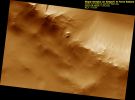
Psp_001808_1875_red.jpgSlope Streaks (or "Seeps"?) in Terra Sabaea74 visiteSlope streak formation is among the few known processes currently active on Mars. While their mechanism of formation and triggering is debated, they are most commonly believed to form by downslope movement of extremely dry sand or very fine-grained dust in an almost fluidlike manner (analogous to a terrestrial snow avalanche) exposing darker underlying material. Other ideas include the triggering of slope streak formation by possible concentrations of near-surface ice or scouring of the surface by running water from aquifers intercepting slope faces, spring discharge (perhaps brines) and/or hydrothermal activity.
Several of the slope streaks visible here, particularly the 3 longest darker streaks, show evidence that downslope movement is being diverted around obstacles such as large boulders. Several streaks also appear to originate at boulders or clumps of rocky material.
In general, the slope streaks do not have large deposits of displaced material at their downslope ends and do not run out onto the crater floor suggesting that they have little reserve kinetic energy. The darkest slope streaks are youngest and can be seen to cross cut and superpose older and lighter-toned streaks. The lighter-toned streaks are believed to be dark streaks that have lightened with time as new dust is deposited on their surface.
MareKromium
(6 voti)
|
|
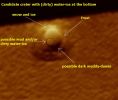
Psp_001485_2280_red-01.jpgDirty water-ice down in the crater? (EDM - False Colors)56 visitenessun commento
(6 voti)
|
|

Terra_Sirenum-PIA09101-01.jpgSeasonal frost in Terra Sirenum (according to Lunexit)55 visitenessun commentoMareKromium
(6 voti)
|
|

Channel-PSP_001342_1910_RED.jpgSecondary Craters' Field and a deep Channel116 visitenessun commentoMareKromium
(6 voti)
|
|

Elysium_Planitia-Tra_000867_1875_red-01.jpgFresh Crater Cluster in Elysium Planitia (EDM - False Colors)56 visiteImage TRA_000867_1875 was taken by the High Resolution Imaging Science Experiment (HiRISE) camera onboard the Mars Reconnaissance Orbiter spacecraft on October 3, 2006. The complete image is centered at 7,4° North Latitude and 157,3 East longitude. The range to the target site was 274,6 Km (171,6 miles).
At this distance the image scale ranges from 54,9 cm/pixel (with 2 x 2 binning) to 109,9 cm/pixel (with 4 x 4 binning).
The image has been map-projected to 50 cm/pixel and north is to the right.
The image was taken at a Local Mars Time of 3:26 PM and the scene is illuminated from the West with a solar incidence angle of 52°, thus the Sun was about 38° above the horizon.
At a Solar Longitude of 115,1°, the season on Mars is Northern Summer.MareKromium
(6 voti)
|
|

Craters-Holden_Crater-01.jpgThe beautiful "Holden Crater" (1)57 visitenessun commentoMareKromium
(6 voti)
|
|

Deimos-PIA02699.jpgDeimos, from MRO59 visiteCaption NASA originale:"This image showing the position of the Martian moon Deimos against a background of stars is part of a successful technology demonstration completed by NASA's MRO before arrival at Mars. The spacecraft's Optical Navigation Camera (ONC) was used in February and March 2006 to demonstrate the use of pictures from a small camera for calculating precise location of a Mars-bound spacecraft by comparing the observed positions of Mars' two moons to their predicted positions relative to background stars. While this technique was not necessary for the Mars Reconnaissance Orbiter's own navigation, the demonstration prepares the way for relying on it for navigating precise arrivals for future missions that land on Mars.
This example image from the ONC was taken on March 6, 2006, at a distance of 1,08 MKM (about 671.000 miles) from Deimos. That moon, the smaller of Mars' two, has a diameter of about 15 Km (approx. 9 miles), and orbits 23.459 Km (approx. 14.577 miles) above Mars' surface".
(6 voti)
|
|

TRA_000827_1875_IRB.jpgCerberus' River66 visiteThe prominent trough in this sub-image (of HiRISE image TRA_000827_1875_IRB ) is a segment of the Cerberus Fossae rift system. In geological terminology the trough is known as a graben, or down-dropped region bounded by faults. In this location the graben is about 300 m wide and 90 m deep. Bright, dust-covered, cratered plains surround the graben, and darker sediments blanket much of its floor. Dunes that vary in size and spacing occur within the darker sediments, and their shapes suggest that the wind typically blows from east to west. Light-toned, angular boulders pepper the darker sediments. They have broken away from the rocky walls of the graben and tumbled downhill. Over time this mass wasting has caused the cliffs to retreat, widening the trough. The somewhat lighter patches of cratered terrain on the graben floor were once level with the surrounding plains, but have since been lowered by faulting. Over time they may become obscured or buried by the darker sediments. High-standing ridgesÑremnants of the former surfaceÑcast jagged shadows on the floor of the graben that reveal the rugged nature of the landscape in this region of Mars.
Image TRA_000827_1875 was taken by the High Resolution Imaging Science Experiment (HiRISE) camera onboard the Mars Reconnaissance Orbiter spacecraft on September 29, 2006. The complete image is shown below, centered at 7.4 degrees latitude, 168.5 degrees East longitude. The range to the target site was 275 km (171 miles). At this distance the image scale is 55 cm/pixel (with 2 x 2 binning) so objects ~165 cm across are resolved. The image shown below has been map-projected to 50 cm/pixel and north is up. The image was taken at a local Mars time of 3:26 PM and the scene is illuminated from the west with a solar incidence angle of 51.9 degrees, thus the sun was about 38.1 degrees above the horizon. At a solar longitude of 113.7 degrees, the season on Mars is Northern Summer / Southern Winter.
(6 voti)
|
|

Craters-Becquerel_Crater_mound_6m-01.jpgBeautiful Becquerel Crater (2)58 visitenessun commento
(6 voti)
|
|

Craters-Becquerel_Crater_mound_6m-00.jpgBeautiful Becquerel Crater (1)57 visiteThe mound of layered rock near the center of Becquerel Crater (2,6° North and 8,2° West) is one of the best examples of sedimentary rocks on Mars. This location has been suggested as a possible target for the 2009 Mars Science Laboratory Rover Mission. An interesting attribute of this mound is that most of the actual rock is light-toned. The darker bands seen in this image are actually dark, wind-blown sediment that has been trapped on the surface by the small escarpments associated with each layer. The source of this dark sediment is the sand dune fields to the north and south of the layered mound.
North is towards the top of the 5 images and the Sun is shining from the left.
(6 voti)
|
|
| 2235 immagini su 187 pagina(e) |
 |
|
|
|
|
21 | |
|
|
|
|





