| Piú votate - Mars Reconnaissance Orbiter (MRO) |

PSP_005813_2150_RED_abrowse.jpgUnusual Depression near Elysium Mons (MULTISPECTRUM; elab. Lunexit)55 visiteThis unusual depression and the associated concentric rings are situated within an area thought to have been deposited as a mud flow. Due to the lack of a distinctive, raised rim or other impact-related features, this crater is thought to have formed by the loss of material below the surface and subsequent collapse, rather than by an impact from space.
The exact mechanism for the loss of material is not fully understood, although the missing material was likely water in some form. This feature is near a large volcano, so perhaps there were explosive magma-water interactions that violently removed the water and some magma, followed by surface collapse. Or, less violently, there could have been simple melting of subsurface ice and then collapse of the surface into the resulting void. The rays emanating from the depression suggest some amount of violence before the surface collapse that sprayed material far from the depression.
Some aspects of this and other, nearby features are similar to the collapse pits associated with Grímsvötn volcano in Iceland, which erupts beneath an ice-cap. However, there are no rays formed during the eruptions at Grímsvötn.
MareKromium
(6 voti)
|
|

PSP_005682_1035_RED_abrowse-01.jpgBasal Exposure of South Polar Layered Deposits (extra-detail mgnf; possible natural colors - elab. Lunexit)55 visiteSome layers have an irregular wavy appearance that may have been caused by flow of the ice in the past when the now-exposed ice was still buried.
It is currently too cold at the surface in the South Polar Region of Mars for significant flow to be occurring today.
Other layers appear to be converging and some are truncated and may represent the so-called "unconformities" (see here).
Unconformities form when a previous episode of erosion removes all or part of a layer and is later followed by more deposition.MareKromium
(6 voti)
|
|

PSP_005346_1755_RED_abrowse-01.jpgLow-Order Inverted Streams near Juventae Chasma (extra-detail mgnf)54 visiteThis subimage (approx. 1120 meters across) shows a juncture of 2 of the "Inverted Channels".
It is likely that the water flowed from the left to the right of the scene, because channels usually join rather than divert unless there is an obvious obstacle in the way.
No such obstacle is seen here, but one might have been present when the stream originally flowed.
However, there is no way of knowing this.MareKromium
(6 voti)
|
|

PSP_004959_0865_RED_browse.jpgPolygonal Fracturing of South Polar Layered Deposits55 visiteThis image shows the South Polar Layered Deposits, with curving layer outcrops caused by erosion of valleys into the Deposits.
On closer inspection, polygonal (mostly rectangular) fractures are visible, mostly near the center of the image. Polygonal fractures are also observed in the North Polar Layered Deposits, but typically on a much smaller scale.
Here in the South, the fractures cross layer boundaries, while in the North the fractures are usually confined to a single layer.
Therefore, the fractures in the South Polar Layered Deposits formed after the surface was eroded to the configuration seen here, probably due to expansion and contraction of water ice below the surface.MareKromium
(6 voti)
|
|

PSP_003948_0935_RED_browse.jpgSouth Pole Residual Cap (Swiss-Cheese Terrain Monitoring)55 visiteLike Earth, Mars has concentrations of water ice at both Poles. Because Mars is so much colder however, Carbon Dioxide (CO2) ice is deposited at high latitudes in the Winter and is removed in the Spring, analogous to winter-time water ice/snow on Earth.
Around the South Pole there are areas of this CO2 ice that do not disappear every Spring, but rather survive Winter after Winter; this persistent CO2 ice is called the "South Pole Residual Cap".
The retention of CO2 ice throughout the year by the Southern Polar Cap is one characteristic that distinguishes it significantly from Mars' North Polar Cap.
As can be seen in this HiRISE image of the south pole residual cap, relatively high-standing smooth material is broken up by circular, oval, and blob-shaped depressions. This patterned terrain is called "swiss cheese" terrain. The high-standing areas are carbon dioxide ice with thicknesses of several to approximately 10 meters. The depressions are thought to be caused by the removal of this carbon dioxide ice by sublimation (the change of a material from solid directly to gas). As most depressions seem to have relatively flat floors, there is likely some layer below, possibly made of water ice, that cannot be as easily removed by sublimation. Complicated shapes arise when neighboring growing depressions intersect.
A previous Mars imaging system, the Mars Orbiter Camera (MOC), took images of the same places on the south pole residual cap every year for many years, and showed that there are annual changes taking place within it. By looking at different sizes and shapes of depressions in an image such as this, and by comparing images of the same place from year to year, the development of "swiss cheese" terrain can be described. The sublimation process may begin as a small, shallow depression in a smooth surface. This depression then deepens until reaching the resistant layer below, and continues to expand laterally in all directions, creating the generally round depressions we see today. Different heights and thicknesses of smooth areas, and different depths of depressions, may indicate that multiple episodes of accumulation and sublimation have occurred.
This is one of the locations previously monitored at lower resolution by MOC. With the high resolution and repeat-imaging capability of HiRISE, we intend to continue monitoring and better measure the amount of expansion of the depressions over one or more Mars years. This is one of the locations specifically targeted by HiRISE for this purpose.
Knowing the amount and rate of carbon dioxide removal can give us a better idea of the role of carbon dioxide (the main component of the Martian atmosphere) in polar and atmospheric processes, of current environmental and climatic conditions, and of how Mars climate may be changing.
In HiRISE images such as this one, it is evident on the slopes of the large, especially high mesa just above the center of the image that the carbon dioxide-rich material may be constructed of several individual horizontal layers. However, it also appears that as erosion eats into the mesa, pieces of a stronger mesa surface layer break off and are left strewn on the mesa slopes, where they may give the appearance of layering.
An interesting feature in this HiRISE image is the crisscrossing network of faint ridges and troughs on the upper smooth terrain. These may also be complexly involved in the sublimation and deposition of carbon dioxide ice. MareKromium
(6 voti)
|
|

PSP_004989_0945_RED_browse.jpgSwiss Cheese Terrain in the South Polar Region55 visiteSince Mars is colder than Earth, there is not just water ice at the Poles, but also a concentration of Carbon Dioxide (CO2) ice. Some of the Carbon Dioxide ice at the South Pole is there all year long and called the "Residual Cap".
This image was taken near the South Pole of Mars and shows a characteristic "Swiss cheese" pattern.
This pattern is created when there is relatively high, smooth material that is broken up into these circular-shaped depressions forming the "Swiss cheese" terrain.
The depressions are thought to be caused by sublimation, which is when a material goes directly from a solid to a gas phase.
Repeated images are taken of areas like this so the changes in depression size and where they form can be monitored through the seasons.MareKromium
(6 voti)
|
|
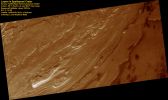
PSP_003442_1215_RED_browse-00.jpgLayers in Spallanzani Crater (context image)55 visiteThis image shows light-toned layered deposits along the floor of Spallanzani crater, a 72 Km (about 45 mile) diameter crater located just South-East of Hellas Planitia.
These layered deposits may be remnant sediments once deposited within the crater. Mechanisms for sediment deposition include windblown debris, airfall volcanic ash, or sediments that accumulated in a lake on the crater floor.
The slopes are covered in debris, and not fallen plates or blocks from the plateau edge.
This suggests that the layers are composed of weak materials that are protected by a stronger, more coherent surface.
The crater is named after the 18th Century Italian biologist, Lazzaro Spallanzani (1729-1799).
MareKromium
(6 voti)
|
|

PSP_003464_1380_RED_browse-01.jpgGullies and Dunes in a Crater in Newton Basin (extra-detail mgnf)55 visiteThis extra-detail mgnf (~1 Km across) shows several generations of dunes interacting with the protruding rock.
MareKromium
(6 voti)
|
|

PSP_003368_1755_RED_browse.jpgProposed MSL Site in Juventae Chasma (detail of the so-called "Martian Handwriting")109 visiteForse qualche Lettore avrà già riconosciuto il luogo e l'oggetto di questa ripresa e forse no.
Nel dubbio, Vi diciamo che si dovrebbe trattare (il condizionale è d'obbligo, poichè non abbiamo le coordinate esatte al centesimo di grado e quindi potremmo anche sbagliarci - ma di poco...) di una porzione della famosa - si fa per dire, naturalmente - "Scritta Marziana" di cui si è parlato sia nel Forum di SpazioUfo.com, sia nella nostra Rubrica TruePlanets.
Nostra opinione?
Se si tratta effettivamente di una porzione della "Scritta", allora pensiamo che adesso risulterà evidente a tutti come il parlare di artificialità del rilievo sia stato non solo azzardato e fuori luogo, ma addirittura ridicolo.
In caso contrario (e cioè qualora questo dettaglio fosse semplicemente relativo ad una zona promiscua alla "Scritta"), un simile e spettacolare frame MRO ci deve comunque essere di aiuto per capire, una volta che esso sia stato posto a confronto con il frame ESA-Mars Express relativo alla medesima zona, che l'operare congetture usando le orrende ed extra-piallate pseudo-immagini ESA è più che periglioso: è - semplicemente - assurdo.
E con questo, almeno per noi, la querelle sulla "Calligrafia Marziana"...è chiusa.MareKromium
(6 voti)
|
|

PSP_003193_0850_RED_browse_00.jpgMartian Spring: the "V" Fans (context image)58 visiteSouthern Spring sunshine is causing the seasonal Carbon Dioxide (CO2) Cap at the South Pole to evaporate.
This process happens fitfully, as small and large spots expose bare ground, which warms up, causing small spots to grow.
The defrosting areas are controlled by small scale differences in topography, which cause some areas of frost to be sheltered longer than others.
Once dust has accessed the surface it is blown in directions controlled by the local winds, making a distinctive fan. When the wind changes direction the fans broaden or may show multiple orientations.
It has also been proposed that dust is carried to the top of translucent seasonal carbon dioxide ice by release of gas held under pressure by the ice cap. When the pressure is released, like pulling the cork out of a champagne bottle, the gas escapes, carrying dust with it.MareKromium
(6 voti)
|
|

PSP_003193_0850_RED_browse_01.jpgMartian Spring: the "V" Fans (extra-detail mgnf)69 visitenessun commentoMareKromium
(6 voti)
|
|

PSP_002917_2175_RED_browse.jpgCrater Cluster in the Northern (Mid-Latitude) Plains54 visiteA Northern Mid-Latitude scene consisting of craters, intercrater plains and mantled material is seen in PSP_002917_2175. The mantled material seen here covers much of the Middle Latitudes in both Hemispheres of Mars; it has been visibly removed in some locations. It's called "mantled" because it looks as if it's just draped over, or mantling, the topography underneath. The mantled material is what causes the craters to have a muted, softened appearance. It's thought to be ice-rich material deposited in a climate different from that of today.
The mantled unit is dissected here, meaning that is not pristine and has likely undergone modification since it was originally laid down. The intercrater plains have a pitted texture that is thought to be caused by water ice sublimating and leaving depressions behind.
Unlike that of Earth, the obliquity (tilt of the planet's rotation axis) of Mars changes wildly.
Earth has the Moon to keep its axis stable, but Mars' satellites, Phobos and Deimos, are not massive enough to do the same.
Today Mars' obliquity (25.19°) is similar to that of Earth's (23.45°), but this has not always been the case. As the obliquity changes, the portions of Mars that receive the most sunlight shift. During periods of high obliquity, polar regions receive the most sunlight. This causes polar ices, including water ice and carbon dioxide ice, to sublimate (evaporate) into the atmosphere. They would then potentially be re-deposited in the mid-latitudes, similar to where this image is located. It is believed that this process is responsible for the mid-latitude mantled unit.
MareKromium
(6 voti)
|
|
| 2235 immagini su 187 pagina(e) |
 |
|
|
|
|
20 | |
|
|
|
|





