| Piú votate - Mars Reconnaissance Orbiter (MRO) |

PSP_008927_2010.jpgUnnamed Crater in Nili Fossae Region (True Colors; credits: Dr M. Faccin)56 visitenessun commentoMareKromium
(6 voti)
|
|

PSP_007612_2045_RED_abrowse~0.jpgProposed MSL Landing Site in Mawrth Vallis (MULTISPECTRUM; credits: Lunexit)62 visitenessun commentoMareKromium
(6 voti)
|
|
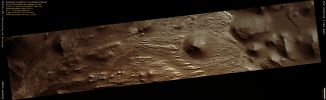
PSP_008708_1780_RED_abrowse.jpgGeologic Contacts in Juventae Chasma (MULTISPECTRUM-2; credits Lunexit)55 visiteMany of the Troughs of Valles Marineris contain mounds composed of light-toned Layered Deposits and Scientists have been debating both the origin of these Layered Deposits and their age of deposition relative to the Troughs themselves.
Some scientists think that the Layered Deposits formed first and then were covered by lava flows that make up the plains. Later, formation of the troughs of Valles Marineris created large openings through the plains that exposed the buried Layered Deposits.
Others have argued that the light-toned Layered Deposits formed after the Troughs and filled up portions of the canyons.
The chaotic terrain in Juventae is believed to have formed when subsurface water in the ground flowed away, causing collapse of the ground and leaving behind numerous hills along the floor of the Trough.
In this HiRISE image, the geologic contacts between the wallrock (darker units on the left - Sx - of the image), light-toned Layered Deposits, and darker hills of the chaotic terrain are visible. By studying the image, scientists hope to determine what are the relative ages of these different units in order to decipher the Geologic History of this Region.
(note: a stereo image of this location could be even more helpful because it will show the three-dimensional relationships between the different units, thus revealing more information about their relative ages)
MareKromium
(6 voti)
|
|
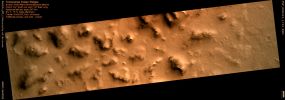
PSP_008323_1735_RED_abrowse-00.jpgTARs and Unusual "Star Ripples" (MULTISPECTRUM; credits: Lunexit)63 visiteThis blocky terrain is southwest of Schiaparelli Crater and is surrounded by a field of Transverse Aeolian Ridges (TARs) and unusual "Star Ripples" (dunes).
TARs are linear ripples with crest-ridge morphologies that can vary in shape; these morphologies include forked, sinuous, barchanoid, networked or feathered characteristics. The ridges also appear to transition into star dunes.
Star Dunes are complex features and are not yet fully understood on Earth. They form by multidirectional wind regimes with a dominant Primary Wind. Chains of Star Dunes often appear to have a massive linear appearance, or can be modified linear or Barchan Dunes with the formation of secondary slipfaces (on the steeper slope). On Earth, there are incipient Star Dunes, such as in the Dumont Dune field in the Mojave Desert, that display similar characteristics. The Dumont embryonic Star Dunes may result from dunes merging as they overrun one another, or are modified preexisting dunes, which could also be the case in this image.
Martian weather models predict that the dominate wind comes from a South-Westerly direction. This direction aligns nicely with the Transverse Ripples and the main arms of the Star Ripples.
This suggests that the Star Ripples were also affected by a different wind pattern or "Secondary Winds" or "Secondary Airflow". (Secondary Airflow is the airflow and sediment transport around the slopes of the dune).
Formation of incipient Star Dunes depends on the nature (strength, direction, and duration) of the Primary Wind and the volume of the sand to create the dune. Secondary airflow maintains the dune arms. The last factor is the deposition or removal of the sand by grainfall or grainflow avalanching. Grainfall and grainflow transports material from the main crestline slipface and along-slope or down-slope which maintains the secondary arm crest.MareKromium
(6 voti)
|
|

PSP_006268_1995_RED_abrowse.jpgThe alleged "Bridges" of Chrise Planitia (MULTISPECTRUM; credits: Lunexit)74 visiteThis image shows part of the surface of Chryse Planitia, near the mouth of several of the giant outflow channels carved by massive floods. At this location the channel is much too large to be seen within a HiRISE image, and this shows an area of level plains near the mouth.
Two geologic units are visible at this site: a relatively dark expanse in the southern part of the image (Dx) and a light, slightly higher-standing area along the northern edge. The light unit may be material that has flowed out from below the surface in a process called mud volcanism. However, many aspects of the history of the Northern Plains of Mars remain uncertain.
A few other prominent features are present. A long trough with aeolian ripples runs through the eastern part of the image. This feature likely formed by contraction of the surface layer. This must have occurred after the formation of the light material since it cuts through the light unit in the northwest part of the image.
There is also a large mound which appears to bury part of the trough, and thus is even younger. Alternatively, two troughs could both terminate at the hill.
Despite the resolution of HiRISE, the nature of this mound is still unclear. It has a rugged surface, which might mean that it has been eroded enough to remove indications of its origin.
MareKromium
(6 voti)
|
|

PSP_006248_1235_RED_abrowse.jpgDark-Reddish Dunes in Terra Cimmeria (MULTISPECTRUM-2; credits: Lunexit)55 visiteThis image shows a set of dark sand dunes within the Northern part of an unnamed crater in the Terra Cimmeria Region.
The dunes have a distinctive shape, with two horns on one end and a rounded edge on the other. The side of the dunes with the horns has a steeper slope and the rounded side a more shallow slope. These types of dunes are called “Barchans” and, by analogy with similar dunes on Earth, form in areas with limited sand supply.
The horns of the barchans point in the downwind direction, thereby indicating that the predominant surface winds in this Region blew from the East (up). Further evidence of this wind regime is apparent when one zooms into the image. “Wind tails” are visible on the Western (down) side of many rocks (many of these rocks may be ejecta from the degraded crater in the Northern part of the image). Wind tails are formed by the accumulation of dust and sand in the lee of rocks, which act as wind shadows. Very small light ripples at a scale of a few meters (yards) are also apparent.
The dark, sinuous forms in the image are tracks left by dust devils, which lift bright dust off the surface, revealing the darker surface. Where dust devils cross the dunes, the fine texture on the dunes is undisturbed, indicating that the particles making up the dunes are coarse and fairly immobile.
MareKromium
(6 voti)
|
|
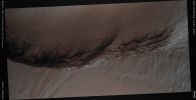
PSP_008244_2645_RED_abrowse.jpgNorth Polar Layered Deposits (MULTISPECTRUM; credits: Lunexit)55 visiteThe North Polar Layered Deposits of Mars form a layered stack of dusty ice up to 3 Km (about 2 miles) thick. The differences from layer to layer are thought to reflect differences in the climate of Mars that existed when the layers were formed.
We can see these internal layers exposed on the faces of the many troughs and scarps that cut through these deposits.
One of these scarp faces is shown here; it is situated at the head of a large canyon (named Chasma Boreale) that cuts through these Polar Layered Deposits.
The terrain on the upper side of the picture is higher and consists of the upper surface of the icy layered deposits in this area while the terrain on the lower side of the frame consists of the rocky ground that underlies the layered deposits. The cliff that separates these two areas runs down the center of the image with a relief of about 700 meters (about 2300 feet).
The section of the Layered Deposits that is exposed on this cliff face is unusual in that, as well layers of dusty ice, there are also layers of sand present. Small structures, called cross-beds, visible in the sandy layers indicate that each layer was originally a dune field that only later became covered with ice. Some of this sandy material is being removed from the cliff face and is forming new dunes at the foot of the cliff.MareKromium
(6 voti)
|
|

PSP_007801_2610_RED_abrowse.jpgDefrosting Dunes in the North Polar Sand Sea (MULTISPECTRUM; credits: Lunexit)64 visiteThis image shows defrosting sand dunes near the North Polar Region of Mars.
Around Mars’ North Pole is a vast Region or “sea” of sand dunes that become covered with CO2 frost or ice in the Northern Hemisphere’s Winter. The light areas indicate that parts of the dunes are still covered in frost or ice.
As Mars’ Northern Hemisphere enters into Spring and begins to warm, the CO2 sublimates. The CO2 sublimates in surprising ways, with trapped gas bursting through the ice in jets that leave dark streaks when the wind is blowing
During the Summer, all the frost will have sublimed leaving dark sand dunes. The unfrosted dunes are dark because the sand is derived from dark volcanic rocks.MareKromium
(6 voti)
|
|

PSP_007653_2010_RED_abrowse-00.jpgBright on Dark (MULTISPECTRUM; credits: Lunexit)56 visiteThis image reveals bright Slope Streaks in Bahram Vallis, a long sinuous valley that winds across North-Eastern Lunae Planum and Xanthe Terra to the circum-Chyrse basin.
Typically, dark and light-toned Slope Streaks appear together on light-toned slopes. This scene is a rare case in which only bright streaks are visible on a dark surface. Slope Streaks generally start at a point source and widen downslope as a single streak or branch into multiple streaks. Some of the Slope Streaks show evidence that downslope movement is being diverted around obstacles, such as large boulders, and a few appear to originate at boulders or clumps of rocky material.
Many hypotheses have been proposed for the formation of slope streaks including dry avalanching, geochemical weathering, liquid stains or flows, and moisture wickering. Recent observations from HiRISE images have revealed that the interior of Slope Streaks is lower in elevation than the surroundings indicating that material must have been removed and then deposited in the formation of the streak.
Slope Streak formation is among the few known processes currently active on Mars. Where they appear together, dark Slope Streaks cross cut and lie on top of the older and lighter-toned streaks leading to the belief that lighter-toned streaks are dark streaks that have lightened with time as new dust settled on their surface. Over the course of several years, MOC images from this Region did not reveal any new dark or light-toned Slope Streaks suggesting that streak formation is not currently active here.
HiRISE will continue to monitor this Region for new slope streaks and changes in tone of old streaks.MareKromium
(6 voti)
|
|
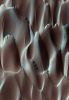
PSP_007193_2640_RED_abrowse-01.jpgDefrosting Northern Dunes (extra-detail mgnf - MULTISPECTRUM; credits: Lunexit)56 visiteThis extra-detail mgnf shows a Region of the dunes that are just beginning to lose their seasonal ice cover. In most of the image the dunes are a muted red color. Where the sun is shining on the steep dune crests the frost is gone and dark dust is free to cascade down the sides. This thin layer of dust, like slope streaks found elsewhere on Mars, flows down around obstacles and may come to rest mid-slope.MareKromium
(6 voti)
|
|
PSP_007338_2640_RED_abrowse-1.jpgCaught in Action: Avalanches on North Polar Scarps (natural colors; credits: Lunexit)56 visitenessun commentoMareKromium
(6 voti)
|
|

PSP_006891_1970_RED_abrowse-01.jpgAt the base of the Olympus... (EDM - Saturated Natural Colors; credits for the additional process. and color.: Dr Paolo C. Fienga - Lunexit Team)54 visiteThe bottom right part of the cutout has a much flatter and smoother surface. These are younger lava flows that have buried the lower part of the volcano. When lava flows form vast smooth sheets, they are called "flood" lavas.
In the bottom of the cutout, the flood lavas have odd, wiggly looking plateaus. These are parts of the lava crust that were lifted up when more liquid lava was injected into the middle of the slowly solidifying lava flow.
This process is called "inflation" and is seen on many lava flows on Earth. These younger lava flows are cut by two different sets of faults. One makes the branching valley in the flood lavas and the other creates the sinuous ridge and valley along the edge of the Olympus Mons lava flows.
Lower resolution images that cover a broader area suggest that the sinuous fault is an old buried structure that has been more recently reactivated.MareKromium
(6 voti)
|
|
| 2235 immagini su 187 pagina(e) |
 |
|
|
|
|
19 | |
|
|
|
|





