| Piú votate - Mars Reconnaissance Orbiter (MRO) |

Q-pia08014-08-AEB1-full-reduced1.jpgMartian Southern Highlands (8) - HR110 visitenessun commento
(14 voti)
|
|

Psp_010259_1525_red.jpgBedrock inside Terby Crater (possible True Colors; credits: Lunar Explorer Italia)57 visiteMars Local Time: 15:40 (middle afternoon)
Coord. (centered): 27,3° South Lat. and 74,3° East Long.
Spacecraft altitude: 260,9 Km (such as about 163,1 miles)
Original image scale range: 52,2 cm/pixel (with 1 x 1 binning) so objects ~1,57 mt across are resolved
Map projected scale: 50 cm/pixel
Map projection: EQUIRECTANGULAR
Emission Angle: 6,4°
Phase Angle: 74,2°
Solar Incidence Angle: 69° (meaning that the Sun is about 21° above the Local Horizon)
Solar Longitude: 136,4° (Northern Summer)
Credits: NASA/JPL/University of Arizona
Additional process. and coloring: Lunar Explorer ItaliaMareKromium
(8 voti)
|
|
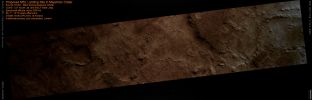
PSP_007704_1765_RED_abrowse~0.jpgProposed MSL Landing Site in Miyamoto Crater (MULTISPECTRUM; credits: Lunexit)56 visiteMiyamoto Crater is located in South-Western Meridiani Planum (and South-West of the Mars Exploration Rover Opportunity Landing Site).
This image shows fairly smooth plains and some areas covered by Windstreaks.
The streaks suggest that wind is an active process here, depositing surface material downwind in this distinctive form. This Landing Site is adjacent to the Hematite-bearing plains unit where the Opportunity Rover sits.
The CRISM instrument has detected Phyllosilicates (Clay Minerals) at this Landing Site, which scientists believe to have formed in the presence of water.
The Mars Science Laboratory rover would investigate the mineral diversity here, which includes Phyllosilicates and Sulfate Minerals.MareKromium
(6 voti)
|
|

Psp_009731_2165_red.jpgPeriglacial Modification of a Fairly Fresh Crater in Utopia Planitia (possible True Colors; credits: Lunar Explorer Italia)58 visiteMars Local Time: 15:19 (early afternoon)
Coord. (centered): 36,0° North Lat. and 80,7° East Long.
Spacecraft altitude: 295,3 Km (such as about 184,6 miles)
Original image scale range: 29,5 cm/pixel (with 1 x 1 binning) so objects ~89 cm across are resolved
Map projected scale: 25 cm/pixel
Map projection: EQUIRECTANGULAR
Emission Angle: 8,4°
Phase Angle: 53,4°
Solar Incidence Angle: 45° (meaning that the Sun is about 45° above the Local Horizon)
Solar Longitude: 116,8° (Northern Summer)
Credits: NASA/JPL/University of Arizona
Additional process. and coloring: Lunar Explorer ItaliaMareKromium
(6 voti)
|
|
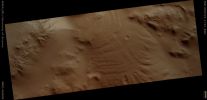
Psp_009729_1735_red.jpgTerraced Fan in Aeolis Planum Region (possible True Colors; credits: Lunar Explorer Italia)57 visiteThis image shows the South-Western Region of a degraded crater’s floor, located near the Equator. The high-standing ridge near the left side of the scene is a terrace that slumped off the crater’s rim (located to the far left of this frame, but out of the image). The bumpy terrain near the bottom of the image is also material that has slumped off the crater rim.
The center of the image contains a terraced fan. The fan emanates from a valley (not pictured, located in the lower part of the scene) that intersects the crater’s south rim, which suggests that the valley might have transported fluid, likely water, into the crater. If this happened, then the fan marks where the flow deposited its sediment.
Mars Local Time: 15:29 (early afternoon)
Coord. (centered): 6,5° South Lat. and 141,2° East Long.
Spacecraft altitude: 266,7 Km (such as about 166,7 miles)
Original image scale range: 26,7 cm/pixel (with 1 x 1 binning) so objects ~80 cm across are resolved
Map projected scale: 25 cm/pixel
Map projection: EQUIRECTANGULAR
Emission Angle: 6,2°
Phase Angle: 63,8°
Solar Incidence Angle: 59° (meaning that the Sun is about 31° above the Local Horizon)
Solar Longitude: 116,8° (Northern Summer)
Credits: NASA/JPL/University of Arizona
Additional process. and coloring: Lunar Explorer ItaliaMareKromium
(5 voti)
|
|

Psp_009557_1905_red.jpgChannels in Athabasca Valles (Natural Colors; credits for the additional process. and color.: Dr Paolo C. Fienga - Lunar Explorer Italia)56 visiteMars Local Time: 15:32 (middle afternoon)
Coord. (centered): 10,3° North Lat. and 157,0° East Long.
Spacecraft altitude: 292,6 Km (such as about 182,9 miles)
Original image scale range: 29,3 cm/pixel (with 1 x 1 binning) so objects ~88 cm across are resolved
Map projected scale: 25 cm/pixel
Map projection: EQUIRECTANGULAR
Emission Angle: 19,7°
Phase Angle: 35,8°
Solar Incidence Angle: 52° (meaning that the Sun is about 38° above the Local Horizon)
Solar Longitude: 110,6° (Northern Summer)
Credits: NASA/JPL/University of Arizona
Additional process. and coloring: Lunar Explorer ItaliaMareKromium
(5 voti)
|
|
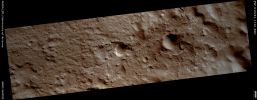
PSP_010281_1510_RED_abrowse-00.jpgSedimentary Layers in Columbus Crater (ctx frame - possible True Colors; credits: Lunar Explorer Italia)57 visiteThis image covers a portion of the North-Eastern Inner Wall of Columbus Crater, located in the Southern Hemisphere of Mars and is approx. 100 Km (about 60 miles) in diameter.
Layered sedimentary rocks are found on the Crater Walls and Floor, and may have been deposited by water or by wind. These rocks have subsequently been eroded to expose their successive layers in cross-section.
The near-infrared spectrometer CRISM has revealed that these layers contain various hydrated minerals.
Mars Local Time: 15:42 (middle afternoon)
Coord. (centered): 28,6° South Lat. and 194,3° East Long.
Spacecraft altitude: 256,0 Km (such as about 160,0 miles)
Original image scale range: 25,6 cm/pixel (with 1 x 1 binning) so objects ~77 cm across are resolved
Map projected scale: 25 cm/pixel
Map projection: EQUIRECTANGULAR
Emission Angle: 0,5°
Phase Angle: 70,9°
Solar Incidence Angle: 70° (meaning that the Sun is about 20° above the Local Horizon)
Solar Longitude: 137,3° (Northern Summer)
Credits: NASA/JPL/University of Arizona
Additional process. and coloring: Lunar Explorer ItaliaMareKromium
(6 voti)
|
|
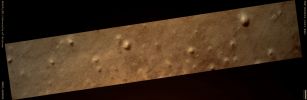
Psp_009659_2425_red.jpgTerrain in Vastitas Borealis (possible True Colors; credits: Lunar Explorer Italia)57 visiteMars Local Time: 15:08 (early afternoon)
Coord. (centered): 62,4° North Lat. and 241,9° East Long.
Spacecraft altitude: 309,5 Km (such as about 193,4 miles)
Original image scale range: 61,9 cm/pixel (with 1 x 1 binning) so objects ~1,86 mt across are resolved
Map projected scale: 50 cm/pixel
Map projection: EQUIRECTANGULAR
Emission Angle: 0,3°
Phase Angle: 50,8°
Solar Incidence Angle: 51° (meaning that the Sun is about 39° above the Local Horizon)
Solar Longitude: 114,3° (Northern Summer)
Credits: NASA/JPL/University of Arizona
Additional process. and coloring: Lunar Explorer ItaliaMareKromium
(4 voti)
|
|
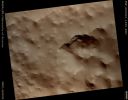
Psp_009435_1850_red.jpgLayered Outcrop and associated Boulder Tracks, North of Pavonis Mons (possible True Colors; credits: Lunar Explorer Italia)57 visiteMars Local Time: 15:25 (early afternoon)
Coord. (centered): 5,1° North Lat. and 246,7° East Long.
Spacecraft altitude: 266,0 Km (such as about 166,3 miles)
Original image scale range: 26,6 cm/pixel (with 1 x 1 binning) so objects ~80 cm across are resolved
Map projected scale: 25 cm/pixel
Map projection: EQUIRECTANGULAR
Emission Angle: 2,2°
Phase Angle: 54,6°
Solar Incidence Angle: 53° (meaning that the Sun is about 37° above the Local Horizon)
Solar Longitude: 106,3° (Northern Summer)
Credits: NASA/JPL/University of Arizona
Additional process. and coloring: Lunar Explorer ItaliaMareKromium
(4 voti)
|
|

Psp_009406_2600_red.jpgExposed Rupes Tenuis of the Southern Margin of Hyperborea Lingula57 visiteMars Local Time: 14:42 (early afternoon)
Coord. (centered): 79,9° North Lat. and 302,1° East Long.
Spacecraft altitude: 320,6 Km (such as about 200,3 miles)
Original image scale range: 32,1 cm/pixel (with 1 x 1 binning) so objects ~64,1 cm across are resolved
Map projected scale: 25 cm/pixel
Map projection: EQUIRECTANGULAR
Emission Angle: 8,0°
Phase Angle: 51,8°
Solar Incidence Angle: 58° (meaning that the Sun is about 32° above the Local Horizon)
Solar Longitude: 105,3° (Northern Summer)
Credits: NASA/JPL/University of Arizona
Additional process. and coloring: Lunar Explorer ItaliaMareKromium
(4 voti)
|
|
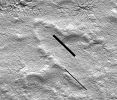
ESP_014282_0930_RED_abrowse-03.jpgSpiders (EDM n.2 - credits: Dr G. Barca)66 visite...Si, a questo punto è certo: si trattava di un image-artifact. Senza dubbi. Grandi complimenti al nostro sempre puntualissimo Dr Barca per la pazienza avuta!MareKromium
(5 voti)
|
|
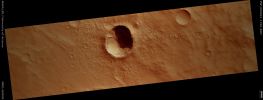
Psp_009622_1590_red.jpgMedium-size Impact Crater (possible True Colors; credits: Lunar Explorer Italia)57 visiteMars Local Time: 15:31 (middle afternoon)
Coord. (centered): 20,9° South Lat. and 184,4° East Long.
Spacecraft altitude: 257,3 Km (such as about 160,8 miles)
Original image scale range: 51,5 cm/pixel (with 1 x 1 binning) so objects ~1,54 mt across are resolved
Map projected scale: 50 cm/pixel
Map projection: EQUIRECTANGULAR
Emission Angle: 3,5°
Phase Angle: 70,5°
Solar Incidence Angle: 68° (meaning that the Sun is about 22° above the Local Horizon)
Solar Longitude: 112,9° (Northern Summer)
Credits: NASA/JPL/University of Arizona
Additional process. and coloring: Lunar Explorer ItaliaMareKromium
(5 voti)
|
|
| 2235 immagini su 187 pagina(e) |
 |
|
|
|
|
|
|
|
185 | |
|





