| Piú votate - Mars Reconnaissance Orbiter (MRO) |
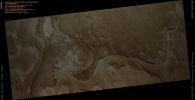
ESP_014167_1300_RED_abrowse.jpgExposures of Layered Rocks in Argyre Planitia (Natural Colors; credits: Lunexit)57 visitenessun commentoMareKromium
(5 voti)
|
|
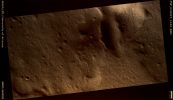
PSP_010025_1410_RED.jpgDark Area in Hartwig Crater (possible True Colors; credits: Lunar Explorer Italia)56 visiteMars Local Time: 15:39 (middle afternoon)
Coord. (centered): 38,2° South Lat. and 344,1° East Long.
Spacecraft altitude: 256,7 Km (such as about 160,4 miles)
Original image scale range: 51,4 cm/pixel (with 1 x 1 binning) so objects ~1,54 mt across are resolved
Map projected scale: 50 cm/pixel
Map projection: EQUIRECTANGULAR
Emission Angle: 6,6°
Phase Angle: 82,8°
Solar Incidence Angle: 78° (meaning that the Sun is about 12° above the Local Horizon)
Solar Longitude: 127,6° (Northern Summer)
Credits: NASA/JPL/University of Arizona
Additional process. and coloring: Lunar Explorer ItaliaMareKromium
(5 voti)
|
|
ESP_025680_1350-PCF-LXTT-01.jpgUnnamed Crater with "Pedestal" in Terra Cimmeria (EDM - Absolute Natural Colors; credits for the additional process. and color.: Dr Paolo C. Fienga - Lunexit Team)82 visiteMars Local Time: 15:08 (Early Afternoon)
Coord. (centered): 44,814° South Lat. and 264,976° East Long.
Spacecraft altitude: 247,7 Km (such as about 154,8 miles)
Original image scale range: 49,6 cm/pixel (with 2 x 2 binning) so objects ~ 1 mt and 49 cm across are resolved (with 4 x 4 binning)
Map projected scale: 50 cm/pixel
Map projection: EQUIRECTANGULAR
Emission Angle: 0,3°
Sun - Mars - MRO (or "Phase") Angle: 79,1°
Solar Incidence Angle: 79° (meaning that the Sun is about 11° above the Local Horizon)
Solar Longitude: 58,6° (Northern Spring/Southern Fall)
Credits: NASA/JPL/University of ArizonaMareKromium
(4 voti)
|
|
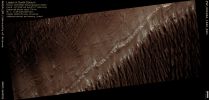
PSP_006984_1840_RED_abrowse~0.jpgLayers in Gordii Dorsum (MULTISPECTRUM; credits: Lunexit)57 visiteThis image shows distinctive differences in the texture of the ground surface in an area of Mars called Gordii Dorsum.
The upper right part of the image contains many subparallel ridges. These ridges are geological features called yardangs (long irregular ridges carved by wind erosion). The lower half of the image is smoother and contains a few small knobs and ridges. This area of Mars contains extensive outcroppings of layered sedimentary rocks that may have formed by the accumulation of sand and dust either blown in by the wind, transported by water, or some combination of processes such as these.
The distinctive surface textures may be due to differences in the rock structure and formation process. Mapping differences in the surface textures such as these may help to reveal how these rocks formed and advance our understanding of the geologic history of Mars.MareKromium
(4 voti)
|
|
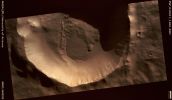
PSP_010017_1460_RED.jpgRelatively Flat Crater Floor bounded By sharp change in Slope (possible True Colors; credits: Lunar Explorer Italia)56 visiteMars Local Time: 15:42 (middle afternoon)
Coord. (centered): 33,7° South Lat. and 202,9° East Long.
Spacecraft altitude: 253,3 Km (such as about 158,3 miles)
Original image scale range: 50,7 cm/pixel (with 1 x 1 binning) so objects ~1,52 mt across are resolved
Map projected scale: 50 cm/pixel
Map projection: EQUIRECTANGULAR
Emission Angle: 5,2°
Phase Angle: 71,8°
Solar Incidence Angle: 75° (meaning that the Sun is about 15° above the Local Horizon)
Solar Longitude: 127,3° (Northern Summer)
Credits: NASA/JPL/University of Arizona
Additional process. and coloring: Lunar Explorer ItaliaMareKromium
(4 voti)
|
|

Psp_009460_2665_red.jpgSmall Crater on the North Polar Permanent Cap (possible True Colors; credits: Lunar Explorer Italia)57 visiteMars Local Time: 12:06 (early afternoon)
Coord. (centered): 86,5° North Lat. and 227,9° East Long.
Spacecraft altitude: 317,5 Km (such as about 198,4 miles)
Original image scale range: 31,8 cm/pixel (with 1 x 1 binning) so objects ~95 cm across are resolved
Map projected scale: 25 cm/pixel
Map projection: EQUIRECTANGULAR
Emission Angle: 0,2°
Phase Angle: 62,6°
Solar Incidence Angle: 62° (meaning that the Sun is about 28° above the Local Horizon)
Solar Longitude: 107,2° (Northern Summer)
Credits: NASA/JPL/University of Arizona
Additional process. and coloring: Lunar Explorer ItaliaMareKromium
(4 voti)
|
|
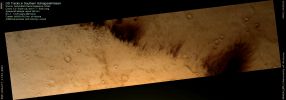
PSP_006477_1745_RED_abrowse-00~0.jpgDD Tracks in Southern Schiaparelli Basin (context frame - False Colors; credits: Lunexit)55 visiteDust-Devils (DD) are vortices of wind that form when air rising from a warm surface encounters shear in the above atmosphere.
Martian Dust-Devils can attain gargantuan proportions, reaching the size of terrestrial tornadoes with plumes that tower up to 9 Km above the surface.
Dust-Devils play an important role in sustaining the aerosols that make up Mars’ Red Sky and in cleaning the Martian Surface after a Dust Storm.
Nota Lunexit: sono quindi i DD, secondo la NASA, la "causa maggiore" del Cielo Rosso di Marte? Interessante riflessioni ed interessante quesito: dunque il Cielo di Marte NON E', naturalmente, "rosso" o "arancio", ma è "tinto di rosso/arancio"!
Pensateci sopra...
MareKromium
(4 voti)
|
|

PSP_009161_1450_RED-00.jpgLong Shadows over Ariadnes Colles (ctx frame- natural colors; credits: Lunexit)56 visiteAriadnes Colles is a labyrinth-like cluster of hills, mesas and knobs located near Terra Cimmeria, in the Southern Highlands of Mars.
This image, which covers a portion of that labyrinth, was acquired only a few Soles away from Winter Solstice.
Winter Solstice occurs in the shortest Sol of the year, when the Sun travels the lowest in the Martian sky, making shadows appear very long. These conditions are ideal to analyze modest relief features, that would pass unnoticed when illuminated from above but are highlighted when illuminated from the side.MareKromium
(4 voti)
|
|
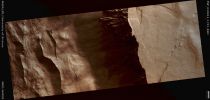
PSP_010013_1725_RED.jpgGreat Exposure of Ganges Chasma Wall and Slump Deposit (possible True Colors; credits: Lunar Explorer Italia)56 visiteMars Local Time: 15:34 (middle afternoon)
Coord. (centered): 7,2° South Lat. and 308,2° East Long.
Spacecraft altitude: 264,3 Km (such as about 165,2 miles)
Original image scale range: 52,9 cm/pixel (with 1 x 1 binning) so objects ~1,59 mt across are resolved
Map projected scale: 50 cm/pixel
Map projection: EQUIRECTANGULAR
Emission Angle: 0,7°
Phase Angle: 60,0°
Solar Incidence Angle: 59° (meaning that the Sun is about 31° above the Local Horizon)
Solar Longitude: 127,2° (Northern Summer)
Credits: NASA/JPL/University of Arizona
Additional process. and coloring: Lunar Explorer ItaliaMareKromium
(6 voti)
|
|

Psp_010345_2150_red.jpgPits in Cyane Fossae (Saturated Natural Colors; credits for the additional process. and color.: Dr Paolo C. Fienga - Lunar Explorer Italia)57 visiteMars Local Time: 15:30 (middle afternoon)
Coord. (centered): 34,4° North Lat. and 239,0° East Long.
Spacecraft altitude: 285,7 Km (such as about 178,6 miles)
Original image scale range: 57,2 cm/pixel (with 1 x 1 binning) so objects ~1,72 mt across are resolved
Map projected scale: 50 cm/pixel
Map projection: EQUIRECTANGULAR
Emission Angle: 0,3°
Phase Angle: 50,5°
Solar Incidence Angle: 50° (meaning that the Sun is about 40° above the Local Horizon)
Solar Longitude: 139,8° (Northern Summer)
Credits: NASA/JPL/University of Arizona
Additional process. and coloring: Lunar Explorer ItaliaMareKromium
(6 voti)
|
|
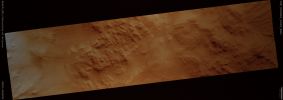
PSP_009660_2020_RED.jpgWest Olympus Mons (Extremely Saturated Natural Colors; credits for the additional process. and color.: Dr Paolo C. Fienga - Lunar Explorer Italia)58 visiteMars Local Time: 15:25 (early afternoon)
Coord. (centered): 21,5° North Lat. and 221,9° East Long.
Spacecraft altitude: 280,3 Km (such as about 175,2 miles)
Original image scale range: 28,0 cm/pixel (with 1 x 1 binning) so objects ~56,1 cm across are resolved
Map projected scale: 25 cm/pixel
Map projection: EQUIRECTANGULAR
Emission Angle: 0,4°
Phase Angle: 47,5°
Solar Incidence Angle: 47° (meaning that the Sun is about 43° above the Local Horizon)
Solar Longitude: 114,3° (Northern Summer)
Credits: NASA/JPL/University of Arizona
Additional process. and coloring: Lunar Explorer ItaliaMareKromium
(6 voti)
|
|
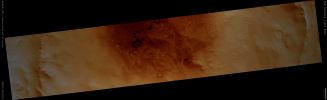
Psp_009565_1905_red.jpgDark Material on the Floor of an Unnamed Crater (Enhanced Natural Colors; credits for the additional process. and color.: Dr Paolo C. Fienga - Lunar Explorer Italia)56 visiteMars Local Time: 15:27 (early afternoon)
Coord. (centered): 10,3° North Lat. and 297,2° East Long.
Spacecraft altitude: 273,8 Km (such as about 171,1 miles)
Original image scale range: 27,4 cm/pixel (with 1 x 1 binning) so objects ~82 cm across are resolved
Map projected scale: 25 cm/pixel
Map projection: EQUIRECTANGULAR
Emission Angle: 2,5°
Phase Angle: 48,8°
Solar Incidence Angle: 51° (meaning that the Sun is about 39° above the Local Horizon)
Solar Longitude: 110,9° (Northern Summer)
Credits: NASA/JPL/University of Arizona
Additional process. and coloring: Lunar Explorer ItaliaMareKromium
(3 voti)
|
|
| 2235 immagini su 187 pagina(e) |
 |
|
|
|
|
|
|
184 | |
|
|





