| Piú votate - Mars Reconnaissance Orbiter (MRO) |

ESP_011635_1510_RED_abrowse.jpgRitchey Crater's Central Uplift (Natural Colors; credits: Lunar Explorer Italia)73 visiteThe Natural Color image of this observation includes some interesting features in and near the central uplift of Ritchey Crater.
At the top is an ancient streambed, above center are very bright rocks and minerals can be seen in the Central Uplift. Large impact craters are unstable when they are formed, because their Walls are so steep.
Gravity causes the Walls to collapse toward the center of the Crater, colliding to form an Uplift or Peak. This process of Central Uplift formation can bring rocks from deep in the Crater Walls up to the surface. The angular bright blocks near the center of this image show that this process breaks the wall rocks into fragments as the Central Uplift is formed.
Mars Local Time: 16:00 (middle afternoon)
Coord. (centered): 28,5° South Lat. and 309,1° East Long.
Spacecraft altitude: 264,8 Km (such as about 165,5 miles)
Original image scale range: 26,5 cm/pixel (with 1 x 1 binning) so objects ~79 cm across are resolved
Map projected scale: 25 cm/pixel
Map projection: EQUIRECTANGULAR
Emission Angle: 15,1°
Phase Angle: 46,9°
Solar Incidence Angle: 61° (meaning that the Sun is about 29° above the Local Horizon)
Solar Longitude: 194,0° (Northern Autumn)
Credits: NASA/JPL/University of Arizona
Additional process. and coloring: Lunar Explorer ItaliaMareKromium
(1 voti)
|
|
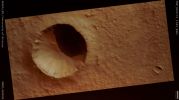
Psp_009772_1545_red.jpgSchaeberle Crater (possible True Colors; credits: Lunar Explorer Italia)67 visiteMars Local Time: 15:35 (middle afternoon)
Coord. (centered): 25,4° South Lat. and 50,0° East Long.
Spacecraft altitude: 254,6 Km (such as about 159,1 miles)
Original image scale range: 50,9 cm/pixel (with 1 x 1 binning) so objects ~1,53 mt across are resolved
Map projected scale: 50 cm/pixel
Map projection: EQUIRECTANGULAR
Emission Angle: 0,9°
Phase Angle: 71,4°
Solar Incidence Angle: 71° (meaning that the Sun is about 19° above the Local Horizon)
Solar Longitude: 118,3° (Northern Summer)
Credits: NASA/JPL/University of Arizona
Additional process. and coloring: Lunar Explorer ItaliaMareKromium
(1 voti)
|
|

Psp_009480_2265_red.jpgLayers and Scallops (True Colors; credits: Lunar Explorer Italia)66 visiteMars Local Time: 15:10 (early afternoon)
Coord. (centered): 45,9° North Lat. and 91,1° East Long.
Spacecraft altitude: 306,6 Km (such as about 191,6 miles)
Original image scale range: 30,7 cm/pixel (with 1 x 1 binning) so objects ~92 cm across are resolved
Map projected scale: 25 cm/pixel
Map projection: EQUIRECTANGULAR
Emission Angle: 11,8°
Phase Angle: 55,8°
Solar Incidence Angle: 44° (meaning that the Sun is about 46° above the Local Horizon)
Solar Longitude: 107,9° (Northern Summer)
Credits: NASA/JPL/University of Arizona
Additional process. and coloring: Lunar Explorer ItaliaMareKromium
(1 voti)
|
|

PSP_008075_1590_RED_abrowse.jpgLight-toned Rocks (MULTISPECTRUM; credits: Lunexit)70 visiteThis observation shows a portion of an approximately 30 kilometer diameter impact crater located to the south of Valles Marineris.
The image reveals that the central uplift inside the crater is a mixture of dark-toned and light-toned materials. It’s likely that some of the rocks in the center of the crater represent units at depth that we wouldn’t otherwise see along the plains that surround the crater. The light-toned units in particular are not visible in the plains surrounding this crater so they could be material that is buried beneath the plains and only visible inside craters or other vertical exposures, such as those created by faults.
Some of the light-toned material appears angular and blocky, consistent with material that has been disrupted and uplifted by an explosion associated with the crater’s formation. The reason why some material appears light-toned is unknown but could be due to a different composition than the darker-toned unit.
Many light-toned units seen elsewhere on Mars, including within Valles Marineris, are made of sulfates so there may be sulfate-rich rocks buried beneath the plains at this location and the formation of the crater exposed them. In any case, the distinct materials visible within impact craters suggest that the crust on Mars may contain many units of variable composition.MareKromium
(1 voti)
|
|
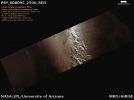
PSP_008095_2500_RED_abrowse.jpgLouth Crater, Southern Rim (MULTISPECTRUM; credits: Lunexit)85 visitenessun commentoMareKromium
(1 voti)
|
|

PSP_008100_1790_RED_abrowse.jpgLayered Rocks in Iani Chaos (MULTISPECTRUM; credits: Lunexit)72 visiteThis image shows rocks on the floor of Iani Chaos, a Region of collapsed and disorganized Terrain.
The Chaotic Terrains on Mars may have been the sources of floodwaters that carved the giant outflow channels. They typically contain irregular hills like the one in the center of this image. In some cases, they also have light-toned rocks exposed on the floors. The point of interest is to determine whether these rocks predate the chaos or formed after the collapse; however, the contacts may be obscured by later material mantling the ground.
The rocks here are light-toned, and have dark low patches which are likely a thin cover of wind-blown sand. At a coarse scale, linear features are also visible in the rock, likely reflecting aeolian (wind) erosion in a preferred direction. A variety of processes could have contributed to forming these rocks, from volcanic eruptions to lake deposition or accumulation of wind-blown sand.
Stepped layers occur in places, suggesting a repetitive process. This argues for an origin as aeolian or lake-bed sediments, since volcanic eruptions may be of variable strength.MareKromium
(1 voti)
|
|

T-TRA_000862_1710_RED_CandorChasma_01.jpgCandor Chasma56 visiteThis HiRISE sub-image shows the steep slopes along wallrock in the eastern edge of West Candor Chasma. In general, the rocks in the upper part of the canyons are interpreted to be lava flows that cover the plains surrounding Valles Marineris, whereas the deeper material along the walls could be either more lava flows or megaregolith that resulted from numerous impact craters that disrupted the Martian surface during the first billion years after formation of the planet. Resistant material is visible in portions of the sub-image and HiRISE is able to resolve 1-2 meter size boulders shedding out of these resistant wallrock units. The bright and dark lineations seen in the right of the sub-image follow the slope of the wallrock (downslope is towards the top of the sub-image) and likely represent bright dust and dark sand that are sliding downslope. The large number of small impact craters visible along the slopes indicates that there isn't a large amount of material moving downslope recently because these craters would have been destroyed or buried.
(1 voti)
|
|

PSP_006567_2220_RED_abrowse-01.jpgFlooded terrain in Terra Sabaea (extra-detail mgnf - MULTISPECTRUM; credits: Lunexit)67 visiteThe smooth surfaces of the flows are punctuated by curved, subparallel fractures oriented transverse to the flow direction.
These cracks resemble crevasses in terrestrial glaciers and were formed when the brittle solid crust of the flow fractured as it was dragged downstream. Detailed images such as this will help determine the role ice may have played in these flows.MareKromium
(7 voti)
|
|

PSP_001367_1620_RED_abrowse.jpgGratteri Crater (Natural Colors; credits: Lunexit)54 visitenessun commentoMareKromium
(6 voti)
|
|
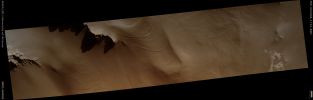
Psp_009408_1715_red.jpgShadowland (possible True Colors; credits: Lunar Explorer Italia)56 visiteMars Local Time: 15:31 (middle afternoon)
Coord. (centered): 8,3° South Lat. and 266,4° East Long.
Spacecraft altitude: 263,4 Km (such as about 164,6 miles)
Original image scale range: 52,7 cm/pixel (with 1 x 1 binning) so objects ~1,58 mt across are resolved
Map projected scale: 50 cm/pixel
Map projection: EQUIRECTANGULAR
Emission Angle: 10,5°
Phase Angle: 53,3°
Solar Incidence Angle: 61° (meaning that the Sun is about 29° above the Local Horizon)
Solar Longitude: 105,3° (Northern Summer)
Credits: NASA/JPL/University of Arizona
Additional process. and coloring: Lunar Explorer ItaliaMareKromium
(6 voti)
|
|

Elysium_Planitia-Tra_000867_1875_red-00.jpgElysium Planitia (CTX Frame - False Colors)55 visiteA low, sinuous tectonic ridge ("wrinkle ridge") can be seen in the South-East (lower left) and a rough-textured flow (lava?) fills the North-West (upper right) part of the image. Terraces that may have been carved by floodwaters are visible on the Southeastern side of the contact between the wrinkle ridge and the flow.
On the Northwestern side of this contact, the flow itself has a banded appearance reminiscent of contour lines or bathtub rings. It may be that long ago, when the flow was mobile, its surface level dropped, leaving these bands as indicators of how high it once stood. Alternatively, the bands could be buried terraces draped by the rough-textured flow. Relatively straight and narrow dunes (about 10 mt wide) have marched across the surface of the flow, and a thin layer of light-toned dust blankets the region. A dark spot about 100 mt in diameter on the left side of the image is probably where a cluster of small impacts blew away the dust, revealing the darker shade of the underlying surface.MareKromium
(6 voti)
|
|

ESP_018301_2505_RED_abrowse-00.jpgLouth Crater (CTX Frame- Natural Colors; credits for the additional process. and color.: Dr Paolo C. Fienga - Lunexit Team)67 visiteThis HiRISE image shows a large Ice Mound located in Louth Crater. At 70° North (in the Region of Vastitas Borealis), this is the lowest latitude permanent deposit of water ice on Mars.
The HiRISE image, taken in early Summer, shows details of the Mound and non-ice portions of the Crater Floor.
The Mound is characterized by rough textures and layering similar to features seen on the North Polar Layered Deposits near the Martian North Pole. Zooming in to an area in the South-Eastern part of the Mound (see the following EDMs), dark Sinuous Ridges appear.
These may be the crests of partially defrosted Dark Sand Dunes or perhaps some other feature that we do not understand.
This is the only area on Louth where these enigmatic Ridges are found.MareKromium
(5 voti)
|
|
| 2235 immagini su 187 pagina(e) |
 |
|
|
|
|
|
183 | |
|
|
|





