| Piú votate - Mars Reconnaissance Orbiter (MRO) |

ESP_016288_2610_RED_abrowse.jpgHigh Northern Latitudes (possible Natural Colors; credits: Dr Paolo C. Fienga - Lunexit Team)57 visitenessun commentoMareKromium
(1 voti)
|
|
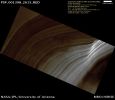
PSP_001398_2615_RED_abrowse.jpgExposure of NPLD with "Unconformities" (Natural - but enhanced - Colors; credits: Dr Paolo C. Fienga - Lunexit Team)81 visiteThis image shows a portion of the North Polar Layered Deposits (NPLD). The NPLD are layers that have been deposited over an extensive area at both Poles, possibly throughout Martian History. They likely contain ice-rich and dust-rich layers, with the darker layers being probably more dust-rich than the bright layers.
The NPLD holds clues to past climate regimes similar to ice cores on Earth. Several of the layers occur in fairly regular sequences, as seen in this image, suggesting that Mars underwent cyclic climate changes in the past.
Towards the top left side of the image, there is a series of layers that appears truncated at an angle, forming what geologists call "Angular Uncomformity". They typically form by first laying down a series of continuous beds. Then erosion cuts through the beds at an angle. Aferwards, a new set of beds are laid over this partially eroded sequence. A similar Unconformity exists at the bottom right of the image.MareKromium
(1 voti)
|
|
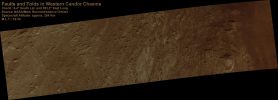
PSP_003540_1735_RED_browse~0.jpgFaults and Folds in West Candor Chasma (Natural Colors; credits: Lunexit)61 visiteThis image shows various interesting structures along the Floor of Candor Chasma, a major canyon of Valles Marineris.
The rocks along the floor of the chasma consist of multiple layers of light-toned material, possibly windblown or water-lain sediment. These layers have been shifted along faults and also folded, giving the layers an apparent wavy appearance as they are exposed at the Surface through erosion.
Some waviness in the Layers may also have formed as these sediments were laid down (for example, in Dunes or large Ripples. Detailed mapping of these Faults and Folds may help reveal the origin of these Layered Deposits and if water played any role in their formation.MareKromium
(1 voti)
|
|
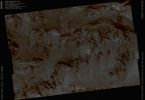
PSP_001415_1875_RED_abrowse.jpgAlluvial Fans in Mojave Crater (Natural Colors; credits: Lunexit)83 visiteAptly-named Mojave Crater in the Xanthe Terra Region has Alluvial Fans that look remarkably similar to landforms in the Mojave Desert of South-Eastern California and portions of Nevada and Arizona.
Alluvial Fans are "fan-shaped deposits of water-transported material" (---> Lat.: alluvium). They typically form at the base of hills or mountains where there is a marked break, or flattening of slope.
They typically deposit big rocks near their Mouths (close to the mountains) and smaller rocks at greater distances. Alluvial Fans form as a result of heavy desert Downpours, typically "Thundershowers" (Nota Lunexit: piogge torrenziali che occorrono durante violenti temporali, per lo più di tipo tropicale).
Because deserts are poorly vegetated, heavy and short-lived Downpours create a great deal of erosion and nearby deposition.
There are Fans inside and around the outsides of Mojave Crater on Mars that perfectly match the morphology of Alluvial Fans on Earth, with the exception of a few small impact craters dotting this Martian Landscape.
Channels begin at the apex of topographic Ridges, consistent with precipitation as the source of water, rather than groundwater. This remarkable landscape was first discovered from Mars Orbital Camera images. Mars researchers have suggested that impact-induced Atmospheric Precipitation may have created these unique landscapes.
This HiRISE image at up to 29 cm/pixel scale supports the Alluvial Fan interpretation, in particular by showing that the sizes of the largest rocks decrease away from the Mouths of the Fans.MareKromium
(1 voti)
|
|
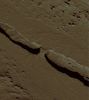
PSP_001420_2045_RED_browse-01~0.jpgSmall Channel in Tartarus Colles (EDM - Natural Colors; credits: Lunexit)68 visiteThe Channel between the Knobs has a variable depth as seen by the varying shadow lengths. The origin of the Channel is unknown, but it is probably NOT a Fluvial Channel because there are no obvious source or Deposit Regions; the Channel, therefore, is probably a Collapse Feature.
One portion of it, (see this EDM, approx. 375 meters across), contains a Bridge, and is probably a remnant of the original surface.
A depression that extends from the Channel Northwards — but which is not as deep as the majority of the Channel — might be in the process of collapsing and enlarging the Channel. MareKromium
(1 voti)
|
|
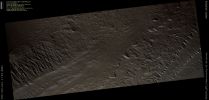
PSP_001422_1750_RED_abrowse.jpgLayers in Gale Crater Central Mound (Natural Colors; credits: Lunexit)55 visiteThis image shows a portion of the Central Mound in the Gale Crater (Central Mound that is of interest to scientists because of the light-toned Layered Deposits that can be found inside it).
The Layered Deposits could have formed in a water environment if, for instance, a lake - once - filled the Crater. Alternatively, particles suspended in the Atmosphere, such as Dust or Volcanic Ashes, could have built up the Layers over time.
By using HiRISE images to see details in the Layers, such as how their thicknesses vary horizontally and vertically, scientists can narrow down the potential origins.
The paucity of Impact Craters on the Layered Deposits indicates that either the Deposits are very young, or more likely that they are being eroded up to the point where such (alleged) Impact Craters were erased.
Wind Erosion modified the Layers after they formed, creating both sharp corners and rounded depressions along the Surface.
A few meter-size Boulders are visible at the base of some steep Cliffs, but the really poor amount of visible Boulders elsewhere suggests that most of the erosion occurred (and it is still occurring) because of eolic processes (such as wind action) rather than downslope movement of material.MareKromium
(1 voti)
|
|
ESP_014298_1375_RED_abrowse.jpgNereidum Montes (Natural Colors; credits: Lunexit)60 visitenessun commentoMareKromium
(1 voti)
|
|

ESP_011873_1675_RED_abrowse.jpgLayering and Faulting in Candor Chasma (Natural Colors; credits: Lunar Explorer Italia)56 visitenessun commentoMareKromium
(1 voti)
|
|

ESP_012016_1800_RED_abrowse.jpgIani Chaos (Natural Colors; credits: Lunar Explorer Italia)59 visitenessun commentoMareKromium
(1 voti)
|
|

PSP_010630_2115_RED_abrowse-01.jpgCraters and possible "Pingo" in Mamers Vallis (edm - Natural Colors; credits: Lunar Explorer Italia)88 visite"At first this resembles a cinder cone volcano on Earth. However, when magnified, it reveals a feature [found in Arctic regions] on Earth called "Pingo". These are caused by ice protruding through the soil creating a positive-relief geologic feature. If you examine the smaller craters in the surrounding terrain you'll see a checkerboard pattern in each one. These closely resemble melted Pingos on Earth, again suggesting an area of Mars that was once rich with water."
While the student's suggestion that the mound-like structure is a Pingo is reasonable, there is yet no scientific consensus for the origin of these interesting structures.
Nota Lunexit: con tutto il rispetto per le brillanti intuizioni dei ragazzini "sponsorizzati" dalla NASA, l'idea del "Pingo" non stà - davvero - nè in cielo, nè in Terra. Eppure, come leggete, anche a queste boutades (perchè provengono da fanciulli - probabilmente - "quotati" a tutti i livelli), viene dato spazio. Poi però, se chiedi ai Signori di Pasadena o della University of Arizona, ad esempio, cosa potrebbe essere la Silver Sphere (o altri rilievi anomali simili, a parer nostro - e NON SOLO nostro - MOLTO più intriganti dello "pseudo Pingo")...Ecco che cala il silenzio più totale.
Che tristezza...MareKromium
(1 voti)
|
|
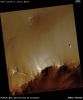
PSP_010437_1655_RED_abrowse.jpgSample of Southern Surface (Natural Colors; credits: Lunar Explorer Italia)86 visiteMars Local Time: 15:42 (middle afternoon)
Coord. (centered): 14,5° South Lat. and 253,6° East Long.
Spacecraft altitude: 251,9 Km (such as about 157,5 miles)
Original image scale range: 25,2 cm/pixel (with 1 x 1 binning) so objects ~ 76 cm across are resolved
Map projected scale: 25 cm/pixel
Map projection: EQUIRECTANGULAR
Emission Angle: 0,2°
Phase Angle: 62,3°
Solar Incidence Angle: 62° (meaning that the Sun is about 28° above the Local Horizon)
Solar Longitude: 143,3° (Northern Summer)
Credits: NASA/JPL/University of Arizona
Additional process. and coloring: Lunar Explorer ItaliaMareKromium
(1 voti)
|
|
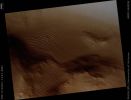
PSP_010447_1525_RED_abrowse.jpgKashira Crater (Natural Colors; credits: Lunar Explorer Italia)70 visiteMars Local Time: 15:44 (middle afternoon)
Coord. (centered): 27,0° South Lat. and 342,2° East Long.
Spacecraft altitude: 257,4 Km (such as about 160,8 miles)
Original image scale range: 51,5 cm/pixel (with 1 x 1 binning) so objects ~ 1,54 mt across are resolved
Map projected scale: 50 cm/pixel
Map projection: EQUIRECTANGULAR
Emission Angle: 0,3°
Phase Angle: 68,8°
Solar Incidence Angle:69° (meaning that the Sun is about 21° above the Local Horizon)
Solar Longitude: 143,7° (Northern Summer)
Credits: NASA/JPL/University of Arizona
Additional process. and coloring: Lunar Explorer ItaliaMareKromium
(1 voti)
|
|
| 2235 immagini su 187 pagina(e) |
 |
|
|
|
|
182 | |
|
|
|
|





