| Piú votate - Mars Reconnaissance Orbiter (MRO) |
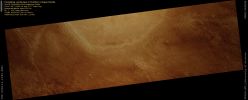
PSP_008214_2285_red.jpgPeriglacial Landscape in Northern Utopia Planitia (Saturated Natural Colors; credits for the additional process. and color.: Dr Paolo C. Fienga - Lunexit Team)71 visitenessun commentoMareKromium
(6 voti)
|
|
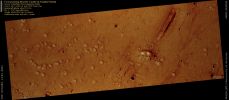
PSP_009485_2185_red.jpgClusters of Mounds at Acidalia Planitia (Extremely Enhanced and Saturated Natural Colors; credits for the additional process. and color.: Dr Paolo C. Fienga - Lunexit Team)56 visiteThis HiRISE image shows clusters of light-colored Mounds poking through the Dark Plains of Acidalia. These Mounds are similar in shape and color to mounds identified elsewhere in the Northern Lowlands.
The mounds imaged here are approximately 250 meters (270 yards) across, and most of them have one or more central crater-like depressed areas, looking like terrestrial cinder cones. Terrestrial cinder cones are formed by loose volcanic fragments, mostly gravel- and boulder-size. In contrast, the surface of these Martian Mounds looks cemented rather than bouldery.
There are several hypothesis to explain the origin of these Martian Mounds; all of them require the presence of fluids near or at the surface.
One hypothesis is that these mounds are Hydrothermal Spring edifices like those at Yellowstone. Terrestrial Hydrothermal Spring Mounds form when hot subsurface fluids, loaded with minerals, reach the surface and deposit their load.
Another possible explanation is that these Mounds are "Mud Volcanoes", similar to those found at Trinidad and Tobago. Mud Volcanism occurs when buried wet sediments are subject to high pressures and squeeze out though weak points at the surface.
Some terrestrial "Pseudocraters" are also similar to these Martian Mounds. Pseudocraters form when lava flows over wet terrains or over water bodies. The lava’s heat vaporizes the fluids, which then burst through the lava, producing small explosions and building conical landforms.MareKromium
(6 voti)
|
|

PSP_005770_1745_RED_abrowse-00.jpgThe "Martian Black Hole" (False Colors; credits for the additional process. and color.: Dr Paolo C. Fienga - Lunexit Team)56 visitenessun commento
MareKromium
(6 voti)
|
|

PSP_005817_1515_RED_abrowse.jpgBedrock (MULTISPECTRUM; credits: Lunexit)54 visite
This frame shows part of the floor of an unnamed crater in the Southern Highlands, near Hellas Planitia. It depicts light-colored bedrock and darker wind deposits. The bedrock appears tan-colored and shows subtle signs of layering in places (...).
Layering in terrestrial formations usually indicates that the rock-forming materials were deposited by wind or water.
The bedrock is crisscrossed by a dense network of rectilinear (lines that are parallel or at right angles) fractures; some can be followed for hundreds of meters.
The fractures look bluish in color, indicating that they are occupied by materials that are somehow different from the bedrock. Perhaps wind-carried materials got trapped in the depressed fracture zones.
MareKromium
(6 voti)
|
|
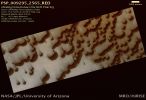
PSP_009295_2565_RED.jpgAbrading Dunes in the North Polar Erg (natural colors; credits: Lunexit)58 visiteThis location is where Mars Global Surveyor (a.k.a.: MGS) saw evidence of dunes that either shrank or completely disappeared over a span of a few years. HiRISE provides new details at higher resolution.
As seen here, the dunes show clear evidence of erosion.
Based on the shape of the dunes in this picture, the strongest winds have blown from the upper right (South-East) to lower left (North-West).
Streamers of dark sand are visible on the white, frost-covered surface downwind of the dunes. This is particularly prominent at the “horns” of the barchan dunes (these are the dunes with the prominent points at their edges).
Scientists believe these dunes are cemented, by ice, such that the wind is progressively eroding them over time. Future observations by HiRISE will determine if the dunes shrink as indicated by MGS, or maybe even migrate, over time.MareKromium
(6 voti)
|
|
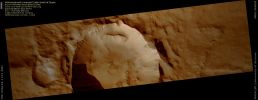
Psp_008238_1555_red.jpgWell-Preserved Unnamed Crater South of Gusev Crater (natural colors; credits: Lunexit)55 visitenessun commentoMareKromium
(6 voti)
|
|
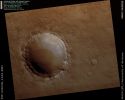
PSP_008206_1620_RED.JPGCrater with Exposed Layers (natural colors; credits: Lunexit)56 visitenessun commentoMareKromium
(6 voti)
|
|

Psp_008222_1640_red.jpgCollpse Pits along Claritas Rupes (Saturated and Enhaced Natural Colors; credits for the additional process. and color.: Dr Paolo C. Fienga - Lunexit Team)74 visitenessun commentoMareKromium
(6 voti)
|
|
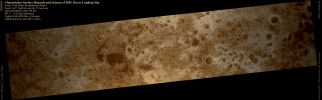
PSP_008825_2040_red.jpgCharacterize Surface Hazards and Science of Possible MSL Rover Landing - Mawrth Vallis (natural colors; credits: Lunexit)56 visitenessun commentoMareKromium
(6 voti)
|
|

PSP_009396_2590_red.jpgDefrosted Margin of the North Polar Erg (natural colors; credits: Lunexit)56 visiteThis image shows a traverse across a section of the North Polar Erg, a vast Sea of Sand that surrounds the Polar Cap.
The source of the dunes may be from the eroding North Polar Layered Deposits. Wind, acting on this mixture of sand, dust and ice, has formed several dune types on top of bright megaripples and polygons. A dark mantle of sand lies beyond the dunes.
The central part of the field contains transverse dunes with the dominant wind direction coming from the North/West-West. The outer edges of the Dunefield transition into "Star Dunes" (with multiple arms) and "Barchanoid Dunes" (crescent-like shape). The Star Dunes indicate a multidirectional wind regime or a change in wind direction over the Dunefield’s evolution.
The dunes are somewhat confined to their location and may have taken hundreds of years to form.MareKromium
(6 voti)
|
|
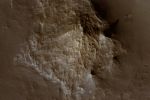
PSP_009161_1450_RED-01.jpgLong Shadows over Ariadnes Colles (edm - natural colors; credits: Lunexit)56 visiteThis edm shows one of the hills in detail.
The hill appears criss-crossed by long fractures and most of them made apparent by the shadows they cast.
The shadows indicate that the fractures “stick out” from their surroundings, and hence that they are more resistant to erosion. In terrestrial environments this occurs when fluids flow along the fractures, leaving behind cementing minerals or when fractures are filled by igneous materials.MareKromium
(6 voti)
|
|

PSP_005410_1115_RED_abrowse.jpgPolar Pit Gullies (MULTISPECTRUM; credits: Lunexit)54 visiteThis image shows Polar Pit Gullies in a depression. The gullies do not appear to have been active recently, as their channels and alcoves are covered with polygonal fractures and ripples that have formed over time. The alcoves contain boulders from eroding layers up-slope. Several of the alcoves extend to the slope rim, suggesting head-ward erosion.
The rest of the scene contains abundant polygonal ground, thought to have formed by processes involving ground ice. This image is at a High Latitude where polygonal terrain is common. This feature is not found in Equatorial Regions, which supports a relationship with ground ice because ground ice is not stable near the equator today.
There are several muted circles on the plains in the lower half of the image; these are possibly relaxed craters. If a crater forms in ice-rich ground, the ice enhances the degradation of the crater and gives the crater a “softened” appearance.MareKromium
(6 voti)
|
|
| 2235 immagini su 187 pagina(e) |
 |
|
|
|
|
18 | |
|
|
|
|





