| Piú votate - Mars Reconnaissance Orbiter (MRO) |

PSP_006969_1725_RED_abrowse-00.jpgThe Floor of Noctis Labyrinthus (context frame - MULTISPECTRUM; credits: Lunexit)56 visiteThis image shows part of Noctis Labyrinthus, the “Labyrinth of the Night.” This is a system of connecting troughs which form a maze-like network at the western end of Valles Marineris, the giant canyon system of Mars.
The individual troughs are usually kilometers across; this image shows part of the floor of one of the troughs, with some intriguing fine-scale features.
Near the center of the image, the floor is broken up into many small knobs and hills, probably eroded remnants of a larger geologic unit.MareKromium
(6 voti)
|
|

PSP_006968_1735_RED_abrowse~0.jpgMound of Layers in East Candor Chasma (MULTISPECTRUM; credits: Lunexit)56 visiteThis image shows the Northern portion of East Candor Chasma, part of the Valles Marineris Canyon System. In the center of the image is a light-toned mound that has dozens of layers exposed along its edge. As the upper layers weather and break apart into smaller grains, these grains subsequently fall down the edge, burying layers beneath and producing triangular-shaped debris aprons.
The color image of the mound doesn’t show any significant color variations between the different layers.
However, another instrument on MRO called CRISM (Compact Reconnaissance Imaging Spectrometer for Mars) has observed compositional differences between the layers and these results have been helpful in deciphering the origin of these layers.
This deposit is one of several examples exhibiting sulfate-rich layers with alternating hydration states. Cliff-forming Kieserite-rich layers alternate with slope-forming polyhydrated sulfate layers. (Kieserite is a mineral containing Magnesium).
The apparent lack of slumping, channels, cross-bedding or bed truncation supports quiescent water or deposition from the air as the most likely origin for the layers.MareKromium
(6 voti)
|
|

PSP_010052_1560_RED.jpgFeatures of Eberswalde Crater (natural colors; credits: Lunexit)56 visiteEberswalde Crater is an approx. 65-Km diameter, closed Basin Crater. It contains a delta, which indicates that flowing water was present for an extended period of time in the past.
Parts of the Crater have inverted channels that have higher relief because a more resistant material was deposited in the channel and therefore it was less susceptible to erosion than the surrounding area. The image also shows resistant knobs and mounds as well as a scoured surface.
The CRISM instrument on-board MRO has detected Phyllosilicates (Clays) in some of the bright layers here. On Earth, clays form in the presence of water, so this is more evidence that there was a persistent flow of water in Eberswalde.MareKromium
(6 voti)
|
|
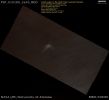
PSP_010180_2645_RED_abrowse-00.jpgSmall and young Impact Crater in the NPLD (ctx frame - natural colors; credits: Lunexit)56 visiteThis image shows a small impact crater on the bright North Polar Perennial Ice Cap. Mars has Ice Caps at both its North and South Poles.
The Perennial, or Permanent, portion of the North Polar Cap consists almost entirely of water ice.MareKromium
(6 voti)
|
|

PSP_010057_2040_RED.JPGUnnamed Crater with Ridges and DD Tracks (natural colors; credits: Lunexit)57 visiteThis image shows two features of interest on the floor of a large impact crater. The first is the set of roughly parallel ridges on the crater floor that point towards the crater center north of the image. These may be Inverted Stream Channels, where old streambeds became resistant to erosion due to cementation or simply deposition of large rocks. This is consistent with the slightly wavy, sinuous shape of the ridges, but these examples are not particularly well-preserved.
More recently, this site has become blanketed by dust, settling out after Global Dust Storms. This obscures much of the fine-scale geology, but allows HiRISE to see the effects of a recent process: Dust Devils. These have left the dark stripes across the surface by disturbing the dust cover. Most followed straight paths, but a few loops or turns are visible. Dust Devils may be an important factor in the Martian climate system because they lift dust into the atmosphere, helping to trigger larger Dust Storms.MareKromium
(6 voti)
|
|
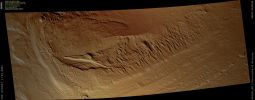
PSP_009927_1750_RED_abrowse-00.jpgExposed Layers in Gale Crater (Enhanced Natural Colors; credits: Lunexit)57 visiteGale Crater contains a massive central mound of layered material that has an average vertical thickness of almost 4 Km (about 2,4 miles), making it more than twice as thick as the layers exposed along the Grand Canyon on Earth.
Gale Crater is approximately 152 Km in diameter.MareKromium
(6 voti)
|
|
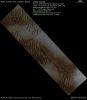
PSP_009739_2580_RED.JPGLinear Dunes in the North Polar Region (possible natural colors; credits: Lunexit)57 visiteThis observation shows linear dunes in the north polar region of Mars. Linear or longitudinal sand dunes are elongated, sharp crested ridges that are typically separated by a sand–free surrounding surface.
These features form from bi-directional winds and extend parallel to the net wind direction. In this case, the net wind direction appears to be from the west-southwest. Linear sand dunes are found in many different locations on Earth and commonly occur in long parallel chains with regular spacing.
Superimposed on the surface of the linear dunes are smaller secondary dunes or ripples. This is commonly observed on terrestrial dunes of this size as well. Polygons formed by networks of cracks cover the substrate between the linear dunes and may indicate that ice-rich permafrost (permanently frozen ground) is present or has been present geologically recently in this location.MareKromium
(6 voti)
|
|
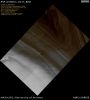
PSP_009663_2635_RED-00.jpgSmall Crater on the North Polar Layered Deposits (CTX Frame - Saturated and Enhanced Natural Colors; credits for the additional process. and color.: Dr Paolo C. Fienga - Lunexit Team) 57 visiteThe North Polar Layered Deposits, and the bright Ice Cap that covers them, are very young (by geologic standards) features. To try and figure out the age of an area, or how quickly it's being resurfaced, planetary scientists count up the number of craters at different sizes. An older surface has more time to accumulate more craters whereas a younger surface, or one that has a lot of geologic activity that destroys craters, doesn't have many impact craters.
These Polar Deposits have a very low crater count so it is possible that the Ice Cap (bright white in this image) might only by about 10.000 years old and the surface of the layered deposits (orange-brown in this image) may be only a few million years old.
This sounds like a long time but is very short compared to other surfaces on Mars.
HiRISE is enabling a more detailed study of these Polar Craters and the target of this observation is visible in the center of the image.MareKromium
(6 voti)
|
|
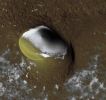
PSP_009663_2635_RED-01.jpgSmall Crater on the North Polar Layered Deposits (EDM - Enhanced Natural Colors; credits for the additional process. and color.: Dr Paolo C. Fienga - Lunexit Team) 57 visiteThis crater proved to be a surprise in a few ways. Its shape is non-circular which is quite unusual for an impact crater. One possibility is that flow of the ice beneath the surrounding terrain has deformed the crater; however, ice-flow rates are thought to be very low on Mars today.
The crater also contains a patch of bright ice despite being surrounded by terrain that has mostly lost its ice cover. This seems typical for these polar craters and it may be that ice within these craters is protected from ablation by shading from the crater walls.MareKromium
(6 voti)
|
|
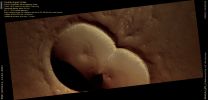
Psp_009619_1630_red.jpgDouble Impact Crater (natural colors; credits: Lunexit)94 visiteThis image shows a double impact crater in Syria Planum, and probably formed when a binary asteroid pair (two asteroids closely orbiting each other, while also orbiting the Sun) struck the Surface. The asteroids must have been about the same size, on the order of a few hundred meters across, to produce these craters.
How is it possible to say that the double crater is due to a binary asteroid, instead of two independent impacts? Neither crater shows signs of burial by ejecta from the other. More importantly, the ejecta (material thrown out of the craters) shows signs of interacting; the ridges extending to the southeast of the crater probably formed when ejecta from the craters collided in midair, causing more debris to pile up at certain points.
This means that the impacts occurred within moments of each other.
Ejecta interaction features like this can also form in association with “secondary” craters (craters made by debris from other impacts, rather than by asteroids), since many secondary craters form at once. In this case, however, a binary asteroid is the likely cause. The very large size is one indicator (secondary craters are generally much smaller than the “primary” crater), and there is not an obvious nearby source crater. While secondary craters are common, binary impacts are expected to occur as well, since binary asteroid pairs are observed.
This crater pair is also of geologic interest since it exposes a cross-section of the local rocks. Thin, flat layers are visible in the upper walls. Since this region has seen extensive volcanic activity, these may be a mix of old lava flows and other volcanic debris. Exposures like this provide evidence for the extent and thickness of these deposits. MareKromium
(6 voti)
|
|
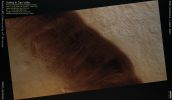
PSP_006659_1460_RED_abrowse~0.jpgGullies in Dao Vallis (MULTISPECTRUM; credits: Lunexit)55 visiteGullies on the North-West side of Dao Vallis, a Martian outflow channel, are the focus of this observation. The outflow channels are thought to have been carved by gigantic, ancient floods.
Gullies are largely thought to be the result of water flow, but the origin of the water is much debated.
One theory proposes that melting snowpack, or a mantling (blanketing) unit, forms gullies. Such a mantling unit is visible here between some of the gullies, in the full high-resolution image. Some alcove-shaped features appear to have mantling material in them.
If the mantling unit is indeed related to gully formation, then gullies are potentially forming here.
MareKromium
(6 voti)
|
|

Psp_009535_2240_red.jpgMerging Lobate Debris Aprons of Deuteronilus Mensae (Natural Colors; credits for the additional process. and color.: Dr Paolo C. Fienga - Lunar Explorer Italia)120 visiteThis image lies within the Deuteronilus Mensae Region, located on the Northern Edge of Arabia Terra and borders the high-standing, heavily cratered Southern Hemisphere and the low, relatively uncratered, plains of the Northern Hemisphere of Mars.
Deuteronilus Mensae is characterized by hills and mesas surrounded by broad debris aprons and this HiRISE image shows examples where lobate-shaped debris aprons appear to overlap.
There is zone of ridges that formed in an area where lobate debris aprons merged from different directions. A current hypothesis is that these ridges are expressions of compressional deformation between two lobes acting like a viscous fluid. One possibility, given the high latitude of the occurrence, is that the lobes of debris are ice-rich and flow somewhat like glaciers.
Recent results from the SHAllow RADar (SHARAD) instrument, also onboard the Mars Reconnaissance Orbiter, indicate that lobate debris aprons in Deuteronilus Mensae are composed of material dominated by ice [Plaut et al., 2008].
This supports the interpretation that these might be potential debris-covered glaciers or rock glaciers.
Some of the detailed textures on the surface of the debris aprons are commonly believed to be the result of ice loss due to sublimation (ice changing into water vapor). On Earth, debris-covered glaciers/rock glaciers typically develop wrinkles and fractures due to stresses in the ice as it flows. Where flows merge, they can buckle and push up ridges producing features similar to those visible here.MareKromium
(6 voti)
|
|
| 2235 immagini su 187 pagina(e) |
 |
|
|
|
|
17 | |
|
|
|
|





