| Piú votate - Mars Reconnaissance Orbiter (MRO) |
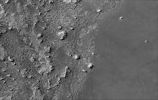
T-TRA_000833_1800_RED.jpgMeridiani Planum56 visiteThis HiRISE image shows geologic "contacts", or boundaries, between light-toned and dark-toned material in Meridiani Planum, near the equator of Mars. Merdiani Planum is where the Mars Exploration Rover Opportunity is located, although this image covers an area that is more than 600 km to the east of the Opportunity site. The central portion of the image shows very smooth, dark plains that are typical of much of the Meridiani region. These plains are flanked by more rugged lighter-toned materials. The light-toned materials have been eroded to form dramatic pits, buttes and mesas. Based on the lengths of the shadows that they cast, some of the buttes and mesas are up to about 30 meters (~100 feet) tall. The light-toned material shows distinctive layering, suggesting that it may be composed of sedimentary rock. Scattered across the scene, especially in the light-toned materials where they are prominent in low spots and around some of the larger buttes and mesas, are dunes and other similar landforms created by martian winds.

(2 voti)
|
|
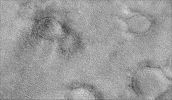
T-TRA_000828_2495_RED.jpgNorthern Plains56 visiteA network of shallow surface troughs and fissures coalesce into polygonal patterns that are ubiquitous throughout this image. Polygonal patterned ground of this nature is quite common in permafrost regions of Earth, where seasonal thermal contraction of ice-cemented soil produces a honeycomb network of subsurface cracks. Cracks of this nature can also be produced by desiccation (mud cracks) or lava cooling (columnar joints), though typically on a smaller scale. The diameter of these martian polygons are dominantly 10-20 meters, analogous to terrestrial permafrost. The individual troughs are frequently only a couple of meters or less wide, and easily resolved at HiRISE resolution. Other characteristics, such as small ridges on either side of the troughs and the distribution of rocks in and around each polygon is also readily apparent. Small rocks and occasional larger boulders are also seen scattered throughout the image. Rocks protruding above the surface soil can be seen to cast shadows (solar illumination is from the lower left), which can aid in the determination of the rock's size and height. This image is located near an area under consideration as a landing site for the Mars Scout mission, Phoenix, planned for 2008. Examination of many factors including surface texture (roughness and morphology) and the size distribution of rocks will aid in final landing site selection.
(2 voti)
|
|

T-TRA_000828_1805_RED.jpgYardangs in Medusa Fosse58 visiteThis image covers a portion of an outcrop of the Medusae Fossae Formation, a series of light-toned terrains in the Martian mid-latitudes. The Medusae Fossae has been and remains one of the most enigmatic features on Mars. The unit is characterized by wind-sculpted landforms, most notably eroded ridges known as yardangs. The composition of the Medusae Fossae is not known, but candidates include indurated (hardened) volcanic ash or remnants of dust-ice mixtures that formed in a different Martian climate. This HiRISE image reveals new details of the Medusae Fossae.
Three prominent yardangs are seen, at upper right, lower center right, and partially at lower right. They are aligned with their long axes pointing NW-SE, with tapered ends on the NW, consistent with erosion from a southeasterly wind. One or more hard rocky layers within the yardangs are visible, with the layers commonly segregated into discreet boulders. Isolated rocks are seen on the slopes and at the base of the yardangs, indicating that some formed from breakup of the layers. The rocks may be similar in composition to the softer, non-rocky parts of the yardangs, but simply more indurated. Alternatively, they may be compositionally distinct, challenging current hypotheses for the origin of the Medusae Fossae.
Light-toned ridges at center left have a gross morphology similar to that of barchanoid dunes, formed from wind-blown sand. If these are dunes or ripples, their orientation is consistent with the presumed wind direction that carved the yardangs. However, zooming in to full resolution reveals flat tops, grooves, and smaller, darker ripple forms to the northwest of the ridges. Therefore if these are dunes, they seem indurated.
(2 voti)
|
|

Q-S-HalleyCrater-PIA08048_modest-2.jpgIn the vicinities of Halley Crater (2)56 visiteThis image was taken by the High Resolution Imaging Science Experiment (HiRISE) camera onboard NASA's Mars Reconnaissance Orbiter spacecraft on March 24, 2006. The image is centered at 47,14° South Latitude and 302,00° East Longitude. It is oriented such that north is 7° to the left of up. The range to the target was 1.699 Km (such as about 1.056 miles). At this distance the image scale is 1,70 mt (about 5,58 feet) per pixel in the center portion of the image, so objects as small as 5,1 meter (such as 16,7 feet) are resolved. In the side regions the pixels were binned 2x2 to a scale of 3,4 mt (such as 11,2 feet) per pixel. The camera has a total of 10 red-bandpass CCD detectors and in this image the first 4 CCDs on the left and the last 3 on the right were binned 2x2, while 3 in the middle returned data at full resolution. In total this image is 34,08 Km(21,18 miles) or 20.081 pixels wide and 8,50 Km (5,28 miles) or 5.164 pixels high. The image was taken at a MLT of 07:27 and the scene is illuminated from the upper right with a Solar Incidence Angle of 84,5° (this meaning that the Sun, at the time that the picture was taken, was about 5,5° above the local horizon).
(2 voti)
|
|

Q-pia08014-07-AEB1-full-reduced1.jpgMartian Southern Highlands (7) - HR58 visitenessun commento
(2 voti)
|
|

Q-pia08014-06-AEB1-full-reduced1.jpgMartian Southern Highlands (6) - HR59 visitenessun commento
(2 voti)
|
|

Q-pia08014-05-AEB1-full-reduced1.jpgMartian Southern Highlands (5) - HR61 visitenessun commento
(2 voti)
|
|

Q-pia08014-02-AEB1-full-reduced1.jpgMartian Southern Highlands (2) - HR56 visitenessun commento
(2 voti)
|
|

Q-pia08014-01-AEB1-full-reduced1.jpgMartian Southern Highlands (1) - HR63 visitenessun commento
(2 voti)
|
|

Kunowsky_Crater_-_Sand_Dunes-StripedDunes_HiRISE_1182.jpgStriped Sand Dunes126 visiteCaption NASA:"Why are these sand dunes on Mars striped?
No one is sure.
The featured image shows striped dunes in Kunowsky Crater on Mars, photographed recently with the Mars Reconnaissance Orbiter’s HiRISE Camera.
Many Martian dunes are known to be covered unevenly with carbon dioxide (dry ice) frost, creating patterns of light and dark areas. Carbon dioxide doesn’t melt, but sublimates, turning directly into a gas. Carbon dioxide is also a greenhouse material even as a solid, so it can trap heat under the ice and sublimate from the bottom up, causing geyser-like eruptions. During Martian spring, these eruptions can cause a pattern of dark defrosting spots, where the darker sand is exposed.
The featured image, though, was taken during Martian Autumn, when the weather is getting colder – making these stripes particularly puzzling. One hypothesis is that they are caused by cracks in the ice that form from weaker eruptions or thermal stress as part of the day-night cycle, but research continues.
Watching these dunes and others through more Martian seasons may give us more clues to solve this mystery".MareKromium
(1 voti)
|
|

ESP_022578_2030_and_ESP_014007_2030.jpgSand-Lakes (3D - Credits for the additional process.: Marco Faccin and Elisabetta Bonora)93 visitenessun commentoMareKromium
(1 voti)
|
|

PSP_003180_0945_RED_abrowse-03.jpgSouth Polar Dust Fans (Enhanced Natural Colors; Credits for the add. process. and color.: Dr Paolo C. Fienga)133 visitenessun commentoMareKromium
(1 voti)
|
|
| 2235 immagini su 187 pagina(e) |
 |
|
|
|
|
165 | |
|
|
|
|





