| Piú votate - Mars Reconnaissance Orbiter (MRO) |

TRA_000840_2750_IRB-004.jpgChasma Boreale (4)57 visitenessun commento
(2 voti)
|
|

TRA_000840_2750_IRB-003.jpgChasma Boreale (3)56 visiteImage TRA_000840_2750 was taken by the High Resolution Imaging Science Experiment (HiRISE) camera onboard the Mars Reconnaissance Orbiter spacecraft on September 30, 2006.
The image is centered at 84,7° North Latitude and 16,1° East Longitude. The range to the target site was 319 Km (about 199 miles). At this distance the image scale is 32 cm/pixel (with 1 x 1 binning) so objects ~96 cm across are resolved.
The image shown here has been map-projected to 25 cm/pixel and North is up. The image was taken at a local Mars time of 3:28 PM and the scene is illuminated from the West with a solar incidence angle of 68,1°, thus the Sun was about 21,9° above the horizon.
At a Solar Longitude of 114,2°, the season on Mars is Northern Summer / Southern Winter.
(2 voti)
|
|

TRA_000840_2750_IRB-002.jpgChasma Boreale (2)56 visiteDifferent layers show very different degrees of roughness and pitting, although the texture within a layer is quite consistent. One of the layers even displays a texture of polygons 3 up to 10 mt across, normally associated with periglacial freeze-thaw processes on Earth. Layers of different texture, brightness, and appearance indicate differing physical properties, composition and exposure to surface environmental conditions at time of emplacement and/or erosion.
In this way, polar layers on Mars record a history of climate conditions as sequences of layers on Earth often do.
(2 voti)
|
|

TRA_000830_1440_IRB-2.jpgNiger Vallis (2)57 visitenessun commento
(2 voti)
|
|

TRA_000830_1440_IRB-1.jpgNiger Vallis (1)56 visiteThis image shows a portion of the floor of Niger Vallis, an ancient Martian outflow channel. Niger Vallis originates on the flanks of the volcano Hadriaca Patera, and empties into the Hellas impact basin. Outflow channels are observed in many regions of the planet, and may have been carved by brief eruptions of liquid water from beneath the surface. Since Niger Vallis formed, impacts have cratered the channel floor, and fine-grained wind-blown debris has been transported across the surface, eroding and burying all but the freshest craters. The curved ridge in the scene may be the remnant of a large crater rim. At the high resolution of this image, a pattern of parallel dunes and ripples can be seen, as well as individual boulders as large as two meters across.
Image TRA_000830_1440 was taken by the High Resolution Imaging Science Experiment (HiRISE) camera onboard the Mars Reconnaissance Orbiter spacecraft on September 30, 2006. The full image shown below is centered at -35.5 degrees latitude, 92.1 degrees East longitude. The range to the target site was 255 km (159 miles). At this distance the image scale is 51 cm/pixel (with 2 x 2 binning) so objects ~153 cm across are resolved. The image shown here has been map-projected to 50 cm/pixel and north is up. The image was taken at a local Mars time of 3:35 PM and the scene is illuminated from the west with a solar incidence angle of 77.5 degrees, thus the sun was about 12.5 degrees above the horizon. At a solar longitude of 113.8 degrees, the season on Mars is Northern Summer / Southern Winter.
(2 voti)
|
|
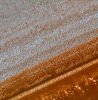
TRA_000825_2665_IRB-01.jpgNorth Polar Layers (2)56 visiteNOTA:
This color images cover only the center swath of the full image, and is composed of images acquired through infrared, red, and blue-green filters. The color has been enhanced to better show the subtle color differences.
It is NOT natural color or how it would appear to normal human vision.
(2 voti)
|
|
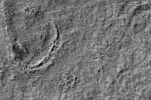
T-TRA_000830_1440_RED_NigerVallis_01.jpgNiger Vallis59 visiteThis image shows a portion of the floor of Niger Vallis, an ancient Martian outflow channel. Niger Vallis originates on the flanks of the volcano Hadriaca Patera, and empties into the Hellas impact basin. Outflow channels are observed in many regions of the planet, and may have been carved by brief eruptions of liquid water from beneath the surface. Since Niger Vallis formed, impacts have cratered the channel floor, and fine-grained wind-blown debris has been transported across the surface, eroding and burying all but the freshest craters. The curved ridge in the scene may be the remnant of a large crater rim. At the high resolution of this image, a pattern of parallel dunes and ripples can be seen, as well as individual boulders as large as two meters across.
(2 voti)
|
|
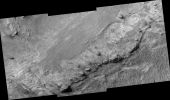
T-TRA_000849_1675_RED.jpgCoprates Labes56 visiteCoprates Labes is a Martian canyon, part of the huge Valles Marineris system. Valles Marineris most likely formed through tectonic processes, with extensional stresses leading to collapse of the terrain that now lies at the base of the canyons. Filling most of this image, we see a raised block on the canyon bottom, which is quite possibly a horst—a block bounded by faults that separate it from sunken blocks on each side. The raised block is heavily eroded, possibly by wind; this erosion has exposed its internal layering, especially at the southeast margin of the block. Here we see asymmetric erosion features with shallow slopes trailing off to the northwest, suggesting that southeasterly winds dominate the flow through this region. The arrangement of dunes and ripples in the lower right portion of the image confirms this prevailing wind direction. Finally, dark-toned material appears to have flowed from northeast to southwest along the block, possibly moving in a very fluid debris flow.
(2 voti)
|
|
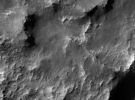
T-TRA_000853_1450_RED_AtlantisChaos_01.jpgAtlantis Chaos56 visiteThis HiRISE image covers a small area within a degraded crater adjacent to Atlantis Chaos in the Electris region of Mars. The crater and much of the surrounding region were once extensively mantled by a layer of material(s) of unknown origin and only small remnant outcrops of this material remain seen as flat topped mesas in the image sub-frame shown here. Intervening areas expose ancient uplands materials locally punctuated by narrow ridges that may represent more resistant material within the mantling deposit that were left in relief as the sediments were eroded away. Although the mesas do not appear to be comprised of finely layered materials, hints of some layering in a few locations can be seen. Large blocks of material are being shed from the mesas, but do not appear to accumulate on the mesa slopes as large talus aprons. Some wind blown dunes and ripples can be observed, but are not as widespread as in many other locations imaged with HiRISE. Collectively, these characteristics suggest that the material(s) forming the mantling deposit possess some limited strength, but are easily broken down and removed by wind over time. One possible Earth analog for these deposits may be the wind blown accumulations of very fine sediments, or silt known as loess.
(2 voti)
|
|

T-TRA_000836_1740_RED_CandorChasma_01.jpgCandor Chasma58 visiteCandor Chasma is one of several large troughs that make up Valles Marineris, the largest canyon system in the Solar System. Much of Candor Chasma is filled with layered deposits, like those shown in this HiRISE sub-image. Layers only 1-2 meters thick can be resolved by HiRISE and provide details on the processes that emplaced and modified these sediments. The layered deposits could be volcanic, lacustrine, or eolian sediments that filled in some portions of the trough of Valles Marineris. The variations in brightness of the layers could represent compositional differences in the layers or the thickness of overlying debris, such as sand or dust. This area was targeted because minerals rich in sulfur were detected here by the OMEGA instrument on Mars Express. By using HiRISE images to look at specific geologic units that correspond to these locations of sulfate, it may be possible to determine the origin of the sediments, particularly those that contain the sulfates. The paucity of impact craters on the layered deposits suggests either a young age for the sediments or erosion has removed much of the upper layers to reveal a fresher-looking surface. Dark dunes and ripples indicate that wind has been, and still may be, moving debris across the sedimentary deposits.
(2 voti)
|
|
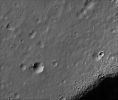
T-TRA_000866_1420_RED.jpgGorgonum Chaos55 visiteThis HiRISE image shows cratered plains along the edge of a large fracture to the south of Gorgonum Chaos. The wall of the fracture is in shadow and, at first glance, appears to reveal little detail about the geologic setting. In reality, the high quality of the HiRISE image, as shown in the stretched sub-image [below], demonstrates that considerable detail along the wall of the fracture can be discerned. A relatively dark layer extends along the upper wall of the fracture and approximately separates the exposed wall above from talus below. Some well defined talus chutes are also visible and are formed by the down slope movement of debris shed from higher along the fracture wall. The wind blown drifts of fine grained sediment accumulated along the base of the talus slope are relatively free of obvious talus. Hence, the wind likely accounts for much of the most recent modification of the scene in the sub image.
(2 voti)
|
|
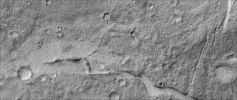
T-TRA_000834_1835_RED.jpgAram Chaos59 visiteAram Chaos is thought to be a degraded impact crater that was once filled with water and sedimentary units. The term "chaos" refers to the cracks and angled blocks formed perhaps by withdrawl of subsurface material. This sub-image covers only a small portion of Aram Chaos and illustrates the modification of the crater by fracturing, younger impact craters, and wind. A linear fracture cuts through the center of the image while a more sinuous depression filled with bright ripples or dunes is located towards the bottom of the image. Both depressions could have resulted from collapse associated with modification of the impact crater that created Aram Chaos or later disruption when water and sediment covered some of the crater floor. Impact craters of many shapes and sizes can be seen across the image, indicating a relatively older surface that has seen little modification since its formation. The bright ripples or dunes appear to cluster in low-lying topography, such as the sinuous depression and a larger impact crater in the lower right of the image, suggesting that wind has moved fine material along the surface until it becomes trapped in low spots where it collects to form ripples or dunes.
(2 voti)
|
|
| 2235 immagini su 187 pagina(e) |
 |
|
|
|
|
164 | |
|
|
|
|





