| Piú votate - Mars Reconnaissance Orbiter (MRO) |
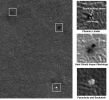
PSP_008585_2915_.jpgPhoenix Lander "Hardware" (Night-Time Frame)55 visiteCaption NASA:"MRO's HiRISE camera acquired this image of the Phoenix Landing Site 11 hours after landing. The image shows 3 unusual features, which were not present in the earlier, pre-landing HiRISE image.
We expect to find three main pieces of hardware: the Parachute attached to the Back-Shell, the Heat-Shield, and the Lander itself. The Parachute (lower right) is easy to identify because it is especially bright, although this image doesn't clearly reveal the Back-Shell.
The double dark marking at upper right seems most consistent with disturbance of the ground from impact and bouncing of the Heat-Shield, which fell from a height of about 13 Km.
The last object (upper left) appears to be a about the right size and height for the Lander and with dark objects on each side (to the East and West) consistent with the solar arrays.
This image was acquired in the nighttime, when the Arctic Sun was only 12° above the horizon to the North-East. Later images will be acquired in the daytime with the Sun higher in the sky and to the South-West, and could confirm our initial interpretations. North is about 7° to the left of straight up in this image.
These objects were later confirmed on the subsequent HiRISE observation acquired 22 hours after landing".MareKromium
(2 voti)
|
|

PSP_008060_1770_RED_abrowse.jpgLayers and Phyllosilicates in Miyamoto Crater (MULTISPECTRUM; credits: Lunexit)86 visiteThis observation was taken in Miyamoto Crater in South-West Meridiani, an area near the Equator of Mars. This image is located to the East of one of the potential Mars Science Laboratory Landing Sites and is near the contact between the Hematite-bearing plains unit to the North-East (where the MER Opportunity is exploring) and the phyllosilicate-bearing unit to the South-West.
Aeolian (meaning "wind deposited") processes are active here, which are visible in dunes and ripples, most likely made of basaltic sand. The bedrock contains Phyllosilicates (such as Clay Minerals), which form in the presence of water. Phyllosilicates have been detected in higher concentrations in other areas of Mars such as Mawrth Vallis and Nili Fossae, but detections of lesser abundance have been noticed in Meridiani as well.MareKromium
(2 voti)
|
|
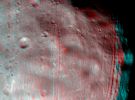
PSP_007769_9010_15.jpgPhobos in 3D (credits: NASA)57 visitenessun commentoMareKromium
(2 voti)
|
|
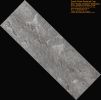
PSP_004739_0935_RED_browse.jpgSouth Pole Residual Cap - Swiss-Cheese Terrain Monitoring (Natural Colors; credits for the additional process. and color.: Dr Paolo C. Fienga - Lunexit Team)56 visitenessun commentoMareKromium
(2 voti)
|
|
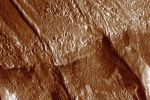
PSP_002620_1410_RED_browse-01.jpgGullies on the edge of Newton Basin (extra-detail mgnf)57 visiteThe gullies start near the top of the wall and can be traced across a break in slope partway down the wall (see here, 750 mt across). This break in slope occurs along the entire portion of the Crater wall in this image. The gullies appear shallower just above the break in slope, and deeper below the slope break.
This suggests that the fluid which eroded and carved out the wall materials forming the gullies, increased in velocity after the slope break, creating a deeper section of the gully.MareKromium
(2 voti)
|
|
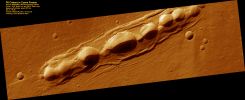
PSP_003370_2140_RED_browse.jpgPit Craters (or Collapse Pits) in Cyane Fossae65 visiteThis image shows several pits along the floor of Cyane Fossae, a set of fissures between the giant volcanoes of Olympus Mons and Alba Patera (North-East of Olympus Mons).
The fissures probably formed when the surface of the Planet was actively being stretched from the stresses of volcanic activity, causing the surface to split open along faults. There is no material piled up around the edges of the pits, as would be expected if these were impact craters or volcanic vents. Instead, parts of the Fossae floor likely collapsed into the void underlying Cyane Fossae, forming the pits.
This type of process, in which the crust is split open, has occurred here on Earth, and it created the geologic "basin and range" province of the western United States.
The walls of the pits are likely covered in dust and the few dark streaks along the walls are likely formed by avalanches of dust. Striations along the slope may be produced by the passage of DDs.
Dust also appears on the floors of the collapse pits and covered most of the plains nearby. Despite the presence of this layer of dust, bouldery outcrops occur in places along the wall, suggesting that the underlying material is hard and rocky.
MareKromium
(2 voti)
|
|

Psp_001481_2410_red-01.jpgEolian and Periglacial Activities in Vastitas Borealis (polygons)57 visiteThe polygons shown in this image's subset, which covers approximately 400 x 250 mt (350 x 225 yards), are in the order of 10 mt (0.9 yards) across; in some cases they are delimited by aligned rocks. Similar features in both shape and scale are found in Terrestrial Periglacial Regions such as Antarctica, where ice is present at or near the surface.
Antarctica's polygons and rock alignments are produced by repeated expansion and contraction of the soil-ice mixture due to seasonal temperature oscillations; dry soil falling into the cracks form sand wedges and amplify this effect. This results in polygonal networks of stress fractures and in the resurfacing and sorting of rocks along these fractures.
(2 voti)
|
|

Psp_001481_2410_red-00.jpgEolian and Periglacial Activities in Vastitas Borealis (DD Tracks and Polygons)58 visiteThis image shows a region of approximately 7 x 7 km (4.4-by-4.4 miles) located in Vastitas Borealis, part of the Northern Plains.
The surface imaged is relatively young, as indicated by the lack of recent impact craters.
Eolian and Periglacial activity seem to be the dominant geological processes at work, as shown by numerous crisscrossing DD Tracks and ubiquitous polygonal features, respectively.
Dust Devils form when the sun warms up the air near a flat, dry surface. Warm air then rises quickly through the cooler air above and starts spinning, causing a forward motion. The spinning, forward-moving cell may pick up dust and sand as it advances, thus leaving behind a "clean" track. We infer from this image that a thin veneer of light-colored particles of dust and/or fine-grained sand cover relatively darker materials, apparent in the dust devil tracks.
The tracks pictured in this image are in many cases more than 30 mt (27 yards) wide and over 4 Km (2,5 miles) long, surpassing the dimensions of average terrestrial DD tracks.MareKromium
(2 voti)
|
|

PSP_002136_1920_cut_b.jpgPhotoartifacts?60 visiteThe image shows two portions of the Isidis Planitia image (PSP_002136_1920) with bright noise at top, and 6 examples of bright noise seen in the cruise images; all are from the original, unprocessed images.MareKromium
(2 voti)
|
|
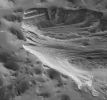
Juventae_Chasma_12m-00.jpgFeatures of Juventae Chasma (1)56 visiteCaption NASA originale:"This image shows a mound of layered rock within the large depression Juventae Chasma (3,5° South Lat. and 61,9° West Long.) known from data from the Omega spectrometer on the Mars Express mission to have sulfate minerals mixed within it. The clear expression of layering in the CTX image and the potential for correlation with MRO-CRISM hyper-spectral data open the possibility of relating specific beds to specific compositions, indicating the nature of the depositional environment and subsequent alteration".
(2 voti)
|
|

TRA_000840_2750_IRB-007.jpgChasma Boreale (6)56 visitenessun commento
(2 voti)
|
|

TRA_000840_2750_IRB-005.jpgChasma Boreale (5)56 visitenessun commento
(2 voti)
|
|
| 2235 immagini su 187 pagina(e) |
 |
|
|
|
|
163 | |
|
|
|
|





