| Piú votate - Mars Reconnaissance Orbiter (MRO) |
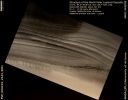
PSP_009293_2645_RED.jpgStructure of the North Polar Layered Deposits (natural colors; credits: Lunexit)57 visiteThe North Polar Layered Deposits on Mars are thought contain a record of global climate changes, similar to ice ages on Earth. This image shows that the geologic history of the NPLD has been complex enough to form angular unconformities.
An angular unconformity represents a gap in the geologic record, where erosion has removed material followed by deposition of more material on the eroded surface. In this image, the angular unconformities are recognized by the truncation, or cutting off of layers, for example right of center and at bottom center.
Also visible in this image are numerous streaks, perhaps caused by recent redistribution of frost by winds.MareKromium
(2 voti)
|
|
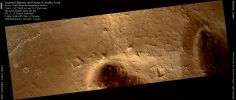
Psp_008982_1965_red.jpgLayered Deposits in Arabia Terra Region (natural colors; credits: Lunexit)58 visiteThis image shows the floor of an Unnamed Impact Crater in Arabia Terra that has Layered Deposits. There are many craters in this Region, where layering is observed.
These layers are often exposed along the sides of large isolated mounds, small knobs and mesas, and other positive relief features. In some cases, the layering is expressed as narrow sinuous ridge-like structures along crater floors.
The presence of Layered Deposits is of particular interest because these materials are not likely to be related to the impact event, but rather post-impact infill of the Crater. Modification of the Deposits has now revealed layers of material.
HiRISE and other instruments onboard the Mars Reconnaissance Orbiter may provide more clues to the origin of the these deposits.MareKromium
(2 voti)
|
|
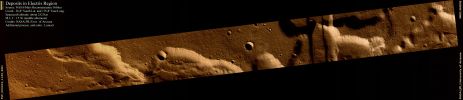
Psp_009029_1430_red.jpgDeposits in Electris Region (natural colors; credits: Lunexit)64 visiteThis observation reveals a portion of a long outcrop of a deposit in the Electris Region of Mars.
The Electris' Deposits occur over a range of landforms and relief and the process(es) responsible for their emplacement remain speculative.
Close examination of the outcrops reveal layering that in some places appear to include meter-scale blocks. Comparison with other HiRISE images of the deposit will enable more detailed mapping of its extent and nature and should provide new insight into the origin of these enigmatic materials.MareKromium
(2 voti)
|
|
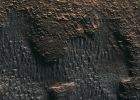
PSP_008427_1380_RED_abrowse-01.jpgAutumn in Hellas Basin (edm n. 1 - MULTISPECTRUM-2; credits: Lunexit)57 visiteFrost is condensing, and shows up as silver/gray patches in this MULTISPECTRUM image: this is seasonal CO2 frost.
Closer to the Pole, CO2 condenses from the atmosphere and forms a Seasonal Polar Cap. At this latitude we do not expect a thick layer to form but rather the frost collects in cold protected areas on poleward-facing slopes.MareKromium
(2 voti)
|
|
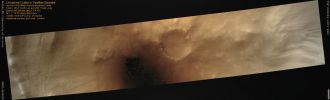
PSP_008181_2405_RED_abrowse.jpgUnnamed Crater in Vastitas Borealis (MULTISPECTRUM-2; credits: Lunexit)79 visitenessun commentoMareKromium
(2 voti)
|
|
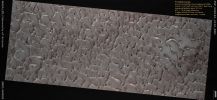
PSP_008185_2610_RED_abrowse.jpgFrosted Dunes (MULTISPECTRUM; credits: Lunexit)80 visitenessun commentoMareKromium
(2 voti)
|
|
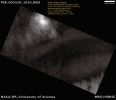
PSP_003520_1010_RED_abrowse-00.jpgSouth Polar Spiders (ctx frame - MULTISPECTRUM-2; credits: Lunexit)55 visiteThis image is located in the South Polar Region of Mars and we can see “spiders” likely caused by the sublimation of Carbon Dioxide ice.
As this happens, the gas moves through channels until it reaches the surface and vents out. These vents show up as the dark streaks because they carry dust and dirt up to the surface.MareKromium
(2 voti)
|
|
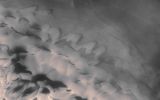
PSP_008426_2595_RED_abrowse-01.jpgPolygons, Crater Layers, and Defrosting Dunes (edm n. 1 - MULTISPECTRUM-2; credits: Lunexit)59 visiteThe dune morphology in this image is complex. Because of the presence of the ice, it is difficult to determine all of the dune types. These jumbled dunes may result from erosion of the layers within the crater walls that act as a dune source. However, two common types of dunes can be classified: the outer ring of the dune field is composed of chains of Barchan Dunes whereas the central area of the field contains transverse dunes.
Barchans are characterized by their crescent-shape with steep horns in the downwind direction. The transverse dunes have asymmetric, nearly parallel ridges and are oriented perpendicular to the wind direction.MareKromium
(2 voti)
|
|
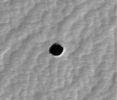
PSP_008130_1745_RED_abrowse-01.jpgSmall but deep Collapse Pit, North of Arsia Mons (extra-detail mgnf n. 1; credits: Dr G. Barca)72 visitenessun commentoMareKromium
(2 voti)
|
|
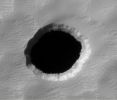
PSP_008130_1745_RED_abrowse-02.jpgSmall but deep Collapse Pit, North of Arsia Mons (extra-detail mgnf n. 2; credits: Dr G. Barca)68 visitenessun commentoMareKromium
(2 voti)
|
|
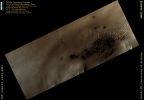
PSP_008197_2655_RED_abrowse.jpgCircular Defrosting Feature (MULTISPECTRUM-2; credits: Lunexit)63 visitenessun commentoMareKromium
(2 voti)
|
|
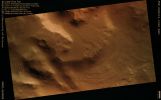
PSP_008233_1920_RED_abrowse.jpgCrater Floor Fan (MULTISPECTRUM; credits: Lunexit)60 visiteThis image shows a Fan of material deposited on the floor of a large Impact Crater.
The material was transported into the Crater through a valley, likely by running water. The end of the valley is visible in the West (lower) part of the image. Arcuate steps visible in the East are probably due to layers of different strength or cohesion; these suggest variations in the flow conditions.
A faint Trough is carved into the upper surface of the Fan. This could have been cut by the last water to flow across the surface. If the channel was flowing into a lake, this might indicate a drop in lake level, leading to erosion.
The surface of the Fan has many small dark spots, particularly on the upper tier.
The largest spots, most commonly around impact craters, are big enough to show that these are boulders.
If these boulders are original and not due to the hardening of fan sediments into rock, it suggests that the flows which deposited the Fan were relatively energetic events able to carry rocks across several feet.MareKromium
(2 voti)
|
|
| 2235 immagini su 187 pagina(e) |
 |
|
|
|
|
162 | |
|
|
|
|





