| Piú votate - Mars Reconnaissance Orbiter (MRO) |

PSP_009309_2725_RED.jpgHigh-Latitude Exposure of North Polar Layered Deposits (possible True Colors; credits: Lunar Explorer Italia)72 visiteMars Local Time: 19:52 (evening)
Coord. (centered): 87,5° North Lat. and 327,2° East Long.
Spacecraft altitude: 317,6 Km (such as about 198,5 miles)
Original image scale range: 31,8 cm/pixel (with 1 x 1 binning) so objects ~95 cm across are resolved
Map projected scale: 25 cm/pixel
Map projection: EQUIRECTANGULAR
Emission Angle: 5,2°
Phase Angle: 60,3°
Solar Incidence Angle: 64° (meaning that the Sun is about 26° above the Local Horizon)
Solar Longitude: 101,9° (Northern Summer)
Credits: NASA/JPL/University of Arizona
Additional process. and coloring: Lunar Explorer ItaliaMareKromium
(2 voti)
|
|
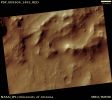
PSP_009304_1495_RED.jpgSmooth Hills (possible True Colors; credits: Lunar Explorer Italia)56 visiteMars Local Time: 15:31 (middle afternoon)
Coord. (centered): 30,2° South Lat. and 227,9° East Long.
Spacecraft altitude: 253,6 Km (such as about 158,5 miles)
Original image scale range: 50,7 cm/pixel (with 1 x 1 binning) so objects ~1,52 mt across are resolved
Map projected scale: 50 cm/pixel
Map projection: EQUIRECTANGULAR
Emission Angle: 0,3°
Phase Angle: 74,9°
Solar Incidence Angle: 75° (meaning that the Sun is about 15° above the Local Horizon)
Solar Longitude: 101,7° (Northern Summer)
Credits: NASA/JPL/University of Arizona
Additional process. and coloring: Lunar Explorer ItaliaMareKromium
(2 voti)
|
|

PSP_009304_2405_RED.jpgRocky Terrain in the Northern Plains (possible True Colors; credits: Lunar Explorer Italia)80 visiteMars Local Time: 15:07 (early afternoon)
Coord. (centered): 60,0° North Lat. and 214,8° East Long.
Spacecraft altitude: 311,3 Km (such as about 194,5 miles)
Original image scale range: 31,1 cm/pixel (with 1 x 1 binning) so objects ~93 cm across are resolved
Map projected scale: 25 cm/pixel
Map projection: EQUIRECTANGULAR
Emission Angle: 0,3°
Phase Angle: 47,9°
Solar Incidence Angle: 48° (meaning that the Sun is about 42° above the Local Horizon)
Solar Longitude: 101,7° (Northern Summer)
Credits: NASA/JPL/University of Arizona
Additional process. and coloring: Lunar Explorer ItaliaMareKromium
(2 voti)
|
|
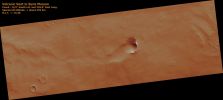
Psp_001840_1660_red.jpgVolcanic Vent in Syria Planum (natural colors; credits: Lunar Explorer Italia)57 visitePrevious images of this area by other space missions indicate that this is a shield volcano with very shallow slopes. What HiRISE reveals is that it is completely covered by a blanket of dust.
While volcanic featues remain obscure, the dust does exhibit some very strange patterns. As you zoom into the middle of the image, the ground appears covered with a fine network of light and dark polygons. But at full resolution, it can be seen that these polygons are actually the edges of small scallops.
The dust is apparently held together by some unknown means, giving it sufficient strength to be carved into this strange pattern.MareKromium
(2 voti)
|
|
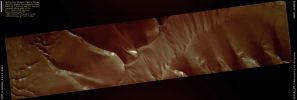
PSP_010090_1255_RED.jpgSpring over Russel Crater (natural colors; credits: Lunexit)59 visiteSpring is already starting to show its influence at the Russell Crater field of sand dunes. Channels down the face of the largest dune show dark spots where the sublimation of the seasonal carbon CO2 Ice Cap has begun.
This active process (where ice evaporates directly to gas) dislodges loose material, leaving dark streaks down steep slopes. The process starts when the Sun peeks above the horizon at the end of Antarctic Night.
Bright streaks may be loose frost cascading down steep slopes.MareKromium
(2 voti)
|
|
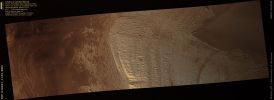
PSP_010027_1745_RED.jpgLayers in Candor Mensa (natural colors; credits: Lunexit)56 visiteThis image shows Layered Sedimentary Deposits in Candor Mensa, a broad plateau of thickly stacked sedimentary rocks in Candor Chasma, part of the giant troughs of Valles Marineris.
Valles Marineris is a system of tectonic depressions formed by down-dropping faults; the floors are among the lowest points on the surface of Mars, and may have once held lakes. Some sites show evidence for streams or rivers. The troughs may have also been sites of volcanic activity.
Currently, the deep floors contain massive deposits of bright sedimentary rocks. Some of the deposits are several kilometers thick, and have diverse composition and appearance. They were probably formed by many different processes in different environments.
At this site, most of the bright rocks exhibit a scalloped, patterned texture.
This is thought to be associated with low-density deposits undergoing wind erosion, although the process is still not well-understood. Despite this relatively uniform texture, some variations are evident. The Southern (left) part of the Deposit is relatively uniform, while the central portion appears to have thin layers.
On close inspection, the layers near the center of the image are all composed of the same material; they are probably visible due to slight topographic steps caused by variations in the strength of the rock. The layers have been highlighted by a mantle of dark, wind-blown sand ripples, which cover the flat parts of the stepped structure. At low resolution, this gives the appearance of alternating light and dark layers.
In the Northernmost part of the image (right), the sediments have an entirely different texture, ranging from massive to fractured. These sediments also show evidence of layering.
Interpretation of these sediments is complicated by younger mantling materials. In addition to the sand ripples (some of which may have hardened to rock), a relatively massive dark layer appears to cap or drape the deposit in many places, including the southern part of this image.MareKromium
(2 voti)
|
|

PSP_010008_2630_RED.jpgStructure of the North Polar Layered Deposits (natural colors; credits: Lunexit)59 visiteThis image shows an exposure of the North Polar Layered Deposits (NPLD) within the Northern Residual Ice Cap. The NPLD are thought to have been formed by recent climate changes on Mars, like ice ages on Earth.
Scientists are studying the NPLD to learn more about these climate changes on Mars. In many places, the NPLD layers appear to extend over large areas, suggesting that they were deposited from atmospheric suspension. If the layers in this image are horizontal and continuous, the apparent curves are caused by erosion of valleys into the NPLD. To determine whether this is the case, HiRISE has acquired two images of this location to form a stereo pair. Analysis of this stereo pair will allow the orientation and thickness of the layers to be measured across the region of stereo coverage, constraining hypotheses for their formation.
Also visible in this image are bright and dark streaks that may be caused by the redistribution of frost by winds.MareKromium
(2 voti)
|
|
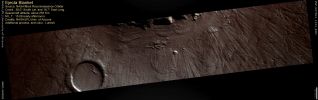
PSP_007822_1415_RED_abrowse~0.jpgEjecta Blanket (MULTISPECTRUM; credits: Lunexit)80 visiteThe Ejecta Blanket of a large (20 Km diameter) impact crater is shown here in vivid detail. The ejecta formed strong linear patterns in the topography that extend radially outward from the crater. This ejecta is rocky material that was ejected from the crater as a result of the high-velocity impact of an object about 100-200 meters in diameter, which probably escaped from the asteroid belt.
Since the impact event, this ejecta has been subject to millions of years of wind erosion that may have etched the surface and accentuated the radial pattern. There are also small-scale landforms such as fractured mounds that may have formed due to the presence of subsurface ice (note: this is a so-called "periglacial phenomenon"). MareKromium
(2 voti)
|
|

Psp_009855_2625_red.jpgUnusually-looking "Mound" in the NPLD (natural colors; credits: Lunexit)68 visiteThe North Polar Layered Deposits (NPLD) are composed of a stack of ice-rich layers that is up to several kilometers thick. Each layer is thought to contain information about the climate that existed when it was deposited, so the stack of layers within the NPLD may represent a record of how climate has varied on Mars in the recent past.
We can see these internal layers exposed in the many troughs and scarps that have been cut by erosion into the stack. One of these troughs, visible in this image, contains a 500 meter (1640 feet) thick section of this layering.
However, the layers are not the only interesting thing being shown here. There is a conical mound part-way down the slope that is approximately 40 m (130 ft) high. One possible explanation for this anomaly is that it may be the remnant of a buried impact crater that is now being exhumed. As the NPLD accumulated, impacts occurred throughout its surface which were then buried by additional ice. These buried craters are generally inaccessible to us, but in a few rare locations, erosion that forms a trough (like this one) can uncover these buried structures. For reasons that are poorly understood right now, the ice beneath the site of the crater is more resistant to this erosion, so when material is removed in forming the trough the ice beneath the old impact site remains, creating this isolated hill.
An inspection of the full-resolution data shows that polygonal blocks, up to 10 mt (33 feet) across, make up this mound. Although covered with reddish dust, the blocks resemble ice-rich blocks seen in other exposures of the NPLD.MareKromium
(2 voti)
|
|
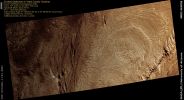
PSP_009460_1745_RED_abrowse-00.jpgCeti Mensa (ctx frame - natural colors; credits: Lunexit)57 visiteThis image shows a steep-sided depression in light-toned, layered rocks in the Valles Marineris Canyon System.
This formation, known as Ceti Mensa, is located in Western Candor Chasma in the Northern Valles.
The origin of Ceti Mensa and other Layered Deposits within the canyons is a source of much debate: proposed interpretations include lake deposits, deposits of volcanic ash, deposits of windblown sand and dust and glacial deposits. Recent spectral observations by the Mars Express and Mars Reconnaissance Orbiter Spacecraft have identified crystalline Iron Oxides and Hydrated Magnesium Sulfate minerals on Ceti Mensa.
These minerals are regarded as indicators of the presence of liquid water during their formation.
The Hydrated Sulfate mineral "Kieserite", in particular, most commonly forms on Earth by evaporation of brines.MareKromium
(2 voti)
|
|
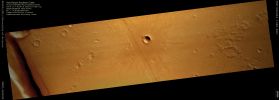
PSP_006681_1580_RED_abrowse~0.jpgFresh Southern Crater (natural colors; credits: Lunexit)88 visiteThis image features a very fresh crater in the Southern Hemisphere. The crater is termed fresh because it is well-preserved with steep walls and obvious small-scale ejecta.
The crater has a set of dark rays extending from it; these rays are ejecta that sprayed out when the crater formed. Boulders ejected during the impact surround the crater.
MareKromium
(2 voti)
|
|

Psp_009207_1765_red.jpgCharacterize Surface Hazards and Science of MSL Rover Landing Site - Equatorial Regions/Meridiani Planum (natural colors; credits: Lunexit)71 visitenessun commentoMareKromium
(2 voti)
|
|
| 2235 immagini su 187 pagina(e) |
 |
|
|
|
|
161 | |
|
|
|
|





