| Piú votate - Mars Reconnaissance Orbiter (MRO) |

PSP_005334_2170_RED_abrowse-00~0.jpgCollapse Pits near Alba Patera (MULTISPECTRUM; elab. Lunexit)54 visiteThis observation shows pits in Acheron Catena, a chain of circular depressions located South-East of Alba Patera, the widest and flattest volcano on Mars.
The layers seen around the pit rims are likely lava flows from Alba Patera or the nearby Tharsis Mons.
The pits probably formed by collapse into empty space beneath the surface as opposed to being formed by an impactor from space. Some of the pits have large piles of material in their centers. These piles are evidence of collapse of the walls, which may have occurred after the main collapse event that formed each pit. The second pit from the right has an indistinct north rim; it appears that there were at least two collapse events here.
A couple of the pits have oval shaped craters on their walls.
The craters were almost certainly circular when they formed, but time and gravity have allowed the deformation of their shape by mass wasting.MareKromium
(6 voti)
|
|
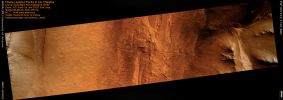
PSP_007219_1720_RED_abrowse-00~0.jpgFinely-Layered Rocks in Ius Chasma (context-frame - MULTISPECTRUM; credits: Lunexit)56 visiteThe high resolution of HiRISE allows us to see the many Fine Layers, or Strata, of Rock Outcrops all over Mars. This image shows a portion of Ius Chasma in the western portion of the large Valles Marineris Canyon System.
The Outcrop of Rock in the center of the image is about 5,5 Km across. Similar light-toned Strata are observed elsewhere in the canyon system and the CRISM instrument has shown that they often contain sulfate salts. The presence of Sulfate Salts indicate that water once interacted with this area, possibly as fluids that migrated through pre-existing rocks or as shallow evaporating pools of water.MareKromium
(6 voti)
|
|

Psp_010695_2225_red.jpgFlow near the Central Peak of Moreux Crater (possible True Colors; credits: Lunar Explorer Italia)55 visiteThis image is of a flow feature within Moreux Crater, located at about 42° North Lat. and 44,6° East Long., on the edge of Mars’ Highlands/Lowlands Boundary. The Crater itself is roughly 135 Km in diameter.
During the impact that forms craters, a roughly bowl shaped volume is excavated from the Martian Crust. In craters larger than about 7 Km in diameter, a Central Peak (or Mound) forms on the floor of the crater. This image focuses on a portion of the Moreux Central Peak that apparently broke off and slid away, forming a type of Giant Landslide.
Interesting hummocks, swirls and ridges are found on the surface of the Landslide. There are also distinct, almost circular depressions of unknown origin near the foot of the flow.
Both light and dark toned dunes later formed on this landform.
§§§
Mars Local Time: 15:43 (middle afternoon)
Coord. (centered): 42,0° North Lat. and 44,7° East Long.
Spacecraft altitude: 322,4 Km (such as about 201,5 miles)
Original image scale range: 32,2 cm/pixel (with 1 x 1 binning) so objects ~97 cm across are resolved
Map projected scale: 25 cm/pixel
Map projection: EQUIRECTANGULAR
Emission Angle: 22,5°
Phase Angle: 35,7°
Solar Incidence Angle: 58° (meaning that the Sun is about 32° above the Local Horizon)
Solar Longitude: 153,6° (Northern Summer)
Credits: NASA/JPL/University of Arizona
Additional process. and coloring: Lunar Explorer ItaliaMareKromium
(6 voti)
|
|

PSP_006806_2215_RED_abrowse~0.jpgRelict Glacial Landform in Deuteronilus Mensae (MULTISPECTRUM; credits: Lunexit)58 visiteThis image shows remnant raised margins and other interior structures of a lobate flow feature emanating the mouth of an alcove along a mesa in Deuteronilus Mensae.
This region of Mars has many features called “lobate debris aprons” that spread out below the scarps of polygonal mesas. Many of the debris aprons have what appear to be lineations or grooves that are parallel to their movement direction indicating flow of the materials.
The flow may be due to the presence of ice in the material. Recent data from the Shallow Radar instrument (SHARAD) on the Mars Reconnaissance Orbiter Spacecraft has indicated a large reservoir of subsurface ice in the Deuteronilus Mensae Region that supports the observational evidence of surface flow.MareKromium
(6 voti)
|
|
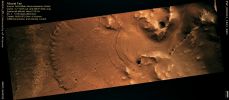
PSP_006941_1825_RED_abrowse~0.jpgAlluvial Fan in Crater East of Maja Valles (MULTISPECTRUM; credits: Lunexit)56 visiteThis image shows a large symmetrical Alluvial Fan at the mouth of a small channel along an unnamed crater. Alluvial fans with a well-defined channel source area are relatively uncommon on Mars.
This fan has a rib-like outer margin and many more terrace-like scarps upslope near the channel mouth. These terraces may indicate the outer margin of sediment deposits during each “pulse” of deposition. Further study of these types of alluvial fans may shed light on past sedimentary environments and conditions on Mars. MareKromium
(6 voti)
|
|

Psp_010369_2065_red.jpgScoured Crater Rim (possible True Colors; credits: Lunar Explorer Italia)60 visiteMars Local Time: 15:30 (middle afternoon)
Coord. (centered): 26,3° North Lat. and 304,3° East Long.
Spacecraft altitude: 290,2 Km (such as about 181,4 miles)
Original image scale range: 29 cm/pixel (with 1 x 1 binning) so objects ~87 cm across are resolved
Map projected scale: 25 cm/pixel
Map projection: EQUIRECTANGULAR
Emission Angle: 8,1°
Phase Angle: 57,9°
Solar Incidence Angle: 50° (meaning that the Sun is about 40° above the Local Horizon)
Solar Longitude: 140,7° (Northern Summer)
Credits: NASA/JPL/University of Arizona
Additional process. and coloring: Lunar Explorer ItaliaMareKromium
(6 voti)
|
|

Psp_009520_1520_red.jpgVery recent small Impact Crater near Hadriaca Patera (Enhanced and Saturated Natural Colors; credits for the additional process. and color.: Dr Paolo C. Fienga - Lunar Explorer Italia)57 visiteMars Local Time: 15:35 (middle afternoon)
Coord. (centered): 27,9° South Lat. and 90,7° East Long.
Spacecraft altitude: 256,9 Km (such as about 160,5 miles)
Original image scale range: 51,4 cm/pixel (with 1 x 1 binning) so objects ~1,54 mt across are resolved
Map projected scale: 50 cm/pixel
Map projection: EQUIRECTANGULAR
Emission Angle: 4,1°
Phase Angle: 70,5°
Solar Incidence Angle: 73° (meaning that the Sun is about 17° above the Local Horizon)
Solar Longitude: 109,3° (Northern Summer)
Credits: NASA/JPL/University of Arizona
Additional process. and coloring: Lunar Explorer ItaliaMareKromium
(6 voti)
|
|
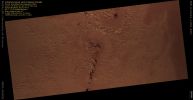
PSP_010269_1900_RED.jpgVolcanic Fissure Vent in Elysium Planitia (natural colors; credits: Lunexit)56 visiteThis observation shows lava-covered plains in the Elysium Planitia region of Mars, located near the equator.
Two distinct lavas are visible in this image. The darker lava to the north (top) is the edge of the youngest major lava flow on Mars; it was fed by a voluminous eruption that coursed through the Athabasca Valles channel system.
The lighter-toned lava that covers the remainder of this image is older and dustier. It has a striped appearance due to slender dunes or ripples composed of windblown materials that are oriented northwest-southeast.
The most prominent feature in this image is the discontinuous line of pits and troughs that cuts across its center. It is an ancient volcanic fissure vent. Lava once erupted through this fracture onto the surface. The irregular depressions around the troughs may either be due to near-vent erosion by the lava or to the ponding and drain-back of the lava around the vent.
MareKromium
(6 voti)
|
|

PSP_010334_1760_RED.jpgYardangs in Southern Amazonis Planitia (natural colors; credits: Lunexit)56 visiteThis image shows Yardangs, or Ridges formed from wind abrasion, in the Southern Amazonis Planitia, which is located between the Tharsis and Elysium Volcanic Provinces on Mars.
Yardangs typically form in dry, desert environments with strong prevailing winds that are unidirectional and carry an abrasive sediment load. Abrasive winds erode the surface into parallel elongate landforms, or ridges, that are often three or more times longer than they are wide. When viewed from above, these landforms resemble the hull of a boat. Yardangs typically form in easily-eroded material, most likely sedimentary rock or volcanic ash deposits that contain some amount of sand. Sometime after the formation of these landforms, they were covered by a relatively thin, uniform coating of dust giving the area a monotone appearance. Dark slope streaks, interpreted as forming by avalanching of the dry dust, are visible on several of the slopes.
Yardangs are found on both Earth and Mars and are common on Mars in the Regions West and South-West of Olympus Mons, such as the area in this image in the southern Amazonis Planitia.MareKromium
(6 voti)
|
|
PSP_010221_1420_RED_abrowse-01.jpgAeolian Features (EDM - False Colors; credits for the additional process. and color.: Dr Paolo C. Fienga - Lunexit Team)56 visiteThis image is particularly interesting because of the occurrence of seasonal frost on the South-facing slopes (the image is relevant to the Southern Hemisphere, so South faces the Pole and gets little Winter light). This is particularly apparent in this natural colors view, as the frost forms pale, blue-grey-silver patterns. On the dunes, this highlights some of the regular patterns, as the frost forms only on parts of the ripples. The result is an intricately textured pattern of color.MareKromium
(6 voti)
|
|
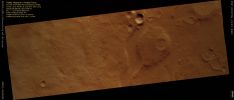
PSP_009706_2125_RED.jpgValley Network in Arabia Terra (Saturated and Enhanced Natural Colors; credits for the additional process. and color.: Dr Paolo C. Fienga - Lunexit Team)56 visiteThe central portion of this image includes a portion of a Valley Network in Arabia Terra. In lower resolution images, this meander (a bend in a valley) appeared discontinuous - hence its selection as a target for HiRISE. However, at HiRISE resolution the valley is visible throughout its course.
This is a mid-latitude scene where ground ice is believed to be stable relatively near the surface today. The mottled terrain visible throughout the image could be a sublimation texture. Sublimation occurs when ice goes directly to the gas phase.
When this happens, the space beneath the subsurface that the ice previously occupied is now empty, allowing the remaining surface to collapse and form the observed texture.
Several of the craters in this scene have flattened appearances, which may have resulted from ice-rich material being driven by gravity into the crater centers.MareKromium
(6 voti)
|
|
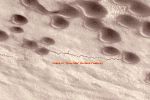
PSP_010169_2650_RED_abrowse-03~0.jpgDunes and other Surface Features in Chasma Boreale (edm n. 3 - false colors; credits: Lunexit)56 visiteAllora? Lo vedete il "possible North Polar drainage channel"? Notate come sia diverso dai soliti "cracks" e "fissures" del suolo? Osservatene bene i bordi e quindi provate a fare un confronto fra questo frame e qualche drainage channel Terrestre o di Titano: le somiglianze ci sono, e sono evidenti.
Verificare per credere!MareKromium
(6 voti)
|
|
| 2235 immagini su 187 pagina(e) |
 |
|
|
|
|
16 | |
|
|
|
|





