| Piú votate - Mars Reconnaissance Orbiter (MRO) |

PSP_010433_1825_RED_abrowse.jpgUnnamed Crater in Meridiani Planum (Natural Colors; credits: Lunar Explorer Italia)57 visiteMars Local Time: 15:36 (middle afternoon)
Coord. (centered): 2,4° North Lat. and 0,1° East Long.
Spacecraft altitude: 274,1 Km (such as about 171,3 miles)
Original image scale range: 27,4 cm/pixel (with 1 x 1 binning) so objects ~ 82 cm across are resolved
Map projected scale: 25 cm/pixel
Map projection: EQUIRECTANGULAR
Emission Angle: 9,3°
Phase Angle: 63,3°
Solar Incidence Angle: 55° (meaning that the Sun is about 35° above the Local Horizon)
Solar Longitude: 143,2° (Northern Summer)
Credits: NASA/JPL/University of Arizona
Additional process. and coloring: Lunar Explorer ItaliaMareKromium
(2 voti)
|
|

PSP_010446_2675_RED_abrowse.jpgNorth Polar Residual Cap Monitoring (Natural Colors; credits: Lunar Explorer Italia)90 visiteMars Local Time: 09:54 (middle morning)
Coord. (centered): 87,4° North Lat. and 273,0° East Long.
Spacecraft altitude: 316,8 Km (such as about 198,0 miles)
Original image scale range: 63,4 cm/pixel (with 1 x 1 binning) so objects ~ 1,90 mt across are resolved
Map projected scale: 50 cm/pixel
Map projection: EQUIRECTANGULAR
Emission Angle: 0,0°
Phase Angle: 73,2°
Solar Incidence Angle: 73° (meaning that the Sun is about 17° above the Local Horizon)
Solar Longitude: 143,7° (Northern Summer)
Credits: NASA/JPL/University of Arizona
Additional process. and coloring: Lunar Explorer ItaliaMareKromium
(2 voti)
|
|

ESP_011765_1780_RED_abrowse-00.jpgRipples in Meridiani Planum (ctx frame - Natural Colors; credits: Lunar Explorer Italia)57 visiteMars Local Time: 15:46 (middle afternoon)
Coord. (centered): 2,1° South Lat. and 354,5° East Long.
Spacecraft altitude: 276,0 Km (such as about 172,5 miles)
Original image scale range: 27,6 cm/pixel (with 1 x 1 binning) so objects ~83 cm across are resolved
Map projected scale: 25 cm/pixel
Map projection: EQUIRECTANGULAR
Emission Angle: 12,5°
Phase Angle: 69,0°
Solar Incidence Angle: 57° (meaning that the Sun is about 33° above the Local Horizon)
Solar Longitude: 200,0° (Northern Autumn)
Credits: NASA/JPL/University of Arizona
Additional process. and coloring: Lunar Explorer ItaliaMareKromium
(2 voti)
|
|

ESP_011765_1780_RED_abrowse-01.jpgRipples in Meridiani Planum (edm - Natural Colors; credits: Lunar Explorer Italia)58 visitenessun commentoMareKromium
(2 voti)
|
|
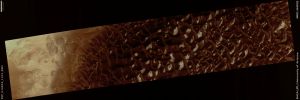
PSP_010854_1325_RED_abrowse.jpgProctor Crater Dunes (Natural Colors; credits: Lunar Explorer Italia)70 visiteIn the winter the dunes in Proctor Crater are covered with seasonal carbon dioxide frost (dry ice). In the spring, the frost gradually evaporates but lingers in protected regions. In this color image bright ice deposits in sheltered areas highlight the ripples on the dunes.
These dunes were imaged during the first year of MRO’s mission. Images taken now in the second Martian spring can be compared to the previous year to study interannual variability.
Mars Local Time: 15:59 (middle afternoon)
Coord. (centered): 47,2° South Lat. and 34,0° East Long.
Spacecraft altitude: 254,5 Km (such as about 159,1 miles)
Original image scale range: 50,9 cm/pixel (with 1 x 1 binning) so objects ~1,53 mt across are resolved
Map projected scale: 50 cm/pixel
Map projection: EQUIRECTANGULAR
Emission Angle: 8,2°
Phase Angle: 70,3°
Solar Incidence Angle: 77° (meaning that the Sun is about 13° above the Local Horizon)
Solar Longitude: 160,1° (Northern Summer)
Credits: NASA/JPL/University of Arizona
Additional process. and coloring: Lunar Explorer ItaliaMareKromium
(2 voti)
|
|
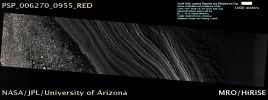
PSP_006270_0955_RED_abrowse~0.jpgSouth Polar Layered Deposits and Residual Ice Cap (natural colors; credits: Lunexit)68 visiteA wide variety of South Polar Terrains are on display in this spectacular HiRISE image. The reddish material on the left of the image is the SPLD. These deposits are a stack of layered, dusty water ice. Scientists believe that these layers record previous climatic conditions on Mars, much like terrestrial ice-sheets provide a record of climate change on the Earth.
This image shows the face of one of the many scarps or shallow cliffs that cut into the SPLD. These scarps expose the internal layers within the SPLD. You can see these climate-recording layers in the last2/3rds of the image, left side, running from lower-left to upper-right.
The terrain in the last third of the image is quite different in both appearance and composition. The bright, white-ish material is a thin covering of CO2 ice draped over the flat areas of the SPLD. This covering of CO2 is being eroded away by expanding flat-floored pits. Parts of the floors of these pits show the reddish brown coloring of the underlying SPLD.
These pits have eroded the CO2 ice layer to such an extent that only isolated mesas remain today and even these shrink in extent by a few meters each year.
These mesas also have several layers within them, indicting that they likely contain a climatic record, albeit a much shorter one than preserved in the SPLD.
Most of the isolated mesas have white-ish tops; however, some (near the foot of the SPLD scarp) have reddish tops. This may either be due to bright CO2 ice thinning to reveal the older (and darker) CO2 ice that makes up the main body of the mesa, or perhaps dust has settled out of the atmosphere to cover the brighter frost.
Remember that there was a large Martian Dust Storm earlier this year which could have caused either effect.MareKromium
(2 voti)
|
|

PSP_009905_2650_RED.jpgNorth Polar Layered Deposits (NPLD) and Dunes in Chasma Boreale (natural colors; credits: Lunexit)64 visiteThis image shows a steep, layered slope and flatter, dune-covered plains in Mars’ North Polar Region. The layers are composed of varying contents of water ice and dust.
On Earth, icy layers like these in Greenland and Antarctica are important because they contain a record of past climate conditions. By looking at the detailed sequence of Polar Layers on Mars, scientists hope to be able to discover the types of variations that Mars’ climate may have experienced.
The lowest section in the stack of light layers is noticeably darker because of the presence of dark, sandy material. Erosion of this dark material is thought to provide the sand making up the large dunes on the plains.
Several exceptionally well-developed barchan (crescent-shaped) dune forms up to approximately 50 meters (160 feet) across are present in the center of the image.MareKromium
(2 voti)
|
|
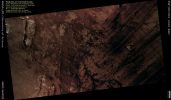
PSP_007095_2020_RED_abrowse~0.jpgInverted Dendritic Stream Channels in Antoniadi Crater (MULTISPECTRUM; credits: Lunexit)57 visiteThis observation is centered within Antoniadi Crater. This crater, even prior to the MRO mission, was identified as a likely ancient lake (now dry) that was supplied by both surface water and ground water.
The image provides further tantalizing evidence of a water-rich past. Most of the flat parts of the image have a polygonal texture, which commonly forms when mud dries. In the center of the image are branched (“dendritic”) features that connect Southward to a larger trunk-shaped landform; the branches resemble stream channels on Earth. Unlike active channels with water, these features are “inverted”, or elevated above the surrounding terrain.
Again, in analogy with such features seen on our Planet, these probably formed when materials deposited by the streams, such as coarse gravel, or chemical cementation after removal of the water, caused the channel bottoms to become resistant. Over time, natural erosion from wind and other processes left the inverted channels elevated above the surrounding terrain.
The branched features are probably remnants of small tributary streams that fed the larger trunk-shaped stream. It appears that the inverted streams lie on top of, and are therefore younger, than the polygons. This area may have first had a lake that later dried to form the polygons, followed by episodes of stream flow and erosion.MareKromium
(2 voti)
|
|
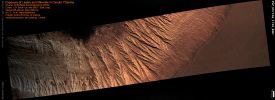
PSP_007166_1740_RED_abrowse-00~0.jpgExposure of Layers and Minerals in Candor Chasma (MULTISPECTRUM; credits: Lunexit)56 visiteScanning across several kilometers of relief, this image shows a cliff along a light-toned layered deposit in Valles Marineris. This particular cliff was targeted because of the excellent exposure of layering and the identification of the minerals Kieserite (a mineral containing Magnesium) and Hematite (an Iron Oxide).
The Hematite appears in the darker low-lying region of the image and the Kieserite is associated with the light-toned layers.
The fact that these minerals are found here with a layered deposit suggests that water may have been involved in the deposition of these minerals and the layers.
Erosion by wind has carved V-shaped patterns along the edges of many of the layers. The layers appear friable (easy to erode) so this is why wind can carve deep grooves along a steep cliff such as visible here.
The top of the layered deposit (lower part of image) is smooth and relatively dark because it is covered by debris laid down by the wind, dust and other fine materials.
The cliff has stronger winds flowing up and down it, plus the effects of gravity, so airborne debris can be shed downslope to expose the fresh brighter layered deposit.MareKromium
(2 voti)
|
|

ESP_011618_1885_RED_abrowse-00.jpgRecent Double-Impact (ctx frame - possible Natural Colors; credits: Lunar Explorer Italia)64 visiteMars Local Time: 15:46 (middle afternoon)
Coord. (centered): 8,6° North Lat. and 46,8° East Long.
Spacecraft altitude: 273,6 Km (such as about 171,0 miles)
Original image scale range: 27,4 cm/pixel (with 1 x 1 binning) so objects ~82 cm across are resolved
Map projected scale: 25 cm/pixel
Map projection: EQUIRECTANGULAR
Emission Angle: 5,9°
Phase Angle: 64,1°
Solar Incidence Angle: 58° (meaning that the Sun is about 32° above the Local Horizon)
Solar Longitude: 193,2° (Northern Autumn)
Credits: NASA/JPL/University of Arizona
Additional process. and coloring: Lunar Explorer ItaliaMareKromium
(2 voti)
|
|
Psp_001462_2630_red~0.jpgFresh crater in the Northern Regions (possible Natural Colors; credits: Lunar Explorer Italia)73 visitenessun commentoMareKromium
(2 voti)
|
|

PSP_010638_1890_RED_abrowse-01.jpgAngular Unconformity in Cerberus Fossae (edm; possible True Colors; credits: Lunar Explorer Italia)71 visitenessun commentoMareKromium
(2 voti)
|
|
| 2235 immagini su 187 pagina(e) |
 |
|
|
|
|
158 | |
|
|
|
|





