| Piú votate - Mars Reconnaissance Orbiter (MRO) |
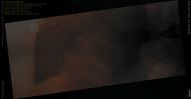
PSP_007126_1210_RED_abrowse~0.jpgLike a "dried-up" Waterfall (True Colors + MULTISPECTRUM; credits: Lunexit)57 visiteThis image shows a large gully in the wall of a crater in the Southern Hemisphere. Such gullies are among the most recent landforms on Mars, and were probably carved by liquid water.
The source of the water is still unknown; it could have been groundwater from a shallow aquifer or melted snow or ground ice from a different climate.
This gully is not particularly fresh, but it is among the largest observed; several sub-channels merge in the alcove on the upper slope, in the north part of the image (Dx).
Numerous faint troughs and lineations are visible downslope, likely indicating old channels that have been buried or reworked. The upper alcove exposes a dense cluster of boulders not seen on the adjacent slope. This could indicate that smaller material has been removed by the gullies, exposing the boulders without transporting them far.MareKromium
(2 voti)
|
|

ESP_013557_1245_RED_abrowse-06.jpgThe "Argyre Lineae" (EDM n.3 - Natural Colors; credits: Dr G. Barca & Lunexit)58 visitenessun commentoMareKromium
(2 voti)
|
|
ESP_014304_1895_RED_abrowse.jpgSouth-Eastern Margin of Athabasca Valles (Natural Colors; credits: Lunexit)57 visitenessun commentoMareKromium
(2 voti)
|
|
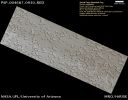
PSP_004687_0930_RED_abrowse.jpgSouth Polar Residual Cap Monitoring (Natural Colors; credits: Lunexit)60 visiteAs on Earth, the seasonal frost caps of Mars grow and recede each year. But seasonal frost on Mars is composed of Carbon Dioxide Ice (also known as Dry Ice), not water ice as on our Planet.
Near the South Pole of Mars, the seasonal CO2 frost never completely disappears, leaving a residual ice cap of CO2 ice throughout the Summer. This HiRISE image shows part of the South Polar Residual Cap, with many shallow Pits dubbed "Swiss Cheese Terrain". Because the Sun is always low in the sky at this latitude, the steep walls of the Pits receive more solar energy than the high-standing, flat areas between the Pits.
This causes the walls of the Pits to retreat several meters per year as Sunlight causes the CO2 ice to evaporate directly to gas, a process called "sublimation".
In some depressions, ridges or blocks of material a couple of meters (several feet) across are visible at the base of the depression walls, likely fallen from the walls during the sublimation and retreat process. At this rate, the layer of Carbon Dioxide ice could completely disappear in about 100 years from now, if not replenished.
Nota Lunexit: interessanti annotazioni. Peccato che la maggiore implicazione da esse derivante (quote: "...lo strato di CO2 che ricopre la Regione Sud Polare di Marte SCOMPARIRA' entro 100 anni da oggi, se non reintegrato...") non è stata minimamente toccata.
Stile NASA, of course. Nihil sub Sole novi, quindi...MareKromium
(2 voti)
|
|
PSP_010839_1525_RED_abrowse.jpgPitted Layers, N/E of Hellas Planitia Region (Natural Colors;: credits: Lunexit)76 visitenessun commentoMareKromium
(2 voti)
|
|
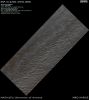
ESP_014282_0930_RED_abrowse-00.jpgSpiders (CTX Frame - Natural Colors; credits: Lunexit)57 visitenessun commentoMareKromium
(2 voti)
|
|

ESP_013499_1650-1.jpgSpirit near Home Plate (EDM n.1 - Natural - but enhanced - Colors; credits: Lunexit)76 visitenessun commentoMareKromium
(2 voti)
|
|
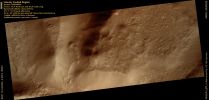
ESP_014306_1905_RED_abrowse.jpgHeavily Faulted Region (Natural Colors; credits: Lunexit)61 visitenessun commentoMareKromium
(2 voti)
|
|
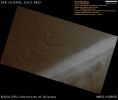
ESP_014306_1015_RED_abrowse.jpgBounding Scarp (Natural Colors; credits: Lunexit)57 visitenessun commentoMareKromium
(2 voti)
|
|

SubsurfaceIce-PIA12216.jpgFading Fresh Craters with Subsurface Ice (Natural Colors; credits: Lunexit)57 visiteThis series of images spanning a period of 15 weeks shows a pair of fresh, middle-latitude craters on Mars in which some bright, bluish material apparent in the earliest images disappears by the later ones. Each panel is 75 meters (246 feet) across. The two craters are each about 4 meters (13 feet) in diameter and half a meter (1,5 feet) deep.
The bright material is water ice that was uncovered by the meteorite impact that excavated these small craters less than 15 weeks before the initial image of this series. Sublimation of the ice during the Martian Summer leaves behind a dust layer that gradually thickens to the point where it obscures the ice.
The High Resolution Imaging Science Experiment (HiRISE) camera on NASA's Mars Reconnaissance Orbiter took these images of this site at 46,33° North Latitude and 176,90° East Longitude. The HiRISE camera's targeting of the site was prompted by two earlier images from the Context Camera on the Mars Reconnaissance Orbiter, which showed that the impact responsible for these craters had not yet occurred by June 4, 2008, but had occurred by Aug. 10, 2008.
The dates when these six HiRISE images were taken were (left to right, top row; then left to right, bottom row): Sept. 12, 2008; Sept. 28, 2008; Oct. 9, 2008; Oct. 14, 2008; Nov. 22, 2008; and Dec. 25, 2008. The span of time corresponded to a period from mid to late Summer in Mars' Northern Hemisphere. The images are subframes of the observations made on those dates.
The full-frame images are online (same order) at http://hirise.lpl.arizona.edu/PSP_009978_2265;
http://hirise.lpl.arizona.edu/PSP_010189_2265; http://hirise.lpl.arizona.edu/PSP_010334_2265;
http://hirise.lpl.arizona.edu/PSP_010400_2265; http://hirise.lpl.arizona.edu/PSP_010901_2265; and
http://hirise.lpl.arizona.edu/ESP_011323_2265.MareKromium
(2 voti)
|
|

SubsurfaceIce-PIA12214.jpgSubsurface Ice is EVERYWHERE!57 visiteThis map shows five locations where fresh impact cratering has excavated water ice from just beneath the Surface of Mars (sites 1 through 5) and the Viking Lander 2 Landing Site (VL2), in the context of color coding to indicate estimated depth to ice.
The map covers an area from 40 to 60° North Latitude and from 130 to 190° East Longitude. Estimates of the depth to water-ice come from a computer model and observations of the brightness and temperature of the Surface. The model matches the ice-exposing crater observations by NASA's Mars Reconnaissance Orbiter and data from the neutron spectrometer on NASA's Mars Odyssey Orbiter.
Analysis of the observations of ice-exposing fresh craters at sites 1 through 5, reported by Byrne et al. in a Sept. 25, 2009, paper in the journal Science, leads the paper's authors to calculate that if NASA's Viking Lander 2 had been able to dig slightly deeper than the 10-to 15-centimeter-deep (4-to-6-inch-deep) trench that it excavated in 1976, it would have hit water ice.
The color coding indicates depths to the top of a water-ice-containing layer, ranging from 1 cm (about 0,5") in dark-blue coded locations to 10 meters (33 feet) in red-coded locations.MareKromium
(2 voti)
|
|
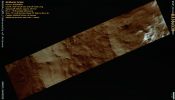
ESP_014324_0955_RED_abrowse.jpgSnow-Streaks on McMurdo Crater (Natural Colors; credits: Lunexit)67 visiteThe SPLD are a stack of ice and dust about 3 Km (a little less than 2 miles) thick. The many layers that make up this feature are of great interest to planetary scientists because, just as with ice sheets on Earth, they are thought to contain a record of the Planet’s climate in previous times.
As with the rest of Mars, impact craters form continuously on these Polar Deposits.
Rarely, a very large impact will occur and the crater will excavate all the way through this ice-sheet to the rocky terrain underneath. This is what happened in the case of McMurdo, a crater roughly 20 Km (about 12,5 miles) across which punched through the ice-sheet in the past.
This HiRISE image shows the wall of this Crater, only half of which has been preserved until current times.
You can see the many layers that comprise the SPLD exposed here.
Scientists study exposures like this to try to understand the length of the climatic record that is recorded in the icy material at the Poles of Mars.MareKromium
(2 voti)
|
|
| 2235 immagini su 187 pagina(e) |
 |
|
|
|
|
154 | |
|
|
|
|





