| Piú votate - Mars Reconnaissance Orbiter (MRO) |
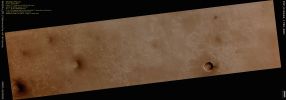
ESP_016644_1780_RED_abrowse-00.jpgOn the Edge of Concepción (CTX Frame - Natural Colors; credits: Dr Paolo C. Fienga - Lunexit Team)70 visiteThis image was acquired by HiRISE on 13 February 2010, on Sol 2153 of Opportunity’s Mission on Mars.
Note the Rover Tracks in the Ripples to the North and North-West of the Rover. Scientists use these high-resolution images (about 25 cm/pixel) to help navigate the Rover. In addition, Rover exploration of areas covered by such high-resolution images provides “ground truth” for the orbital data.MareKromium
(2 voti)
|
|
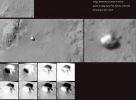
Mars3-MF.jpgIs this "CCCP-Mapc 3" or just a Boulder? (an Image-Mosaic by Dr Marco Faccin)87 visitenessun commentoMareKromium
(2 voti)
|
|
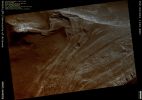
PSP_001662_1520_RED_abrowse.jpgLayered Deposits in Terby Crater (Natural - but enhanced - Colors; credits: Dr Paolo C. Fienga - Lunexit Team)89 visiteTerby Crater is a large (approximately 165 Km), Noachian-aged crater located on the Northern Rim of the Hellas Impact Basin.
Terby hosts a very impressive sequence of predominantly light-toned Layered Deposits, up to 2,5 Km thick that are banked along its Northern Rim and extend toward the center of the Crater.
The full image shows this stack of layered rocks as they are exposed Westward facing scarp. The layered sequence consists of many beds that are repetitive, relatively horizontal and laterally continuous on a kilometer scale. Many beds are strongly jointed and fractured and exhibit evidence of small-scale wind scour.
The light-toned layers are typically at least partially covered with dark mantling material that obscures the layers as well as debris and numerous, meter-scale boulders that have cascaded down slope. The processes responsible for formation of these layers remain a mystery, but could include deposition in water, by the wind, or even volcanic activity.
This HiRISE image is a proposed landing site for the Mars Science Laboratory (MSL) in Terby Crater.MareKromium
(2 voti)
|
|
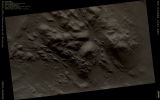
PSP_010888_2030_RED_abrowse.jpgMojave Crater's Floor and Central Uplift (Natural Colors; credits: Dr Paolo C. Fienga - Lunexit Team)60 visiteThis observation shows a portion of the Central Uplift structure in Mojave Crater.
Central Uplifts are a typical feature of large Impact Craters on Earth, Moon and Mars; craters larger than 6 or 7 Km in diameter on Mars typically form this mountain-like peak in the central portion of the crater interior.
This Peak consists of rocks originating from several kilometers beneath the pre-impact surface.
Mojave has a very prominent Central Uplift as it has a diameter of about 60 Km (apprx. 37 miles). In this image, boulders as large as about 15 meters (50 feet) across have been eroded from the massive uplifted rock and have rolled downslope. Fine-grained debris has also collected in the topographic lows, and has been shaped by the wind into Dunes and Ripples.
Notably absent from this image are the striking Drainage Channels and Alluvial Fans that are abundant on the wall-terraces and ejecta of Mojave Crater (see PSP_001415_1875). These features were likely formed by Surface Runoff of liquid water, which may have been released from the Subsurface during the impact event that formed Mojave.
Previously, it had been suggested that a brief, torrential downpour over Mojave Crater delivered the water. However, Mars Orbiter Camera's (MOC) images of Mojave's Central Uplift have previously shown no evidence for Surface Runoff, and the higher resolution of this HiRISE image confirms that this part of the Crater appears untouched by liquid water.
So the question remains: by what means was the water, in the form of Runoff, supplied to Mojave? This question, in addition to several others regarding this phenomenon, are currently being investigated by the HiRISE team and their collaborators.MareKromium
(2 voti)
|
|
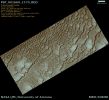
PSP_001660_2570_RED_abrowse.jpgFrost-covered Dunes (Natural Colors; credits: Dr Paolo C. Fienga - Lunexit Team)58 visiteThis image shows Dunes on the Northern Plains of Mars, and appears similar to images taken when the Surface was covered by Frost.
However, CRISM spectra taken at the same time do not show evidence for either water or CO2 frost here. Possibly, and consistent with the CRISM spectra, this area is covered by Dust, obscuring the dark material that is typically present in Dunes of this type.
The orientation of the Dunes indicates that they were formed by winds blowing generally from upper right to lower left. Ripples on the Dunes show that the wind patterns that formed them are more complex, with the dune shapes affecting the wind direction.
It is not known whether these Dunes are currently active (such as if thy're being moved by wind still today) or have been in this location for a very long time; however, if they are indeed covered by Dust, the they cannot have been recently active.
Between the Dunes, the underlying Surface of the Northern Plains can be seen. In places, it has been fractured into polygonal blocks, suggesting that water ice is or was present below the Surface. Meter-size blocks are also seen in places in this image and elsewhere on the Northern Plains.
The origin of these blocks is not known, but they may be remnants of erosion of material that once covered this Region.MareKromium
(2 voti)
|
|
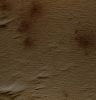
PSP_010200_1805_RED_abrowse-01.jpgFresh Crater Cluster (EDM - Natural Colors; credits: Dr Paolo C. Fienga - Lunexit Team)67 visiteMany of the newest craters are part of a crater cluster, like this one. This cluster is about 350 meters (almost a quarter mile) across at its longest, and the largest crater in the image is 5 meters (16 feet) in diameter.
These clusters likely result from breaking up of the impactor before it strikes the surface. How widely dispersed the craters are depends on the strength and density of the impactor. Scientists can study these clusters to learn more about the object that created them.MareKromium
(2 voti)
|
|

PSP_007767_1970_RED_abrowse-01.jpgMegabreccia inside Toro Crater (EDM - Natural - but strongly enhanced - Colors; credits: NASA/JPL/Univ. of Arizona and Dr Paolo C. Fienga - Lunexit Team)58 visiteThis EDM shows a close-up of one of the features that make Toro Crater a great target for HiRISE images: colorful patches of Megabreccia.
Breccia is a mixture of chunks of rock (clasts) that have been broken by an energetic geologic event, such as a Landslide or Crater-forming Impact, and then that got cemented together in a finer grained material.
Megabreccia features very large clasts that are big enough for HiRISE to see on the surface - some even larger than 30 feet across.
In this 200 meter (about 1/8 of a mile) diameter exposure of Megabreccia, clasts of various colors (indicating different kinds of rocks) and sizes have been exposed in the Uplifted Central Peak of Toro Crater.MareKromium
(2 voti)
|
|
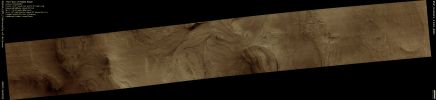
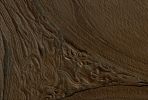
ESP_016022_1420_RED_abrowse-00.jpgThe Floor of Hellas Basin (CTX Frame - Natural Colors; credits: Dr Paolo C. Fienga - Lunexit Team)62 visiteHiRISE images are revealing some very strange landforms on the Floor of Hellas. Materials appear to have flowed in a viscous manner, like ice.
Viscous flow features are common over the Middle Latitudes of Mars, but those in Hellas are often distinctive for unknown reasons.
MareKromium
(2 voti)
|
|
ESP_016022_1420_RED_abrowse-01.jpgThe Floor of Hellas Basin (EDM - Natural Colors; credits: NASA/JPL and Dr Paolo C. Fienga - Lunexit Team)60 visitenessun commentoMareKromium
(2 voti)
|
|

PSP_001406_2680_red-00.jpgLonely and (almost) buried crater in the North Polar "Permanent Cap" (CTX Frame - Natural Colors; credits: Dr Paolo C. Fienga - Lunexit Team)57 visitenessun commentoMareKromium
(2 voti)
|
|

ESP_013726_1475_RED_abrowse.jpgGullies and Flow Features on an Unnamed Crater Wall (Natural Colors; credits: Lunexit)59 visiteThis HiRISE image shows a sample of the variety and complexity of processes that may occur on the walls of Martian Craters, well after the impact crater formed.
At the very top of the image is the high Crater Rim; at the bottom of the image is the Crater's Central Peak - a dome of material rising above the surrounding Crater Floor uplifted during the impact event. Reaching down the Walls of the crater are windy and crooked troughs, or Gullies. Some of these Gullies may have formed with the help of liquid water, melted from ice or snowpack on the Crater Walls or from groundwater within the Walls. Also notable is the long tongue-like lobe stretching down the middle of the image, with a darker, rounded snout, and prominent parallel grooves on its surface. These characteristics, together with faint cracks on its surface, suggest that this lobe may have formed by movement of ice-rich material from up on the Crater Wall down to the floor.
Because surface features on this lobe, as well as most Gullies, do not appear sharp and pristine, and wind-blown dunes have blown up on the front snout of the lobe, and because there are several small craters on the lobe's surface, the movement of ice-rich material, and possibly water, have probably not occurred very recently.
MareKromium
(2 voti)
|
|

PSP_002184_2005_RED_browse-1.jpgOn the Edge of Olympus (Natural Colors; credits: Lunexit)60 visiteOlympus Mons, the largest volcano in the Solar System, has a mysterious halo (or "Aureole") of material on its Western and Northern Sides. There have been many ideas about how this feature may have formed over the years, but the hypothesis that this is a giant landslide deposit has gained favor.
Many large volcanoes on the Earth collapse under their own weight, so it seems reasonable that Olympus Mons would do the same. The edge of the Aureole is seen on the left (North) part of the image.
It is interesting that the main part of the Aureole seems sunk down compared to the edge. It is possible that the ridge along the outer margin of the Aureole formed as the flow turned around after pushing uphill for a ways. Imagine a giant wave of rock pushing up onto the "beach" and then receding. It might leave a deposit like this.
Alternatively, glaciers push up a ramp of rock at their fronts.
After they retreat, the ridge of rock is left at the furthest extent of the glacier. These are called "Terminal Moraines" by geologists.MareKromium
(2 voti)
|
|
| 2235 immagini su 187 pagina(e) |
 |
|
|
|
|
153 | |
|
|
|
|





